Posts

Showing posts with the label Gertrude

INDEX: Good Friday echoes in Hamlet

Image
Since at least 2022, I've done a post around the time of Good Friday, sharing what seem to be either direct allusions, or at least echoes of the Good Friday gospel stories (the Passion of Christ) in Shakespeare's Hamlet .  The index link below is to blog posts about allusions in Hamlet to the Good Friday stories (which Shakespeare and others in England would have been required to hear via mandatory church attendance. The index covers related posts on this subject from 2022-2026. The 2022 post [1] collected a few general allusions or plot echoes. For people interested in a list of detailed, short references in the text of the play, this is a good place to start.  - A post in December of 2023 related to these by way of Ophelia's "willow" [2];  - Good Friday posts in 2024 [3] and in 2025 [4] continued this, each with new insights.  INDEX: Good Friday echoes in Hamlet - April 03, 2026. https://pauladrianfried.blogspot.com/2026/04/index-good-friday-echoes-in-hamlet...
ON THE SIGNIFICANCE OF HAMLET 3.4 “BLESSING BEG OF YOU” and 1-2 KINGS WIDOW TALES

On the Significance of HAMLET 3.4 and 1-2 KINGS Elijah/Elisha, widow tales Here are some of the possibilities for this allusion’s significance:  - If Gertrude (aware of her sick soul and guilt in 4.5) desires to be blessed, then we must ask: What blessings do Hamlet (or his surrogates) beg of her, or what blessings does she offer, perhaps without even being asked (as mothers are sometimes prone to do)?  - Gertrude is faithful to her promise to keep Hamlet’s secret from Claudius (3.4.219-221).  - She overcomes her own reluctance and greets an apparently mad Ophelia (4.5.21).  - When Ophelia drowns, she portrays it not as suicide, but as a holy death, with Ophelia chanting lauds (4.7.202); Gertrude blames crown-envy for Ophelia’s fall into the brook: Ophelia had been placing “coronet weeds” (4.7.197, small floral crowns) on branches, and the sliver on which she stood was envious (4.7.98 envious about not receiving a crown like others). Gertrude figuratively and careful...

Cain and Jesus in Gertrude's Closet, Hamlet 3.4 (Good Friday post)

Image
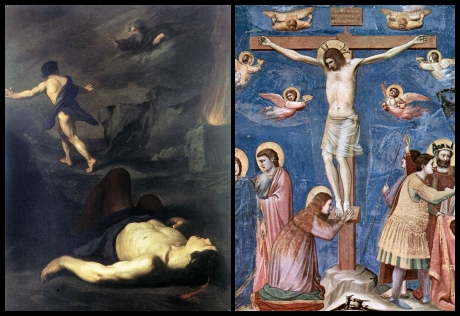
GOOD FRIDAY & CAIN IN GERTRUDE'S CLOSET Compare: Hamlet 3.4.31-32, after Hamlet kills Polonius unseen: Queen:  O me, WHAT HAST THOU DONE? * Hamlet:  Nay, I KNOW NOT. Is it the King? * [1] Genesis 4:9-10, Geneva trans.: Then the Lord said unto Cain, Where is Abel thy brother? Who answered, I cannot tell. Am I my brother’s keeper? Again he said, WHAT HAST THOU DONE? * the voice of thy brother’s blood crieth unto me, from the earth. Luke 23:34, Geneva, Jesus from the cross: Then said Jesus, Father, forgive them: for THEY KNOW NOT what they do. * (* Emphasis mine) - Queen Gertrude echoes God to Cain: What hast thou done? - Hamlet echoes Jesus from the cross: I know not (what I've done). AT LEAST TWO IMPLICATIONS: 1. By killing a human being, Hamlet has sinned, like Cain killing his brother. 2. By stabbing the person hidden behind the arras, blind to who he was stabbing, Hamlet fits what Jesus says from the cross: They know not what they do. WHY HAS THIS BEEN MISSED by previous...

Second Day of Christmas in Shakespeare's time - Feast of Stephen, Martyr (Series, Part 2)

Image
The second day of Christmas, the 26th of December, in Shakespeare’s time as now, was the Feast of St. Stephen [1], the first Christian martyr, reminding Christendom that this infant allegedly born in Bethlehem was born to die for the salvation of all humankind, and that others would be persecuted and killed in his name. Bible readings for the feast include Acts 7 (first lesson), telling the tale of Stephen’s martyrdom, and Matthew 23, a prophesy and history of the killing of prophets. Of course there were other tales of martyrdom or self-sacrifice available to people in Shakespeare’s time, not found in the Bible [2], including the Greek tale of Alcestis, willing to die in place of her husband. English law did not require people to read or hear Greek, non-biblical tales. It did, however, require church attendance, so the tale of the martyrdom of Stephen was required, a non-optional element of the broad fabric of religious and literary stories and literature that would have informed Sh...

Keeping Mice Out with St. Gertrude

Image
Shakespeare’s Hamlet famously contains a play-within-the-play, “The Mousetrap,” which (for some) calls to mind St. Augustine who said the cross of Christ was a mousetrap for the devil.[1] Ophelia refers to a folktale of a baker’s daughter changed into an owl, punishment for being ungenerous with a beggar (Jesus in disguise). Owls, as I have noted before [2], are living mousetraps. Shakespeare named Hamlet’s mother perhaps after St. Gertrude of Nivelles (c.628-659), famous for dealing with an infestation of mice in the convent’s larder [3]. I think of Gertrude at this time of year: Each autumn, we have had troubles with mice. We plugged holes, changed our cheap dryer vent years ago to an expensive one ($29-$39 - !) - which we assumed would keep mice out. We put heavy galvanized screen over a fireplace air intake, and checked the attached garage for openings where mice might get from the garage into the house. No luck. This fall, our expensive dryer vent cover had long since turned yel...

Some history of "poisoned cup" before Shakespeare's Hamlet

Image
Today, “poison cup” can be a way to describe having been given a task that may be one’s undoing [1]. But what was the history of “poison cup” in Shakespeare’s time? These are words found in Shakespeare's Macbeth (1.7), but a plot idea used earlier in his Hamlet. "Poisoned cup" is related to "Trojan horse": looks like a gift, but will bring doom. A poisoned cup brought death for Socrates (state-ordered suicide). Scottish reformer John Knox (1514-1572) said that one (Catholic) Mass is worse than a cup of poison in Protestant-Catholic transubstantiation debates, the phrase an example of anti-Catholic polemics [2]. In fact, it's even older: In a legend told by St. Isidore (c. 560 – 636), St. John (of Patmos) the Apostle had an encounter with a poisoned cup of wine, and (miraculously?) survived, perhaps warned of poison by a serpent. In Greek mythology and Hebrew scripture: The rod of Asclepius, associated with healing, features a snake, and Asclepius' daught...

Part 56: Ophelia to Hamlet: "You are as good as a chorus"

Image
While Ophelia and Hamlet are watching “The Mousetrap,” Hamlet is very talkative with running commentary for the court and especially for Claudius, whose conscience he hopes to catch as the players reenact something like the circumstances of King Hamlet’s poisoning.[1]  Ophelia says to Hamlet, “You are as good as a chorus, my lord.” (3.2.269) The chorus served in Greek plays in many ways, including to comment on the actions on and off stage, and to serve as the voice of fear or of conscience.[2] One way to read Ophelia’s statement is that she is simply describing what Hamlet is doing in the immediate context of the scene. But critics and scholars have always loved to explore how a line in a narrow context may apply to larger contexts. THOUGHT EXPERIMENT: What if Shakespeare uses Ophelia’s line to signal to audiences and readers that, in fact, one could read the whole play as if the very talkative Hamlet is a kind of chorus throughout, who sheds light on other characters, who at so...

Part 53: When a Queen defends Ophelia as saved

Image
WHAT DOES IT MEAN for Elizabethan England, and for its queen and head of England’s church, that Shakespeare’s Hamlet portrays a queen defending Ophelia’s death as not of her own choosing, but fearless and accepted in faith? The play portrays two main attitudes about suicide: Christianity condemned it, while “antique Romans” embraced it as an option for honorable death. Hamlet prevents Horatio from drinking poison [1]; some scholars and productions have proposed that Hamlet offers Claudius the poison cup, and he takes it of his own volition.[2] The play presents gravediggers [3] and a “churlish priest” [4] who assume Ophelia killed herself; before these, no eyewitness accounts, but a queen who asks all to believe that Ophelia’s fall into the brook was not of her own choosing (but due to the crown-envy of a sliver of willow, like the crown envy of Claudius), and that Ophelia accepted her approaching death fearlessly, and in faith. Significantly, this play was written at the end of Eli...

Part 52: In Ophelia's death, was Gertrude complicit, paralyzed by guilt and self-pity?

Image
Because Gertrude was paralyzed by guilt and self-pity after the death of Polonius and her talk with her son, might we consider her complicit in Ophelia’s death? I am grateful to Kushi Shah for suggesting Gertrude’s possible complicity [1]. If Gertrude witnessed Hamlet acting in a misogynistic way toward Ophelia, then for Gertrude to do nothing might make her more complicit [2]. It is easy to blame the men as complicit in Ophelia’s death [3]. But Gertrude? She begins scene 4.5 ashamed, not wanting to meet with a distraught Ophelia, saying, “So full of artless jealousy is guilt, / It spills itself in fearing to be spilt.” (4.5.24-25). She may feel guilty for how her marriage to Claudius caused Hamlet’s madness and led to his killing of Ophelia’s father. Gertrude overcomes her reluctance to greet Ophelia, but may be too shocked by Ophelia’s commanding presence, with Ophelia acting like Prince Hamlet’s intended wife – and perhaps rightful queen. Whether in shock at the spectacle, or para...

Part 51: Ophelia & Transformations of Suicide in Hamlet

Image
Shakespeare’s Hamlet can be read as offering not mere variations, but transformations of suicide [1]: After Hamlet wishes that God had not made laws against suicide, he later feels called by heaven and hell to avenge his father’s death [2], a kind of suicide mission. If he kills Claudius as God’s vengeful scourge [3], Hamlet may be hell-bound. He later realizes: it may be more damnable not to kill him, and for Claudius to cause Denmark further harm [4]; Hamlet may not survive, but his death might be transformed by a higher purpose. Ophelia’s is the first alleged suicide, in 4.7, transformed by her own madness in 4.5 [5] and by Gertrude’s account in three ways: 1. She says it was caused by the breaking of an “envious sliver” of willow [6], envious that it had no crowns like other willow branches (envious, like Claudius of his brother’s crown and wife). 2. Gertrude implies that, in the water, Ophelia seemed to surrender to the unfolding will of God [7]. 3. Her account may be...

Part 46: In Gertrude's final choices, Ophelia lives on

Image
Ophelia and Hamlet influence Gertrude's final choices; they live in her: If we have followed Gertrude’s progress closely (allowing her to be at least as intelligent as the men in the play), we might note: She may have been deceived to marry Claudius, and done so as much for the safety of Denmark facing a threat from Norway [1], as for lust (contrary to what her son and the Ghost say [2]). She understands her son’s “Mousetrap” and its implications: Claudius poisoned his brother and wooed his brother’s wife [3]. Hamlet’s scolding in her closet has “cleft [her] heart in twain” [4]. She feels guilty facing Ophelia after her father’s death and her reported madness [5]. She reports Ophelia’s death not as suicide, but as an accident caused by crown-envy: the breaking of a sliver of willow envious for a crown [6], hinting at Claudius as the ultimate cause [7]. She probably suspects that Claudius poisoned the cup when dropping in a pearl and asking Hamlet to drink [8]. But she can’t know fo...