Posts

Showing posts with the label 10 Commandments

MARY, MARRY, SPELLED CONTRARY: How to Conceal Minced Oaths? (HAMLET & the THIRD COMMANDMENT - Series)

Image
In Hamlet , why is “Mary” spelled “Marry”? The spelling helped to obscure the “minced oath” invoking the name of St. Mary, mother of Jesus [1], breaking the Third Commandment, not to take the name of God (and other holy persons and things) in vain [2]. In performance, audiences would hear “Mary,” but to get the play approved for performance in the first place, the players would submit the ("Marry"-spelling) script to the Master of Revels for approval or changes.  For publication, Elizabethan censors could also approve a text or require changes. “Marry” is interesting for many reasons: The allusion is to Mary, mother of Jesus. Joseph almost didn’t “Marry” her: He learned she had become pregnant before their marriage and considered quietly calling it off, but after a vision in a dream, he married her anyway. The play is about a resentful, vengeful ghost who thinks his wife should have been faithful, even after death (1.5). It’s also about an “incestuous” marriage of a...

Hamlet & Commandment 1: No other gods? (The literal sense) - Series

Image
Why did Hamlet compare his father to Greek and Roman gods - at a time when Elizabeth was often compared to goddesses? In Shakespeare’s England, churches had the Ten Commandments posted prominently. The first commandment: "THOU SHALT HAVE NO OTHER GODS BUT ME." Literally: Don’t worship deities of other religions. Hamlet worries that heaven forbids suicide (“self-slaughter,” 1.2.136), but (oblivious to other biblical prohibitions?) compares his father to a Greek god, the titan Hyperion (1.2.144), and in 3.4, to more gods: See what a grace was seated on this brow, Hyperion’s curls, the front of Jove himself, An eye like Mars’ to threaten and command, A station like the herald Mercury New-lighted on a heaven-kissing hill, A combination and a form indeed Where every god did seem to set his seal To give the world assurance of a man. (3.4.65--72) The ghost says he’s being purged in an afterlife, as in purgatory of Catholic teaching, not Greek or Roman mythology. Is Hamlet confused...

Hamlet the Demonic Iconoclast (Ten Commandments Series)

Image
IN THE PERSON OF HAMLET, DOES SHAKESPEARE ASSOCIATE ELIZABETHAN ICONOCLASM WITH DEMONIC POSSESSION?  In Reformation England, images that recreated scenes from familiar religious and biblical tales were destroyed, removed, or painted over as allegedly idolatrous (as described in the 2nd commandment, which prohibited making any “graven image”).  In their place? Commandment boards.  It is frequently noted that Shakespeare’s father, John, was charged with having to paint over images in their church in Stratford. People who loved religious statues and images in their local churches often had to be content with the Ten Commandments, and words, not images.  By placing on Hamlet’s lips a little speech that seems to make him an iconoclast by analogy – and at the very moment when Hamlet seems tempted to revenge by a possibly demonic ghost – this seems to associate English iconoclasm with the demonic [1].  Consider Hamlet’s little speech after his first encounter with the ...

Blasphemous Claudius and his Drinking Game (Part 18, Claudius series)

Image
Marjorie Garber of Harvard University thinks the drinking games of Claudius, with cannon fire and “earthly thunder,” are possibly blasphemous, adding yet another sin to his list. Claudius breaks a number of the Ten Commandments: Thou shalt not kill (Deuteronomy 5:17, Genesis 4:3-15) [1], nor covet thy neighbor’s house or wife (etc.) (Exodus 20:17) [2], nor bear false witness (Exodus 20:16) [3]. But more essentially, Claudius breaks the first commandment, which is to love God and have no other gods (Exodus 20:3-5). Garber notes the blasphemy implied in his drinking game: No jocund health that Denmark drinks today But the great cannon to the clouds shall tell, And the King’s rouse the heaven shall bruit again, Respeaking earthly thunder. (1.2.129-132) Garber writes, “It even approaches blasphemy, when we hear [...] that every time the King drinks, the cannons will blaze away, and ‘The King’s Rouse the heavens shall bruit again, / respeaking earthly thunder’.... Properly, thunder is heave...

Part 49: Ophelia, Hamlet, Water, and Rites of Passage

Image
Ophelia and Hamlet are an interesting variation on a recurring Shakespeare theme, almost willing to elope like Romeo and Juliet, or Othello and Desdemona, but not willing to disobey Polonius’ parental authority once he expresses disapproval. In stark contrast with the sins of Claudius, at first the play displays children submitting to authority: Ophelia to Polonius [1]; Hamlet to his mother (no return to Wittenberg [2]) and to the ghost (to obey and avenge [3]); Laertes seeking parental and royal approval before returning to France [4]. Forbidden contact with Hamlet [5], but used as bait for spying [6], Ophelia resembles Viola disguised as Cesario in Twelfth Night , tasked as messenger for Duke Orsino, but in love with the duke. Blameless, obedient, but scolded, ordered “to a nunnery” [7], she resembles Hero in Much Ado About Nothing , victim of deception and misunderstanding, rejected by her betrothed.  Hamlet made to her “almost all the holy vows of heaven” [8], probably a be...

Part 18: A mote in Ophelia’s eye met with Gertrude's merciful fiction?

Image
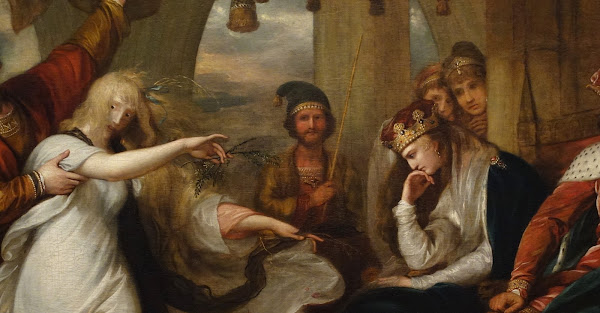
What if Gertrude lied about Ophelia’s death? In a previous post on Ophelia (Part 16), I explored the idea that Gertrude’s story in 4.7 of Ophelia’s death might be true: Ophelia died because a willow branch on which she was standing broke; once in the water, she accepted the possibility of her approaching death in faith, apparently according to Christian expectations of the time.This seems consistent with many aspects of Ophelia’s last scene (4.5). Some note: Gertrude’s account has so much detail, but no one tries to save Ophelia. Can we trust Gertrude’s account? If Gertrude’s account of Ophelia’s death in 4.7 is a fiction, a lie (bearing false witness, a sin in the eyes of Elizabethan Christians [1]), how might we best understand it? 1. As a lie of self-interest, to avoid Laertes’ rage and prevent him from killing Claudius and Gertrude herself, declaring himself king with the mob’s support? 2. To preserve the state and public order, to prevent casualties that might come from a revolt? ...