Posts

Showing posts with the label Jacob

Part 55: Ophelia's Overlapping Biblical allusions and plot echoes

Image
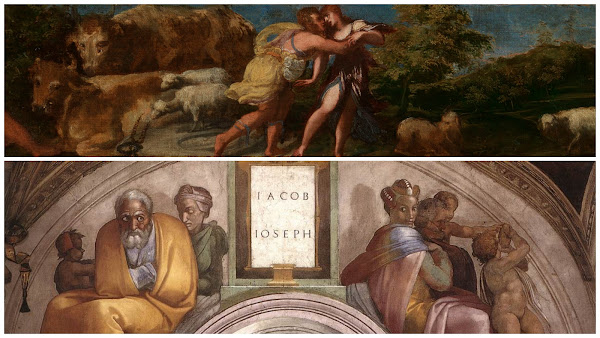
Many biblical allusions (or biblical plot and theme echoes) associated with Ophelia overlap in her character. All of these were well-known in Elizabethan times. (Not an exhaustive list): 1. Hebrews 12: 6-11 (suffering as a sign of God’s love for the “chosen” who will be “saved).[1] 2. JACOB, ESAU, AND RACHEL (lower right): the “double blessing” for Laertes, and the frustration of Hamlet and Ophelia’s hopes for a match, point to the bible tale of how Jacob wins the birthright by deceit, Esau gets the second blessing, and Jacob’s hopes to marry Rachel are at first frustrated.[2] 3. SALOME (top left): Claudius wants Ophelia and her brother Laertes to dance to his tune and serve his purposes: He uses Ophelia a bait to spy on Hamlet, and Laertes as co-conspirator to to kill Hamlet, who protests the incestuous marriage. Salome danced pleasingly for her stepfather, Herod Antipas, who offered almost any reward. His wife, Salome’s mother (divorced wife of his brother) told her to ask for the he...

Series conclusion: Hamlet & Jacob - part 4

Image
In this series of posts on Jacob and Hamlet, I’ve suggested that in Shakespeare’s play, certain elements in the text and its themes are either allusions to the biblical Jacob-Esau tales, or show an influence of those tales on Shakespeare’s development of the play. [1] These include - Laertes’ use of the phrase, “double blessing” ( see part 1 ); - the possibility that Laertes is an Esau figure, while Hamlet and Ophelia might be viewed as Jacob figures ( see part 1 ); - the idea of poetic justice in Hamlet as in part influenced by its presence in the Jacob tales ( see part 2 ); - the importance of maternal approval for marriage, not only for Jacob, but also for Ophelia and Hamlet, with Gertrude’s voice of approval ( see part 3 ). The impulse of some might be to take Laertes’ phrase, “double blessing” (1.3.57-59) and consult Naseeb Shaheen’s “Biblical References in Shakespeare’s Plays” (1999) as authoritative, or even as the last word. But Shaheen is of very limited help, even m...

Marriage & Maternal Approval: Jacob - Hamlet Echoes - part 3

Image
Themes of marriage and maternal approval have some interesting connections when comparing the biblical Jacob tales with Shakespeare’s Hamlet: [1] Jacob’s mother plays a key role in favoring him for the birthright (Genesis 25:19-27), but also helping him deceive his father (Genesis 27:1-40). It is extremely important that Jacob receives encouragement and permission from his mother - who had coddled him, favored him - to go and seek a bride (Genesis 27:41-45) when his brother Esau is angry after learning that Jacob has deceived his father and received the birthright/blessing that Esau had expected. This permission and encouragement from Rebekah helps open a gap between mother and son that Freud and others would say is healthy. Queen Gertrude acts in similar motherly ways toward Ophelia as well as toward her son Hamlet. Ophelia’s mother is absent (like Hamlet's father; she is a feminine mirror image of Hamlet); like the ghost and Claudius, Polonius is a dysfunctional fathe...

“Hoist with his own petard”: Jacob-Hamlet Echoes, part 2

Image
In addition to Laertes’ “double blessing” remark (1.3.58), which points to the biblical Jacob story ( as noted in a previous post ) [1], note how in both Hamlet and the biblical Jacob tale, “purposes mistook” fall on the “inventor’s heads” (Horatio in (5.2.426-427)): What goes around comes around. A perennial theme. As Shakespeare develops this theme richly, echoing biblical themes, we are right to ask if Shakespeare was influenced by the Jacob story - besides a myriad of others, including biblical teachings. [2] DECEIVER BECOMES DECEIVED IN THE JACOB TALES (Gen 25-33): 1.a. By pretending to be his brother, Jacob deceives his father to obtain the birthright. - Later, his father-in-law Laban deceives Jacob on the wedding night, substituting the older sister Leah for the agreed-upon bride of Rachel. [3] 1.b. Jacob who struggles with sibling rivalry is later burdened with two wives, sisters who struggle with sibling-rivalry. IN HAMLET : 2.a. Hamlet tries to deceive the court, pretending...

Laertes' "double blessing": Echoes of Jacob, Esau, & Rachel in Hamlet, part 1

Image
LAERTES: …But here my father comes. A double blessing is a double grace. Occasion smiles upon a second leave. (1.3.57-59) This is a curious statement by Laertes before receiving advice from his father Polonius, with his father’s blessing, before he returns to France. Naseeb Shaheen believes the relevant biblical allusions here might be Isaiah 40:2, “Double grace, whereas she deserved double punishment,” and Ecclus. 26:15, “A shamefast and faithful woman is a double grace.” (542) [1] But this seems an example of how scholars like Shaheen and his predecessors [2] often prefer searching for words and phrases, rather than considering biblical tales and plots. So instead of asking, Where in the Bible we find the words, ‘Double blessing’ or ‘Double grace,’ scholars of Shakespeare and the Bible might do better to ask, In what biblical tale does a son receive a double (or second) blessing from a father? [3] One place is in the tales of Jacob and Esau, twins for whom there is c...

Begging and Poor in The Comedy of Errors (1594)

Image
In The Comedy of Errors, "beg" occurs only four times; "poor," 10. The story contains two sets of twins, and each set bears the same name: Two of Antipholus, two of Dromio, the former raised to be masters, the latter bought and raised to be servants (slaves). - Because "their parents were exceeding *poor*," the Dromio twins were "bought and brought up to attend" Egeon's sons (1.1, an act of charity, or exploitation, or both). - But Egeon of Syracuse has traveled to Ephesus as a refugee to find his later-separated sons, risking death by execution because Syracuse and Ephesus are at war. - Solinus, Duke of Ephesus, tells Egeon to *beg* or borrow the money for his ransom to spare his life (1.1). - Luciana, sister-in-law to Antipholus of Ephesus, tells her sister that the love she *begged* for her sister from the Antipholus she believed was her sister's husband, he begged of her (4.2, because unknown to her, the Antipholus who begged lov...

Strange Angels, a Cherub, & Jacob Wresling in Hamlet: Too Many Angels?

Image
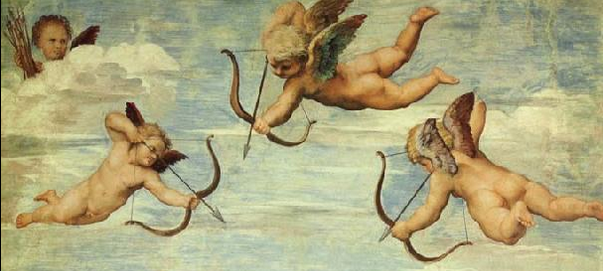
There are ten angels in Shakespeare's Hamlet and one cherub, a changeling with an angel in its heart, strangely, strangely.... What does it all mean? [Cherubs from Raphael's "Triumph of Galatea," detail. Image source: Wikipedia ] Friday of this week is Valentine's day, bringing with it many images of that angelic and mischievous little guy, son of Venus, the goddess of love. Yes, you guessed it: Cupid is coming. Cupid, often depicted as a crossover between Greek mythology and those baby Christian angels, cherubs. It didn't have to be that way, but that's what we've got. There are ten angels in Shakespeare's Hamlet  (or instances of the word, perhaps many others implied), and one cherub - though an unnamed cupid may have left his mark on Hamlet, as we see from his love-gushing letters, and on Ophelia, whose attention for Hamlet her father Polonius describes as follows: 'Tis told me he hath very oft of late Given private time ...