Posts

Showing posts with the label Oedipus

Hamlet's Transcendent paths of Francis, Bernard, & Yorick, vs. Freud's Oedipal path

Image
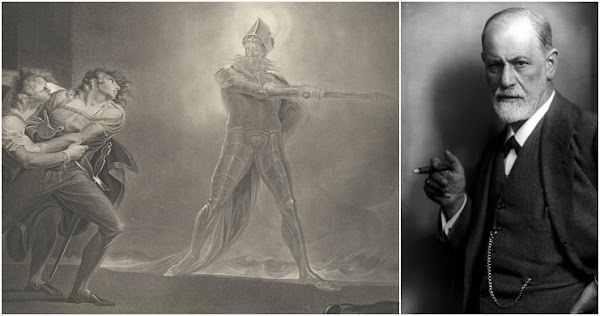
Shakespeare's Hamlet offers glimpses of two ways of transcending dysfunctional parentage: a) The limited path of Freud's Oedipal complex, or b) Yorick and the paths of Francis of Assisi and Bernard of Clairvaux. In the first, the son kills the father-figure to reclaim a lost closeness to the mother. If the father is a tyrant and the son resorts to violence to replace him, this is a very limited, temporary transcendence, with the son too much like the father he replaces [1]. Francisco and Bernardo are the names of sentinels, the first two characters on stage in the play. Together, they are the names of the Pazzi assassins [2], but individually they are names of saints: - Francis of Assisi and Bernard of Clairvaux didn't kill their fathers, but Francis famously renounced his abusive father before the bishop, stripping off his clothes and giving them back to his father, saying that he had a father in heaven. - St. Bernard’s biological father and brothers eventually joined t...

Prodigal is Oedipal spelled badly - Biblical Allusions as Lenses for Hamlet

Image
HAMLET AS PRODIGAL (OEDIPAL SPELLED BADLY) OEDIPAL [1]: Freud claimed that men want to kill their fathers and possess their mothers, like Oedipus, whose father (Laius) was in fact a jerk. Laius made bad karma, abandoning his son to die.[2] - Oedipus doesn't know he was saved and adopted, so he thinks the prophecy means he will kill his adoptive father and marry his adoptive mother. He doesn't want that, so he flees. - While fleeing, his biological father is cruel to him on the road, and Oedipus kills him, not knowing it is his father. - Having suffered trauma as a child, Oedipus may be lashing out in revenge at a stranger who happens to be his father. All fathers die, most before their sons. But the tale is also a metaphor for how children need to establish their own identities as distinct from their parents (though some sons may "want a girl / just like the girl / that married dear old Dad," as the song says.[3]) We can follow Freud and read Hamlet as Oedipal. PRODIG...

Shepherds in Shakespeare, Oedipus, Hamlet, and the Bible

Image
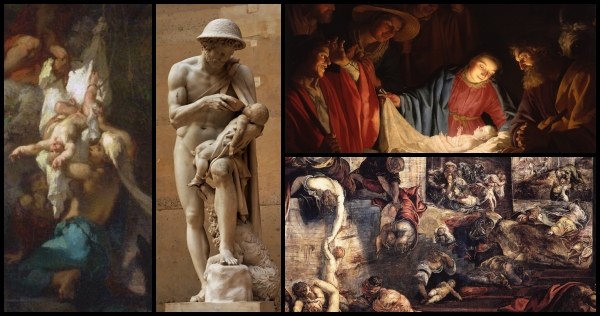
Shakespeare’s Hamlet is often analyzed in terms of Freud’s theories that draw upon the Greek tale of Oedipus. When Hamlet blindly stabs Polonius behind the arras, this may resemble Oedipus unknowingly killing his own estranged and bullying father on the road. Hamlet refers to Herod, possibly Herod the Great or his son, Herod Antipas. A few days after Christmas, Christian churches commemorate Herod the Great’s slaughter of innocent boys. The tale claims that Herod heard of the birth of a new king of Israel, so he tried to avoid being replaced by killing all young male infants (collage, bottom right) [1]. Shepherds in the gospel tale choose a different path: They hear from angels of the birth and go to adore the infant Jesus (collage, top right) [2]. The shepherds could be said to mediate between angels and Jesus, who will come to be called a “good shepherd.” . In the Oedipus tale, Laius, father of Oedipus, fears a prophecy that his son will one day kill him; he tells his wife Jocasta...

That season... Wherein our Saviour's birth is celebrated

Image
“...that season … / Wherein our Saviour's birth is celebrated…” There is a tendency at times for some to approach the Christmas reference in Hamlet as if it is merely about Catholic superstition. But it’s far richer than that. The ghost appears; the cock crows; the ghost disappears (an allusion to Peter’s denial during the passion [1]). Then: MARCELLUS: Some say that ever ’gainst that season comes Wherein our Savior’s birth is celebrated, This bird of dawning singeth all night long; And then, they say, no spirit dare stir abroad… (1.1.173-176) The cock crowing and season of Christmas point to a large sweep of Christian salvation history.   Even regarding the Christmas reference alone, we might treat it as an invitation to view the play in the mirror of the Christmas season tales, which are in part hospitality tales: Some welcome guests and strangers; others inconvenience, neglect, or kill them. There is a similar contrast in Hamlet : — The Christmas tale requires Annunciation and...

Part 13: Ophelia, Hamlet, and 13 ways of looking at madness

Image
Often we speak of Ophelia as having really gone mad, while Hamlet only pretends . But in fact the play uses the word “mad” in many ways, as do critics. So, with a nod to Wallace Stevens’ poem title [1], a list: MADNESS AS DEMONIC POSSESSION: Horatio worries that the ghost is demonic and “might deprive [Hamlet] sovereignty of reason / And draw [him] into madness” (1.4.77-82). MADNESS AS FEIGNED: After meeting with the ghost (1.5), Hamlet says he will “put on” “an antic disposition” (1.5.189-192), as did Odysseus, King David, and Amleth in the Saxo Grammaticus source; but Hamlet’s encounter with the ghost may actually be driving him insane… [Edit 9/24/2023: In 3.1.7-10, Guildenstern also comments on Hamlet's feigned madness: "Nor do we find him forward to be sounded, But with a crafty madness keeps aloof When we would bring him on to some confession Of his true state." ] MADNESS AS WHAT LOST LOVE CAN DO: Polonius believes Hamlet has been made insane by the los...

Part 1: Hamlet Before Freud ("Tough Love" for Gertrude and Ophelia)

Image
If we take seriously that Hamlet, Horatio and the sentinels saw a ghost from purgatory, [1] then we have to consider this possibility: Hamlet is harsh with his mother and Ophelia because he thinks he has seen his father’s ghost from purgatory who claims to be there because he had sinned, committed foul crimes. Hamlet doesn’t want the two women he loves most to end up in purgatory like his father, or worse, in hell. He scolds Ophelia and tells her to get to a nunnery; he scolds his mother, tells her to repent of her incestuous marriage, a relationship that began, according to the ghost, with adultery when his father was still alive. Hamlet feels a duty to be harsh with them because he fears for their eternal fate. If one encountered a ghost from purgatory as Hamlet did, and loved his mother and Ophelia, it makes sense that one might want to warn them, to spare them such a fate. [2] To be clear, while many in Shakespeare’s time believed in ghosts [3], there were also those who did not,...

Anagnorisis (& some peripeteia) in Hamlet

Image
Shobha Pawar is a translator and former English professor and department chair from Pune, Maharashtra, India, who has long been a collegial acquaintance on LinkedIn, and for this, I am most grateful. Last week I posted about Aristotelian poetics, ethics, and politics in Hamlet , and Shobha asked some helpful questions and made good observations. Her comments inspired this week's blog post. Shobha wrote, "Paul, taking the cue from Aristotle I think anagnorisis is the decisive factor in defining tragedy. How would you view Hamlet's journey in the light of this?" Great question. There used to be a series of books called Where's Waldo , in which there were detailed pictures of crowds, and the task on each set of pages of the open book was to find Waldo, who always wore the same clothing. The task Shobha's question suggests is to approach Hamlet and to ask, "Where's anagnorisis?" Edit: I should note early that Shobha does not believe Hamlet is...