Posts

Showing posts with the label Elizabeth I

Hamlet & Commandment 1: No other gods? (The literal sense) - Series

Image
Why did Hamlet compare his father to Greek and Roman gods - at a time when Elizabeth was often compared to goddesses? In Shakespeare’s England, churches had the Ten Commandments posted prominently. The first commandment: "THOU SHALT HAVE NO OTHER GODS BUT ME." Literally: Don’t worship deities of other religions. Hamlet worries that heaven forbids suicide (“self-slaughter,” 1.2.136), but (oblivious to other biblical prohibitions?) compares his father to a Greek god, the titan Hyperion (1.2.144), and in 3.4, to more gods: See what a grace was seated on this brow, Hyperion’s curls, the front of Jove himself, An eye like Mars’ to threaten and command, A station like the herald Mercury New-lighted on a heaven-kissing hill, A combination and a form indeed Where every god did seem to set his seal To give the world assurance of a man. (3.4.65--72) The ghost says he’s being purged in an afterlife, as in purgatory of Catholic teaching, not Greek or Roman mythology. Is Hamlet confused...

Hamlet the Demonic Iconoclast (Ten Commandments Series)

Image
IN THE PERSON OF HAMLET, DOES SHAKESPEARE ASSOCIATE ELIZABETHAN ICONOCLASM WITH DEMONIC POSSESSION?  In Reformation England, images that recreated scenes from familiar religious and biblical tales were destroyed, removed, or painted over as allegedly idolatrous (as described in the 2nd commandment, which prohibited making any “graven image”).  In their place? Commandment boards.  It is frequently noted that Shakespeare’s father, John, was charged with having to paint over images in their church in Stratford. People who loved religious statues and images in their local churches often had to be content with the Ten Commandments, and words, not images.  By placing on Hamlet’s lips a little speech that seems to make him an iconoclast by analogy – and at the very moment when Hamlet seems tempted to revenge by a possibly demonic ghost – this seems to associate English iconoclasm with the demonic [1].  Consider Hamlet’s little speech after his first encounter with the ...

In Hamlet, is "Lenten entertainment" oxymoron, royal hypocrisy, or foreshadowing?

Image
"LENTEN ENTERTAINMENT": OXYMORON, ROYAL HYPOCRISY, OR FORESHADOWING?  Rosencrantz says to Hamlet,  To think, my lord, [...]  what Lenten entertainment the players shall receive from you. (2.2.339-341).  Students unfamiliar with Christian liturgical seasons may skip over the word “Lenten.”  The more curious may look it up: A solemn season of fasting and repentance before Easter.  So what does “Lenten entertainment” imply?  1. Does “Lenten entertainment” pleasantly break up the drudgery of Lent?  - In 1598, Elizabeth I issued an edict prohibiting public theatrical performances during Lent, while privately still sponsoring such entertainment at court.   - Was Shakespeare subtly drawing attention to the hypocrisy of Elizabeth’s policy?  2. If taken literally, while the opening scene of the play (1.1) was cold at night, perhaps in winter (with Christmas mentioned), does 2.2 occur later during Lent? (Too literal?)  3. In 1.2, Hamle...

Hamlet, John the Baptist, and Jesus as Symbolically Political

Image
My previous post noted that Hamlet alludes to John the Baptist [1]. Consider the religious, symbolic, and political significance of John baptizing at the Jordan [2], for Jews who knew their founding story by heart, that Moses led their ancestors through parted waters of the Red Sea to freedom and a promised land, escaping a foreign oppressor [3].  John at the Jordan plays into the same tropes, where Rome (not Egypt) is the foreign oppressor (which in part explains why Rome and Herod Antipas saw him as a threat). England’s Henry VIII claimed he needed to repent of incest, had seen action in battle, but was thought to have died a sinful man, guilty of foul crimes. Hamlet deals with an incestuous king and the ghost of a king, fearsome in battle, who died with sins on his soul, foul crimes. Same tropes. Hamlet alludes to both Julius Caesar and Jesus. Consider Jesus, preaching where Roman coins bore the image of a Roman emperor [4] with an inscription calling the emperor “son of a go...

Why Claudius as a (Thomas) "More" was an insult in Hamlet 3.4

Image
Thomas More and Hamlet’s uncle Claudius were both, in their own ways, defenders of incestuous marriage. More would not agree to Henry VIII’s plan to break from Rome to get his divorce from his first wife, a marriage that the church had considered incestuous from the start: Henry and Catherine had to ask Rome for special permission to marry in the first place [1]. So for Hamlet to refer to Claudius as a “moor” - meaning also a “More” - would be entirely appropriate.  In Act 3, scene 4, when Hamlet refers to his father favorably as a “fair mountain” and his uncle insultingly as a "moor," to the Elizabethan ear, audiences heard no difference between "moor," or "Moor," or the last name of Thomas More [2].  Today, many may consider Thomas More a martyr for conscience who opposed Henry’s quest for divorce [3]. There is nothing wrong with this view, but it is incomplete: It doesn’t consider how some Elizabethans understood More.  By the end of her life, Elizabe...

Does our Sir Thomas More differ from Hamlet's?

Image
How might a 21st century view of Sir Thomas More differ from Hamlet’s?  Catholic worship was illegal in England until 1791 [1]. More was beatified in 1886, canonized a saint in 1935.  In 1960 JFK became the first Catholic US president [2].  Robert Bolt's “A Man for All Seasons,” a play about More that won a 1962 Tony Award, had by the time of JFK’s 1963 assassination finished a successful Broadway run of 637 shows since 1961 after its London debut [3]. The hero of the play, More would not support Henry VIII's quest for a divorce from his first wife, resulting in his execution, a martyr for conscience.  Henry had sought special permission (‘dispensation’) to marry his dead brother’s widow (the church usually considered such marriages incestuous), but after 24 years of marriage and a daughter, Henry famously changed his mind after his affair with Anne Boleyn, and no thriving male heirs.  Shakespeare used More’s historical writing as a basis for Richard III, and ...

Historical reasons for Shakespeare to write a cautious Hamlet who delays

Image
INSTEAD OF ASKING WHY HAMLET DELAYS, let's ask: Why does Shakespeare write Hamlet that way?  Besides the execution of two wives of Henry VIII, and of many Catholics accused of treason, including Shakespeare’s relative Edward Arden in 1583 [1], what figurative ghosts may have made a cautious Shakespeare write a cautious Hamlet?  1. In February 1587, Mary, Queen of Scots was executed in England for conspiring against Queen Elizabeth I, her cousin. She was found guilty and beheaded. 2. In 1594, Ferdinando Stanley, patron of the Lord Strange's Men (in which Shakespeare and many of his fellow players were active) and possible heir to Elizabeth’s throne, was poisoned after faithfully reporting a plot against Elizabeth I that may have been intended to entrap him [2].  3. In February, 1601, Robert Devereux, Earl of Essex, attempted a rebellion against the English government, a year and a half before Shakespeare's Hamlet first appeared in the stationer's registry (July 1602), an...

Beloved Boudica, Contemptible Claudius, Elizabethan Analogies (Part 8, Claudius series)

Image
“CLAUDIUS” WAS NOT A NEUTRAL NAME in Shakespeare’s England, nor was the fact that Claudius I of Rome had invaded England with elephants in 43 AD [1]. By the time Shakespeare’s first and second quartos of Hamlet were published (1603-4), two Roman Catholic popes had excommunicated Elizabeth (Pius V, 1570; Sixtus V, 1588) and openly encouraged her assassination. Rome also supported three Spanish Armada’s attempts to invade England during her reign (1588-1597). All of this colored England’s views of Roman history and of native resistance, such as that of Boudica [2], sometimes called “Queen of the Iceni” tribe, who led a rebellion against Roman occupiers slightly less than two decades after the invasion of Claudius. When her husband, King Prasutagus died, Boudica was flogged and her daughters were raped. Killing as many as 80,000, Boudica’s revolt destroyed a settlement of Roman military veterans at Camulodunum (now Colchester), where a large and expensive temple to Claudius I was locate...

A Note on Gender, Religion, and Politics in Twelfth Night

Image
One last Twelfth Night post before the anniversary of its first 1602 public performance on February 2: In Shakespeare’s time, a young male actor would have played the female Viola, later disguised as male Cesario: Much analysis of the play deals with gender, disguises, social constructs. Some of it considers Elizabeth I, Shakespeare’s monarch, in a role usually reserved for men. The fifth pageant for her coronation portrayed Deborah, a prophetess of Hebrew scriptures who led Israel as judge [1], contrary to Christian assumptions that kept women from female authority roles. Some scholars and historians note that Elizabeth had a reputation for swearing, not so much sexual profanity as religious, like Hamlet’s “swounds” (by Christ’s wounds) or “sblood” (by God’s blood). Elizabeth’s favorite was “by God’s death,” which listeners assumed was for shock value, by a woman in a man’s world, striving to maintain attention and control [2] Like Portia disguised as Balthazar in the courtroom sce...

Part 53: When a Queen defends Ophelia as saved

Image
WHAT DOES IT MEAN for Elizabethan England, and for its queen and head of England’s church, that Shakespeare’s Hamlet portrays a queen defending Ophelia’s death as not of her own choosing, but fearless and accepted in faith? The play portrays two main attitudes about suicide: Christianity condemned it, while “antique Romans” embraced it as an option for honorable death. Hamlet prevents Horatio from drinking poison [1]; some scholars and productions have proposed that Hamlet offers Claudius the poison cup, and he takes it of his own volition.[2] The play presents gravediggers [3] and a “churlish priest” [4] who assume Ophelia killed herself; before these, no eyewitness accounts, but a queen who asks all to believe that Ophelia’s fall into the brook was not of her own choosing (but due to the crown-envy of a sliver of willow, like the crown envy of Claudius), and that Ophelia accepted her approaching death fearlessly, and in faith. Significantly, this play was written at the end of Eli...

Hamlet and the Incestuous Marriages of Claudius and Henry VIII - via John Erskine Hankins

Image
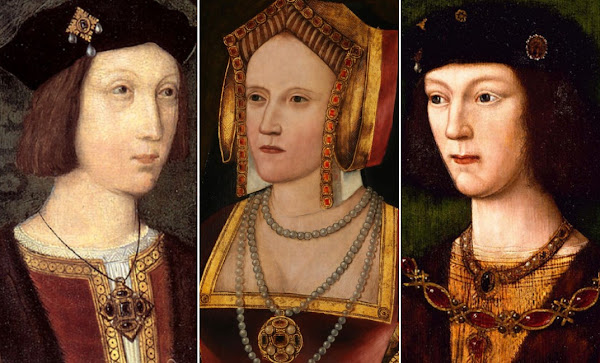
Shakespeare certainly wrote of Claudius and Gertrude’s “incestuous” marriage with Henry VIII in mind. Early audiences recognized it. In teaching the play, is it a mistake to omit that context? [Left: Arthur Tudor, Prince of Wales (1486-1502), "regarded as the only surviving contemporary portrait"; circa 1500. Anglo-Flemish School. Private collection, Hever Castle, Kent. Public domain. Image via Wikimedia . Center: Catherine of Aragon (1485–1536), originally identified as Catherine Parr, but now recognized as Catherine of Aragon. Unidentified painter. 16th Century. Lambeth Palace. Public domain, via Wikimedia . Right: Henry VIII of England (1491-1547), circa 1509. Attributed to Meynnart Wewyck. Denver Art Museum. Public domain. Image via Wikimedia ]. From “The Character of Hamlet,” by John Erskine Hankins* (1941), p.101: ~~~ It will be remembered that Henry VII's eldest son Arthur was married to Katherine of Aragon to cement an alliance between England and Spa...