Posts

Showing posts with the label Bible

Hamlet, Uriah, and Shakespeare's Transformation of the Death Letter

Image
How old is the death letter motif in Hamlet, where did it come from, and is there anything special about the way Shakespeare uses it? In Hamlet, Shakespeare retains the motif of the death letter from the Danish source. Claudius sends a letter with Rosencrantz, Guildenstern, and Hamlet on their journey to England [4.3.67-77], but they don’t know that it orders Hamlet’s death. People in Shakespeare’s time knew this death letter motif by way of the biblical story of David’s affair with Bathsheba (circa 10c. BCE). King David sends Bathsheba’s husband Uriah to the battlefront with a letter that he is to be placed at the front of battle, and others should pull back. He is killed [1]. A later Greek version of the motif comes from the 8th century BCE myth of Bellerophon [2]. The reluctance of kings to violate rules of hospitality plays a key role in delaying fatal plans and helping Bellerophon prevail in the end. For anyone who is sad to hear of Uriah’s fate, a faithful soldier deceived b...

Contested Succession in Hamlet, Reformation, & Christian Scripture

Image
Hamlet is in part about a contested succession, a hot topic in Elizabethan England. The first line in Hamlet, “Who’s there?” sounds like “who’s th’ heir?” [1]. Hamlet believes Claudius is a murderous usurper, an illegitimate successor to his father. Contested succession applies not only to politics, but also to religion in Shakespeare’s time and Christianity in general, and to scientific authority as well. At least some people in Shakespeare’s time would have noticed that the story of Jesus is one of contested succession in which Jesus is heaven’s prince [2]. After the Roman occupation in 63 BCE, Jewish authorities were corrupted in Rome’s favor [3]. Some of these used the letter of the law to condemn the preacher and miracle-worker, Jesus, who like John the Baptist had attracted the attention and concern of Roman authorities. The gospels claim that Jesus associated with revolutionaries (zealots), and that he was crucified with a sign that mocked him as “King of the Jews.” [4] After ...

Hamlet-Claudius, Romulus-Remus, Cain-Abel (Part 11, Claudius series)

Image
Last week I posted [1] about a 1948 journal article by E. G. Berry [2], arguing that Shakespeare’s Hamlet resembled Roman Emperor, Claudius I. [3]. Berry argued that these resemblances are stronger in Shakespeare than in the 1200 A.D. source story from Saxo Grammaticus. What Berry doesn’t emphasize, but makes clear: 1. Saxo did not fashion his prince as a mirror image of his murderous uncle, although Amleth does resemble aspects of Claudius I. No similarity between prince and uncle is emphasized by Saxo. 2. By naming the uncle “Claudius,” Shakespeare invites audiences to view the prince and uncle in a radically revised relationship. Instead of a simple opposition between hero and villain, by changing the uncle’s name from “Feng” to “Claudius,” Shakespeare creates a new mirror effect between the two that was not present in Saxo’s older source tale. By pointing to Claudius I, Shakespeare points to Rome, which has an origin story involving a twin, Romulus, who kills his brother Remus [4...

Claudius Ptolemy and Hamlet (Part 7, Claudius series)

Image
Some might think I missed a comma and that this post is about three people: Hamlet, his uncle Claudius, and Ptolemy, the astronomer. But in fact, the astronomer was a Roman citizen with “Claudius” as part of his name. What does this have to do with Shakespeare’s Danish tragedy? Ptolemy (circa 100 – 170 AD) was on the wrong side of science from an Elizabethan point of view. He thought that the earth was at the center, and that the sun and other heavenly objects went around the earth. About 350 years before Ptolemy, Aristarchus of Samos (310 – 230 BC) had said that the sun was at the center, but that idea didn’t catch on until the likes of Copernicus (1473 – 1543) and others. Certain passages in the Bible claimed that the sun moved, so the church was slow to endorse the Copernican paradigm. When Polonius reads Hamlet’s love letter to Ophelia, it includes the lines, Doubt thou the stars are fire; Doubt that the sun doth move; Doubt truth to be a liar; But never doubt I love. (2.2.124-12...

Prodigal is Oedipal spelled badly - Biblical Allusions as Lenses for Hamlet

Image
HAMLET AS PRODIGAL (OEDIPAL SPELLED BADLY) OEDIPAL [1]: Freud claimed that men want to kill their fathers and possess their mothers, like Oedipus, whose father (Laius) was in fact a jerk. Laius made bad karma, abandoning his son to die.[2] - Oedipus doesn't know he was saved and adopted, so he thinks the prophecy means he will kill his adoptive father and marry his adoptive mother. He doesn't want that, so he flees. - While fleeing, his biological father is cruel to him on the road, and Oedipus kills him, not knowing it is his father. - Having suffered trauma as a child, Oedipus may be lashing out in revenge at a stranger who happens to be his father. All fathers die, most before their sons. But the tale is also a metaphor for how children need to establish their own identities as distinct from their parents (though some sons may "want a girl / just like the girl / that married dear old Dad," as the song says.[3]) We can follow Freud and read Hamlet as Oedipal. PRODIG...

Part 55: Ophelia's Overlapping Biblical allusions and plot echoes

Image
Many biblical allusions (or biblical plot and theme echoes) associated with Ophelia overlap in her character. All of these were well-known in Elizabethan times. (Not an exhaustive list): 1. Hebrews 12: 6-11 (suffering as a sign of God’s love for the “chosen” who will be “saved).[1] 2. JACOB, ESAU, AND RACHEL (lower right): the “double blessing” for Laertes, and the frustration of Hamlet and Ophelia’s hopes for a match, point to the bible tale of how Jacob wins the birthright by deceit, Esau gets the second blessing, and Jacob’s hopes to marry Rachel are at first frustrated.[2] 3. SALOME (top left): Claudius wants Ophelia and her brother Laertes to dance to his tune and serve his purposes: He uses Ophelia a bait to spy on Hamlet, and Laertes as co-conspirator to to kill Hamlet, who protests the incestuous marriage. Salome danced pleasingly for her stepfather, Herod Antipas, who offered almost any reward. His wife, Salome’s mother (divorced wife of his brother) told her to ask for the he...

Part 54: Ophelia, like Jesus, preaching against hypocritical libertines (deconstructed?)

Image
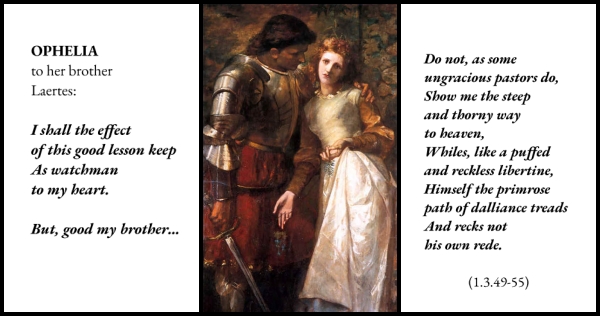
Ophelia’s first biblical allusion made her sound, to Elizabethan ears, like Jesus condemning hypocrisy and corruption of authorities. She targets her brother as a potential hypocrite and “libertine.” Laertes warns her not to get too close to Hamlet, that he is above her station, warning her not to lose her chastity to him. Ophelia responds kindly but strongly: I shall the effect of this good lesson keep As watchman to my heart. But, good my brother, Do not, as some ungracious pastors do, Show me the steep and thorny way to heaven, Whiles, like a puffed and reckless libertine, Himself the primrose path of dalliance treads And recks not his own rede.[1] In Matt. 7:13-14, Jesus’ cautions: Avoid the “wide gate” (of too much freedom). “Straight and narrow” for Ophelia becomes “steep and thorny.” In Matt. 23:1-4 Jesus says, do all that “teachers of the law” and Pharisees teach, as they sit in the “seat of Moses” as authorities, but not to do as they do, for they are hypocrites.[2]  ...

Interview with Paul by ArtMakers on KYMN Radio, March 7, 9 A.M. CST

Image
Tomorrow, March 7 at 9 a.m. CST, KYMN Radio in Northfield, Minnesota, will broadcast an interview of me, pre-recorded by Betsy Spethman and Andrew Rossow of ArtMakers (Disabilities - Arts - Community). Andrew has been one of my music students for at least nine or 10 years; he is blind and handicapped, so he is unable to play guitar, but he can play a number of other musical instruments, including autoharp (the focus of our lessons). He has a great ear for music, remembers chords and lyrics very well, and can transpose on the fly. Andrew’s parents, Jim Rossow and Betsy Spethman, started the organization, ArtMakers, to help people with disabilities have opportunities to be involved in arts and community. Betsy and Andrew regularly interview people in Northfield, Minnesota, a two-college town (where I live, also home to St. Olaf and Carleton colleges); the interviews are broadcast and archived on KYMN Radio in a show called “Townies Radio.” Andrew and his father Jim performed together i...

Top 20 Greatest Hits: Hamlet & the Bible

Image
Below are some of my most essential posts about biblical echoes in Shakespeare, most of them beyond those listed by Naseeb Shaheen & predecessors ( Biblical References in Shakespeare's Plays , which focuses mostly on explicit biblical name- and verse-allusion). A description of my book project is included at the very end. This is not intended to replace Naseeb Shaheen's reference book, but to compliment it, especially with plot echoes that are less explicit and may have been more thoroughly internalized by the writer, or used in more subtle ways for artistic or political reasons. Most of these are short reads, especially early in the list, with a few longer posts toward the end, and a few of them including links for more details. I've tried to illustrate all of these with paintings and drawings from Shakespeare's time or earlier in most instances. Where credits for the images are missing here, see the link for each section. On the one hand, a part of me...