Posts

Showing posts with the label poor

At Christmas be Merry - 1557 rhyme

Image
At Christmas be mery, and thanke god of all: and feast thy pore neighbours, the great with the small. Yea, al the yere long, have an eie to the poore: and god shall sende luck, and bring you much more. - Thomas Tusser, 1557   Via Brigitte Webster on Instagram @tudor_experience https://www.instagram.com/p/DD9Apq-oIOF/?utm_source=ig_web_copy_link ~~~~~~~~~~~~~~~~~~~~~~~~~~~~~~~ ~~~~~~~~~~~~~~~~~~~~~~~~~~~~~~~ YOU CAN SUPPORT ME on a one-time "tip" basis on Ko-Fi: https://ko-fi.com/pauladrianfried IF YOU WOULD PREFER to support me on a REGULAR basis, you may do so on Ko-Fi, or here on Patreon: https://patreon.com/PaulAdrianFried ~~~~~~~~~~~~~~~~~~~~~~~~~~~~~~~ ~~~~~~~~~~~~~~~~~~~~~~~~~~~~~~~ Disclaimer: If and when I quote or paraphrase bible passages or mention religion in many of my blog posts, I do not intend to promote any religion over another, nor am I attempting to promote religious belief in general; only to explore how the Bible and re...

Begging & Poor (& Chastity & Pregnancy) in Love's Labour's Lost (1594-1597)

Image
Love's Labour's Lost has an earliest recorded performance before Queen Elizabeth as part of the court's Christmas festivities in December, 1597. [Title page from the 1598 first quarto, cropped, via Wikipedia . Public domain.] Elizabeth had been promoted as "Virgin Queen," but was rumored to have had affairs, and many in England were anxious about the fact that she had not married and produced an heir; so it is interesting and significant that the play has a theme of how difficult and impractical chastity can be. It's as if Shakespeare said: Court Christmas play? Virgin queen? Rumored affairs? No heir? How about a comedie about failing at chastity, pregnancy before marriage, falling in love, and reforming bad habits? (Let’s face it: Life is not all about work, even for a monarch! It’s about love. Right?) The play preempts heckling from the court by including a masque, which members of the court heckle; it preempts criticism of its playwright for having ...

Begging and Poor in The Comedy of Errors (1594)

Image
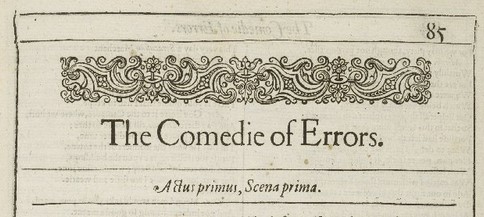
In The Comedy of Errors, "beg" occurs only four times; "poor," 10. The story contains two sets of twins, and each set bears the same name: Two of Antipholus, two of Dromio, the former raised to be masters, the latter bought and raised to be servants (slaves). - Because "their parents were exceeding *poor*," the Dromio twins were "bought and brought up to attend" Egeon's sons (1.1, an act of charity, or exploitation, or both). - But Egeon of Syracuse has traveled to Ephesus as a refugee to find his later-separated sons, risking death by execution because Syracuse and Ephesus are at war. - Solinus, Duke of Ephesus, tells Egeon to *beg* or borrow the money for his ransom to spare his life (1.1). - Luciana, sister-in-law to Antipholus of Ephesus, tells her sister that the love she *begged* for her sister from the Antipholus she believed was her sister's husband, he begged of her (4.2, because unknown to her, the Antipholus who begged lov...

Begging and Poor in Richard III (1592–1593)

Image
The word "beg" occurs 13 times, and "poor," 25 times in Richard III . On the lips of Richard, Duke of Gloucester, when it is not disparaging, it is often dishonest and manipulative. The Princes in the Tower (among others) are very concerned with avoiding the appearance of begging as a mark of weakness. A failed assassin claims conscience leaves him a beggar (a theme that comes up again in Hamlet). In comparison, when Prince Hamlet and others refer to him as “poor” and “beggar” (more often than any other character in that play) the contrast between Hamlet and these other royals is stark and significant. [From title page, Richard III (cropped), from the second folio of 1632. Image via Folger Shakespeare Library . Creative Commons.] Nizar Zouidi of the University of Hail has noted the performative aspect of Richard III : He performs the roles of script writer, actor, and director in his own show ( See Nizar's abstract for his essay/chapter here .) R...

Begging and Poor in 3 Henry VI (1591)

Image
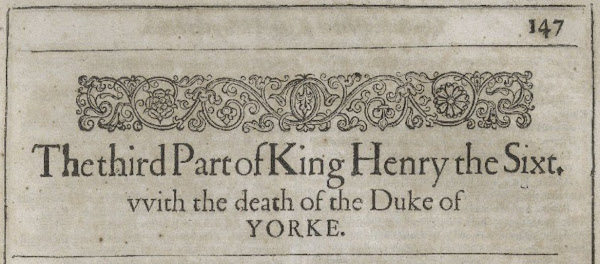
Shakespeare's Henry VI, Part 3 has five instances of "beg" and 18 of "poor." Characters often act more like the self-concerned rich man in the gospel tale than like beggar Lazarus, with the exception of Henry, who, while a weak king, is more humble than most of his nobles. [Image cropped from The third Part of Henry the Sixt, with the death of the Duke of Yorke , in the Second Folio edition of 1632, via Folger Shakespeare Library Digital Image Collection . Creative Commons.] "Poor" in this play is often used to mean "pitiable," and often sarcastically by characters who lack pity ( *emphasis* mine): 1.1 York and Lancaster factions argue about their claims to the throne. Lord Clifford is impoverished by the death of his father but also by his thirst for revenge. Warwick calls him "poor Clifford" as one might taunt an enemy: Earl of Warwick: " *Poor* Clifford! how I scorn his worthless threats!" Under duress, He...

Begging & Poor, Eve, & the Protestant-Catholic Context for 2 Henry VI

Image
A funny thing happened on the way to searching 2 Henry VI for instances of "beg" (five) and "poor" (14): [Image: From the First Folio of 1623, via Folger Shakespeare Library . Creative Commons.]  First, it is hard not to be struck by the idea that Shakespeare was writing at a time of Protestant-Catholic strife, in a divided country: He chose to write about the War of the Roses, a time when England was divided by the houses of Lancaster and York. Teachers who omit mention of this do their students a disservice. Second, in 2 Henry VI , audiences are again (as in Hamlet ) shown a variation of the theme of woman as an Eve figure, a source of corruption. In Hamlet, the prince complains about Gertrude's frailty and asks if she had a hand in killing his father; but in 2 Henry VI , Queen Margaret is having an affair with the Earl of Suffolk; if she is Eve, he is a serpent. Third, while searching for "instances of "beg" and "poor,...

Begging and Poor in 1 Henry VI, 1591-92

Image
I am still exploring instances of "beg" and "poor" in other Shakespeare plays, in light of references in Hamlet to the prince as begging or poor, and of the beggar Lazarus allusion in that play (1.5). 1 Henry VI is my focus today. Henry VI, Parts 1-3 takes up where Henry V leaves off, and is in part about the end of the Hundred Years War and the start of the War of the Roses. [Image from First Folio, File:STC 22273 Fo.1 no.68 k2v.jpg, via Folgerpedia at Folger.edu . Cropped. Fair use.] In 1 Henry VI , there are 11 instances of “poor” but only two instances of “beg.” In 4.5, John Talbot begs his father to flee, and for him to stay behind and fight to his death ( emphasis mine): Then let me stay; and, father, do you fly: Your loss is great, so your regard should be; My worth unknown, no loss is known in me. Upon my death the French can little boast; In yours they will, in you all hopes are lost. Flight cannot stain the honour you have won; But mine ...

INDEX OF POSTS on Love's Labour’s Lost

Image
INDEX OF POSTS on Love's Labour’s Lost In 2021, I did a series of posts exploring a few religious and historical themes in Shakespeare's Love's Labour's Lost , with the second post in the series also dipping into the presence of the same theme in Henry V : Begging & Poor (& Chastity & Pregnancy) in Love's Labour's Lost (1594-1597) - October 12, 2021 https://pauladrianfried.blogspot.com/2021/10/begging-poor-chastity-pregnancy-in.html Good & Grace from Evil & Sin in Love's Labor's Lost & Henry V - October 24, 2021 https://pauladrianfried.blogspot.com/2021/10/good-grace-from-evil-sin-in-loves.html Women Priests Assigning Penance in Love's Labor's Lost? - November 02, 2021 https://pauladrianfried.blogspot.com/2021/11/women-priests-assigning-penance-in.html Elizabeth I, Popes, & Ferdinando I de' Medici in Love's Labor's Lost - November 09, 2021 https://pauladrianfried.blogspot.com/2021/11/is-loves-...