Posts

Showing posts with the label Salome

Painting of John the Baptist in Shakespeare's schoolroom

Image
On Instagram, ShakespearesSchoolroom notes, "during the restoration of Shakespeare’s Schoolroom & Guildhall in 2016 a rare medieval wall painting was uncovered. Identified by experts as John the Baptiste..." [1]. Interesting to think of a young Shakespeare perhaps seeing that and other paintings of the prophet, and later naming the player queen in Hamlet as "Baptista," after the prophet who condemned the marriage of Herod Antipas to his brother's divorced wife. Also, when Jesus goes to be baptized by John at the Jordan River, John says to Jesus, *you* should be baptizing *me* - but Jesus replies, "Let be." Famous line also in Hamlet, and in Paul McCartney's song catalog. In some of the old variorum Shakespeare editions, some editors resisted the idea that "Baptista" was an allusion to John the Baptist, claiming it was merely a common female name, but Joseph Ritson (1752-1803) held his ground and said it was. Good for him. Even centuri...

Part 55: Ophelia's Overlapping Biblical allusions and plot echoes

Image
Many biblical allusions (or biblical plot and theme echoes) associated with Ophelia overlap in her character. All of these were well-known in Elizabethan times. (Not an exhaustive list): 1. Hebrews 12: 6-11 (suffering as a sign of God’s love for the “chosen” who will be “saved).[1] 2. JACOB, ESAU, AND RACHEL (lower right): the “double blessing” for Laertes, and the frustration of Hamlet and Ophelia’s hopes for a match, point to the bible tale of how Jacob wins the birthright by deceit, Esau gets the second blessing, and Jacob’s hopes to marry Rachel are at first frustrated.[2] 3. SALOME (top left): Claudius wants Ophelia and her brother Laertes to dance to his tune and serve his purposes: He uses Ophelia a bait to spy on Hamlet, and Laertes as co-conspirator to to kill Hamlet, who protests the incestuous marriage. Salome danced pleasingly for her stepfather, Herod Antipas, who offered almost any reward. His wife, Salome’s mother (divorced wife of his brother) told her to ask for the he...

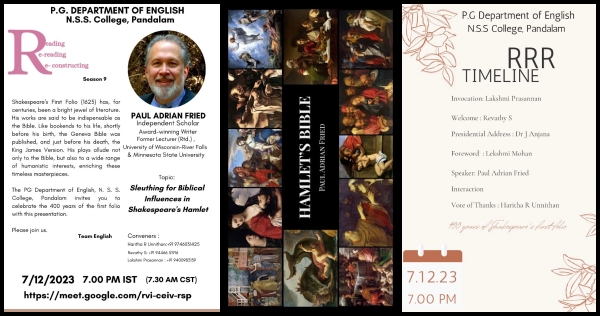
TRANSCRIPT: Presentation for Post Graduates, N.S.S. College, Kerala, India, 7 December, 2023

Image
TRANSCRIPT: Presentation for Post Graduates, N.S.S. College, Kerala, India, 7 December, 2023 Edited planned transcript of remarks delivered on 7 December, 2023, in an online presentation for the Post Graduate program, N.S.S. College, Kerala, India, 7 P.M. IST, 7:30 A.M. CST. (A few words and points below were cut from the live presentation for time considerations, and I made a few additional extemporaneous remarks, but for the most part, this is the transcript.) (I did not have time to talk about allusions that fit into the theme of orphaned children who find transcendent parents in others or in a heavenly parent, but perhaps some other time....) ~~~~~~~~~~~~~~~~~~~~~~~~~~~~~ Informal outline (followed by transcript): INTRODUCTION: [Disclaimers] - Contested times, contested scripture LIST OF BOOKS cataloging Bible allusions in Shakespeare, some open-access: Sleuthing scripture allusions in Hamlet CHANGE THOSE NAMES WITH YOU: Servant-Prince, & Renunciation of Fruits DOUBTING ...

Jewell's Homily V & Lazarus-Hamlet-Claudius Correlations (part 12 in Lazarus series)

Image
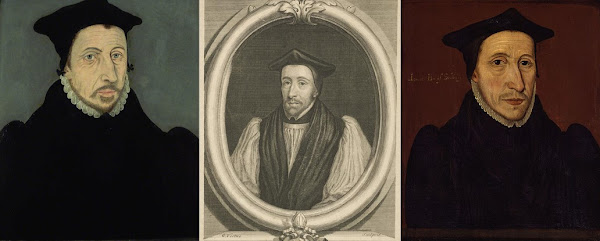
Two Early Modern texts - each in their own ways well-known in their time - both touch upon all the following themes: adultery, lust, drunkenness, selfish ambition, sedition, envy, murder, incest, madness, and poison. They also allude to the following historical or Biblical-mythical characters: Alexander the Great, Herod John the Baptist The Beggar Lazarus and the selfish rich man The Serpent in the Garden Adam Cain King David St. Bernard of Clairvaux What are those two Early Modern texts? If you guessed (1) Homily V. from Book II of the official English Church homilies, "Against Gluttony and Drunkenness" (usually attributed to John Jewell), and (2) Shakespeare’s Hamlet , you are correct. The general idea in the homily is that any excess pursuit of pleasure in sex, food, or drink, is sinful, while all the things Christians receive as gifts from God in a spirit of thanksgiving and moderation are good. (Jewell might therefore disagree with Mae West, oft...