Posts

Showing posts with the label Paris

Hamlet's Use of the Trojan War & Consequences of the Judgment of Paris

Image
Why does Shakespeare’s “Hamlet” refer to the Trojan war? Some may think that Trojan War references in Shakespeare merely represented a Renaissance obsession with things Greek. But the Trojan War speech in Hamlet also alludes to (1) a Greek-themed Marlow play [1]; (2) the widow Hecuba’s grief [2] (a contrast with Gertrude); (3) the pause of Pyrrhus (like Hamlet hesitating to kill Claudius at prayer) [3]. When the players arrive in Elsinore and perform a speech at Hamlet’s request, he asks for a speech about Hecuba, mother of Paris, witnessing the revenge killing of her husband, King Priam. Priam is about to be killed by Pyrrhus, son of Achilles, in revenge for Priam's son Paris having killed Pyrrhus’ father. Revenge begets revenge and more grieving widows, a terrible cycle. Appropriate for Hamlet. “The Judgment of Paris” involves Paris having to choose the fairest goddess. Each goddess offers bribes, with Aphrodite promising Helen of Troy. Paris chooses Aphrodite, and soon abducts ...
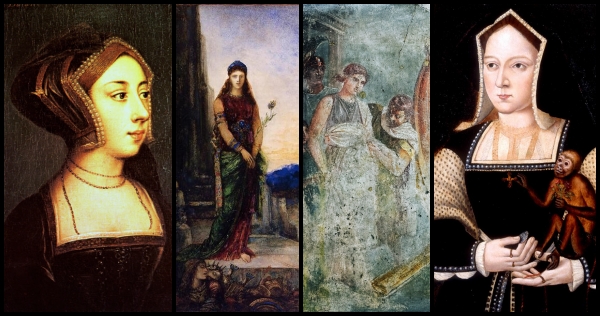
Part 41: Love Madness: Ophelia, Gertrude, and Helen of Troy

Image
QUEEN: [...] for your part, Ophelia, I do wish That your good beauties be the happy cause Of Hamlet’s wildness. So shall I hope your virtues Will bring him to his wonted way again, To both your honors. OPHELIA  Madam, I wish it may.  (3.1.42-47)   Queen Gertrude expresses hope that Ophelia’s father Polonius may be correct in thinking that Hamlet is mad for the loss of Ophelia’s love. Shakespeare often described love as a madness in need of a cure.[1] This may be more significant than one might assume at first glance, for at least three reasons.   First, Gertrude’s comments apply not only to her son but also to her new husband, even if she doesn’t know it. For Claudius to kill his brother and take the throne and his brother’s wife seems a kind of madness. Gertrude’s “virtues” were not enough to cure him. Secondly, “The face that launched a thousand ships” is the famous Christopher Marlowe line describing the beauty of Helen of Troy. To steal her, Paris risked war, w...