Posts

Showing posts with the label James I

Pondering Polonius, again

Image
JSTOR Daily recently published a piece called “In Defense of Polonius,” which is a little misleading in its title and subtitle: “Shakespeare’s tedious old fool was also a dad just doing his best” (15 June, 2022). [1] The article admits that in Shakespeare’s Hamlet, Polonius is a poor father figure, but argues that the role is not only a good one, but an essential one to the play. I agree on that point. The article is by Jeffrey Wilson, also the author of an article I shared a few days ago which explored how today, Claudius would probably be considered an alcoholic. [2] In this 15 June piece, Wilson notes that Polonius apologizes twice, perhaps more convincingly the second time. And yet he softens the effect of the second apology by putting his own mistake in a larger context of mistakes often made by the young: “I am sorry that with better heed and judgment I had not quoted him. I fear'd he did but trifle And meant to wrack thee; but beshrew my jealousy! By heaven, it i...
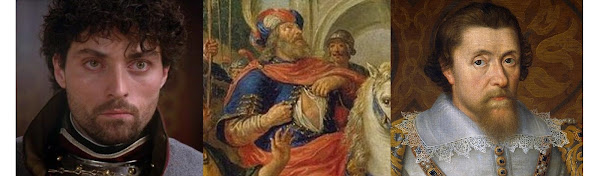
Fortinbras, Jephthah, James: Stealthy, Allusive Triangulation (a Jephthah Postscript)

Image
One of the most astonishing revelations for me during my limited recent research on the Jephthah allusion was how many correlations there were between many aspects of the Jephthah plot, and the character of Fortinbras. There is no literal sacrifice of a daughter, but hints of other kinds of sacrifice. Other scholarship on the Jephthah allusion in the play tends to focus on Polonius, the object of Hamlet's Jephthah remarks, or on unholy vows and the consequences to Ophelia. Some considers the hasty or unholy vows of other characters such as Hamlet or Laertes. But Shakespeare scholars have also noticed correlations, not only between Prince Hamlet and James VI and I of Scotland and England, but also between Fortinbras and James. So if Fortinbras points at least in part toward James, and also to Jephthah, was Shakespeare in a sense predicting that James was an ambitious Jephthah-type, the kind one could imagine sacrificing one of his children on the altar of his ambition? This see...

Hamlet's "Let be": More Jesus to John Baptist than Virgin Mary to Gabriel?

Image
IN OUR LAST EPISODE I recently shared a blog post around the time of the Epiphany , reflecting on how Shakespeare's play, Twelfth Night, is named after the last of the twelve days of Christmas, and how Twelfth Night is the night before the feast of the Epiphany. Epiphany Sunday usually falls one week before the feast of the Baptism of the Lord, which was last Sunday. THIS WEEK: SOMETHING MISSING? A year and two months ago, I shared a blog post about Hamlet's repeated line, "Let be." While Hamlet's "Let be" is similar to what the Virgin Mary says to Angel Gabriel at the Annunciation, telling her she will bear a son conceived by the Holy Spirit, it's not exactly the same. Also, there's a different "let be" in the gospels that offers a closer or exact match: This occurs when Jesus goes to be baptized by John the Baptist. Two years ago, I thought it may have been mostly an allusion to Mary's words, but with a nod toward John...

(Part 13) Does Fortinbras Benefit from Gratitude or Regret (or is he more a cipher for James VI & I)? Labors of Gratitude and Regret in Hamlet

Image
This is the latest installment in a multi-part series examining how characters interact in Hamlet, offering opportunities, gifts, planting seeds for future inspiration, or for changes of heart & mind. It follows ideas from Lewis Hyde (“The Labor of Gratitude,” a chapter in his book, The Gift: Imagination and the Erotic Life of Property) . For more notes on the series and an index of previous posts in this series, see the end of this post. ~~~~~~~~~~~~~~~~~~~~~~~~~~~~~~~~~~~~~~~~~~~~~~~ [Rufus Sewell as Fortinbras in Hamlet , directed by Kenneth Branagh (1996] Does Fortinbras Benefit from Gratitude or Regret (or is he more a cipher for James VI & I)? (part 13, Labors of Gratitude & Regret in Hamlet ) ~~~~~~~~~~~~~~~~~~~~~~~~~~~~~~~~~~~~~~~~~~~ Postscript: Also see my post from a year and two months later than this one, regarding Fortinbras as a remarkable Jephthah figure, if one pays attention to the details of the biblical Jephthah tale: https://pauladrianfried.b...

Thinking about Hamlet, James I, Moses, & Elections with Julia Reinhard Lupton

Image
I am realizing that, more often, I should highlight some of the books I've enjoyed and benefitted from regarding Hamlet studies. One of these recently is called Thinking with Shakespeare: Essays on Politics and Life , by Julia Reinhard Lupton , and more specifically, her chapter called "The Hamlet Elections." Lupton begins the chapter explaining how she is borrowing some ideas from Carl Schmitt, including ideas about similarities between Hamlet the prince and James the king. She also explores a variety of meanings and implications of the word "election" in the play, and discusses Hamlet's first meeting with the ghost as a dark retelling of Moses going up on the mountain to receive the law from God (Hamlet says he will erase all else from the tables of his memory and remember only what the Ghost has told him). Moses Breaking the Tablets of the Law - 1659, by Rembrandt, via Google Cultural Institute I have mentioned in the past on this blog the possib...