Posts

Showing posts with the label Penelope

INDEX: Holding up The Odyssey as mirror in Hamlet

Image
From August 4-23, 2022, I did a series exploring how Shakespeare seems to have had The Odyssey in mind when he named Ophelia's brother Laertes (the father of Odysseus also had that name): In the same way that the family of Odysseus tries to defend his wife Penelope against suitors while he is away at war, Polonius and Laertes try to defend Ophelia against suitors. This was prompted in part by Asimov's book on Shakespeare, in the section on Hamlet , where he briefly mentions this name, Laertes, which stand out like a sore thumb, and which does not sound very Danish. Below is the INDEX to these posts: 1. Laertes in Hamlet & the Odyssey - Part 1: https://pauladrianfried.blogspot.com/2022/08/laertes-in-hamlet-odyssey-part-1.html 2. Laertes in Hamlet & the Odyssey - Part 2: https://pauladrianfried.blogspot.com/2022/08/laertes-in-hamlet-odyssey-part-2.html 3. Seeking Penelope in Ophelia & Hamlet: Laertes & The Odyssey - Part 3: https://pauladrianfried...
Hamlet's Nietzschean madness, via M. Grenke - Hamlet & the Odyssey - Part 5

Image
Perhaps one way to view the corruption in Denmark in Shakespeare's Hamlet, and to view Hamlet's madness as well, is that it has to do with slavery to time and to impatience. As I mentioned in my previous post, Hamlet makes some of his worst mistakes (killing Polonius), not because he delays, but because he is impatient. Claudius kills his brother, not only because he wants the throne, and wants Gertrude for his wife, but because he is impatient. Michael Grenke's Fall 2016 essay, “Penelope: The Odyssey’s Creative Thinker,” includes rich reflections on the character of Penelope from Homer's Odyssey, and about Nietzsche and the madness of impatience, or slavery to time. I would suggest that Hamlet feels a similar pressure and impatience about revenge due to images of masculinity that he has learned from his father and his culture, and which he has internalized. Grenke writes: ~~~ Human beings become slaves to the clock mostly because other human beings put them on...

Hamlet's Delay, Penelope's Weaving, via M. Grenke - Hamlet & the Odyssey - Part 4

Image
Many people ask regarding Shakespeare's Hamlet , "Why does the prince delay for so long to kill Claudius?" In a number of places in the play, Hamlet scolds himself for delaying his killing of Claudius. These include his "To be or not to be" speech (3.1.64-96), and also in his speech, "How all occasions do inform against me" (4.4.34-69). In 2.2 (577-634), he is especially harsh with himself. By the end of the speech, he weaves his way to a solution. He is held back by conscience: He wants wants to be more sure that Claudius is guilty of murder, and that the ghost is being honest. In the fall of 2016, Michael Grenke published an article about the character of Penelope from Homer's Odyssey, and about the significance of her patient weaving and unweaving. [1] Some scholars [2] have suggested that Hamlet is right to delay, and at his worst when he impatiently scolds Ophelia, worried perhaps for her eternal fate, telling her to get to a nunner...

Seeking Penelope in Ophelia & Hamlet: Hamlet & The Odyssey - Part 3

Image
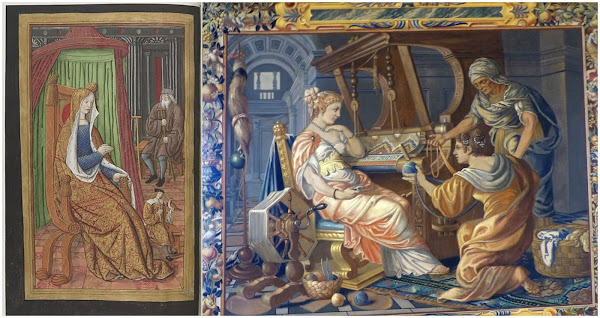
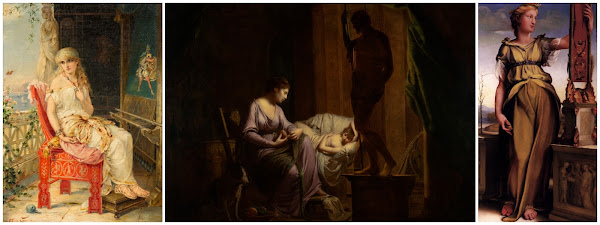
In The Odyssey, the weaving of Penelope, as a ruse to avoid her 108 suitors* later seems to find parallels not only in Ophelia and her sewing and reading, but also in Prince Hamlet. (Penelope and others fending off 108 suitors makes me think of the Buddhist idea of the importance of quieting the "monkey mind" of distractions!) Katherine Goodland has noted: Polonius wants Ophelia reading, to look like common images of Mary at the Annunciation. ( See this post .) [1] So now we have to think loosely, of Ophelia as associated in her sewing with Penelope, and in her reading, with Mary at the Annunciation; In a way, we might consider Penelope's weaving as a kind of compromised involvement with the world (to fend off suitors) and then a kind of prayer or repenting (unweaving, undoing the work), but also a kind of scheming for survival. Hamlet and Ophelia both have rhythms of compromised involvement in their world, followed by types of repenting or undoing: They weave...

Laertes in Hamlet & the Odyssey - Part 2

Image
Can anyone recommend good books or articles that explore connections between Laertes in Hamlet and Laertes in The Odyssey ? Yesterday (8/4/2022) I posted about Shakespeare’s choice of the name Laertes for the son of Polonius . [1] (If that link doesn't work, try here: https://pauladrianfried.blogspot.com/2022/08/laertes-in-hamlet-odyssey-part-1.html ) I observed: - in The Odyssey , Laertes and his funeral shroud are the alleged excuse Penelope uses for fending off suitors; Laertes helps Odysseus deal with the families of Penelope’s suitors; - in Hamlet, Laertes and Polonius fend off Hamlet as suitor for Ophelia, and fend off Ophelia as love interest for Hamlet, perhaps similar to the way William Cecil and other advisors micromanaged suitors for Elizabeth, preferring foreign princes over domestic suitors; - like Penelope at her weaving, Ophelia is at her sewing when Hamlet visits her in her closet, perhaps disguised in feigned madness; - like Odysseus disguised as beggar...

Laertes in Hamlet & the Odyssey - Part 1

Image
Federico La Sala recently reminded me that the name Laertes in Hamlet comes from Homer's Odyssey. [1] I am grateful to him for pointing me in this direction. Allusions for Shakespeare are usually not all-encompassing, and don’t align on every point, but seem chosen for what limited light they shed. I usually focus on biblical allusions, but here’s a detour (some possible Odyssey allusions or influences): 1. DEFENDER OF WOMEN AND PRINCES: ODYSSEY: Laertes defends Penelope, wife of his son Odysseus (gone 20 years), from suitors who believe he is dead. HAMLET: Laertes defends his sister from a possible affair with Prince Hamlet, and defends the prince, in case Hamlet must marry to secure a foreign alliance (1.3). (Polonius is widely believed to be a satire of William Cecil, and therefore Laertes may be a satire of his son Robert Cecil, who became a key advisor to Elizabeth even before his father's death; to call a satire of Robert Cecil "Laertes," may be the ...