Posts

Showing posts with the label pricked on by emulate pride

HAMLET & the FIRST COMMANDMENT: Satan & Pride, Worst of Sins - Series

Image
The First Commandment, "THOU SHALT HAVE NO OTHER GODS BUT ME,” doesn’t mention pride, but Christian tradition considered it to be like playing god, the worst of the seven deadly sins from which the others proceed [1].  By apocryphal tradition it was the sin of Satan and the fallen angels, who in their pride believed they were equal to God or might usurp God’s throne [2].  KING HAMLET & OLD FORTINBRAS: Horatio in 1.1 notes pride: […] our last king, [...] Was, as you know, by Fortinbras of Norway, Thereto pricked on by a most emulate *pride,* Dared to the combat… (1.1.92-96)  King Hamlet was “Dared to the combat”; instead of humbly urging peace instead of violence, “pricked on by… emulate pride,” he accepted the challenge and killed the Norwegian king, both of them gambling their lives and sons’ inheritance – and the future of their countries – on pride.  No “sealed compact,” “law” or “heraldry” (1.1.98-101) can excuse this sin of pride, and it may be among t...

What does it mean that Hamlet defies augury?

Image
In the final scene, why does Hamlet tell Horatio, “We defy augury” [1]?  Hamlet refers to scripture often in this part of the scene - “The readiness is all” [2], “the fall of a sparrow” [3]. But augury? What might that have meant to Elizabethan audiences?  Generally, augury is related to the belief in omens and signs, as mentioned by Horatio in the first scene of the play when he speaks of omens in Roman graveyards and in the heavens,  “the like precurse of feared events, As harbingers preceding still the fates And prologue to the omen coming on”. [4]  Augury in the story of the founding of Rome involved Romulus and Remus observing birds to determine fate or the will of the gods: The two had survived their great uncle’s attempt to drown them (and are adopted by a she-wolf, perhaps as Laertes is figuratively adopted and manipulated by Claudius?); they argued about where to locate the city. They decided to use augury to settle the dispute, but still argued about the ou...

Part 34: Why Gertrude personifies the envious sliver of willow (Interlude D.1)

Image
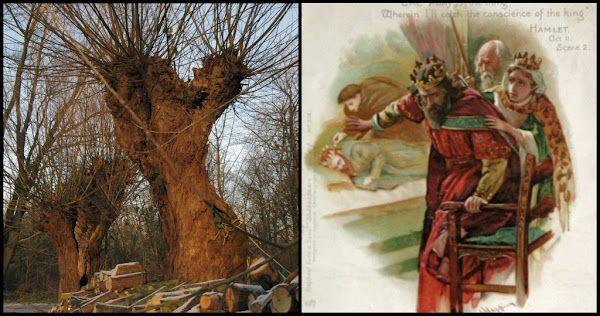
The fact that Gertrude personifies the sliver of willow that sends Ophelia to her death is curious and deserving of more attention. She says an envious sliver breaks [1], sending Ophelia into the water — meaning that it was not Ophelia’s choice to set in motion the events that would lead to her drowning, but that these were caused by an act of envy by something outside herself. Why envious? Envious that it was not given a floral crown (“coronet”) [2] like other branches. Tree branches or slivers can’t feel envy, so Gertrude’s personification of the sliver as “envious” implies a belief that human envy was ultimately the cause of Ophelia’s drowning. Who in the play was envious of another’s crown? - Primarily Claudius, who poisoned his brother, usurped the throne and stole his brother’s wife.[3] Ophelia had bestowed crowns on branches and triggered the envy of one “sliver”; she could have been Hamlet’s wife and borne him another heir, helping to bestow that heir’s crown. What does this en...