Posts

Showing posts with the label suspicion

Part 46: In Gertrude's final choices, Ophelia lives on

Image
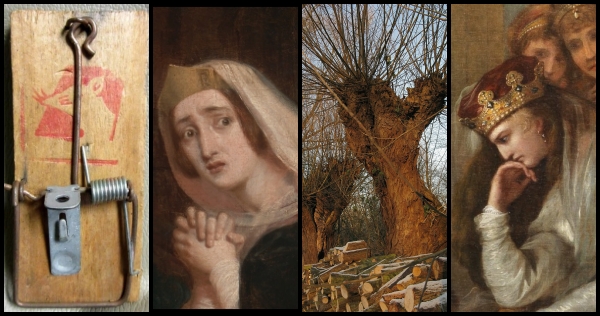
Ophelia and Hamlet influence Gertrude's final choices; they live in her: If we have followed Gertrude’s progress closely (allowing her to be at least as intelligent as the men in the play), we might note: She may have been deceived to marry Claudius, and done so as much for the safety of Denmark facing a threat from Norway [1], as for lust (contrary to what her son and the Ghost say [2]). She understands her son’s “Mousetrap” and its implications: Claudius poisoned his brother and wooed his brother’s wife [3]. Hamlet’s scolding in her closet has “cleft [her] heart in twain” [4]. She feels guilty facing Ophelia after her father’s death and her reported madness [5]. She reports Ophelia’s death not as suicide, but as an accident caused by crown-envy: the breaking of a sliver of willow envious for a crown [6], hinting at Claudius as the ultimate cause [7]. She probably suspects that Claudius poisoned the cup when dropping in a pearl and asking Hamlet to drink [8]. But she can’t know fo...

Part 40: Ophelia, Gertrude, and the Purgatory of Scholarship

Image
Consider how the impulse behind male resistance to women’s suffrage may have also manifested itself in male scholarly bias about Ophelia and Gertrude. If one feels women are too emotional, not rational enough to deserve to vote, how might that color one’s reading of Ophelia’s madness and drowning, and of Gertrude’s decision to drink from what Claudius knows is a poison cup, intended for Hamlet?  Women were not admitted to study at Oxford until 1920, and did not get the vote in England until 1918. (In other words, women have only had the vote in the UK for 100 years, out of four centuries of Shakespeare; and the vote is only one of many possible indicators of male bias.) It is easy to imagine average male literary critics writing off Ophelia’s many lines in Act 4, scene 5, as simply mad ravings, rather than finding any method in her madness; easy to imagine them missing how she acts like a court fool [1], or like Hamlet’s promised, handfast wife and queen regent in his absence [2]...

Part 36: Gertrude builds a better mousetrap for Claudius (Interlude D.3)

Image
In Hamlet 5.2, Gertrude suspects poison, [1] but doesn't know for certain — a dangerous mystery: she avoids openly accusing Claudius. This scene is a variation of King Aegeus, saving son Theseus from a poison cup from stepmother, Medea — with some genders switched and stakes raised.[2] Gertrude will test the wine by drinking it, without saying that is her reason for doing so. In this she sets a better, simpler mousetrap for Claudius: If it is poison, he could stop her and confess. If not, maybe “mad” Hamlet was mistaken about Claudius? Hamlet’s “Mousetrap” foreshadows (and sheds light on) Gertrude’s. She cannot pluck the mystery’s heart without drinking from the cup to test it, and to test Claudius. By drinking, in effect, Gertrude tells Claudius: If you would poison my son, you must go through me first. In her closet, Hamlet had told her that he would later beg a blessing of her [3]. Testing the wine for poison is the blessing she offers her son, without his having to ask. This ...

Part 35: Why Gertrude likely suspects a poison cup (Interlude D.2)

Image
Why might Gertrude suspect a poison cup in Hamlet 5.2? 1. In 3.2, she saw The Mousetrap, arranged by her son, showing a man poisoning a king, then wooing his victim’s widow. The analogy implies that Claudius poisoned King Hamlet to usurp the throne and marry Gertrude. Gertrude tells Hamlet in her closet that the play “much offended” [1] Claudius, meaning they understood perfectly what Hamlet implied that Claudius had done. 2. Hamlet makes this more clear in his mother’s closet, and Gertrude says, O Hamlet, speak no more! Thou turn’st my eyes into my very soul, And there I see such black and grainèd spots As will not leave their tinct.[2] Gertrude knows she is caught up in the sins of her envious, murderous, usurping husband. 3. Just before she speaks to Ophelia in 4.5, Gertrude says, “To my sick soul (as sin’s true nature is), Each toy seems prologue to some great amiss. So full of artless jealousy is guilt, It spills itself in fearing to be spilt.[3] Gertrude fears to spill the secret...

Part 34: Why Gertrude personifies the envious sliver of willow (Interlude D.1)

Image
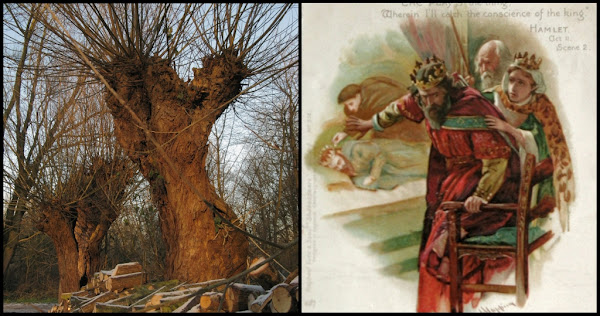
The fact that Gertrude personifies the sliver of willow that sends Ophelia to her death is curious and deserving of more attention. She says an envious sliver breaks [1], sending Ophelia into the water — meaning that it was not Ophelia’s choice to set in motion the events that would lead to her drowning, but that these were caused by an act of envy by something outside herself. Why envious? Envious that it was not given a floral crown (“coronet”) [2] like other branches. Tree branches or slivers can’t feel envy, so Gertrude’s personification of the sliver as “envious” implies a belief that human envy was ultimately the cause of Ophelia’s drowning. Who in the play was envious of another’s crown? - Primarily Claudius, who poisoned his brother, usurped the throne and stole his brother’s wife.[3] Ophelia had bestowed crowns on branches and triggered the envy of one “sliver”; she could have been Hamlet’s wife and borne him another heir, helping to bestow that heir’s crown. What does this en...

Part 33: A Suicidal Gertrude (Interlude C)

Image
[In an earlier post , I mentioned four contrasting interpretations of Gertrude, the third being a suicidal Gertrude as portrayed by Lia Williams in a 2018 BBC production with Andrew Scott as Hamlet, dir. Icke. This post considers that third reading of Gertrude.] Some consider Gertrude drinking the poison cup in Hamlet 5.2 as an act of suicide. But for it to be suicide, Gertrude at least needs to suspect that the cup has been poisoned: If she is ignorant of poison and unsuspicious, it cannot be suicide; a reaction of surprise would then make sense. If she merely suspects and is testing the cup for poison intended for her son, an act of risk and selflessness, it is not strictly suicide.[1] For suicide as sole intention, she must not merely suspect, but know for certain that the cup has been, poisoned. The texts of the play do not support certainty for Gertrude that the cup has been poisoned: Claudius and Laertes conspired about the poison apart from her; she had no way of knowing. But a...