Posts

Showing posts with the label Eucharist

GOD'S BODYKINS: Hamlet and the THIRD COMMANDMENT (series)

Image
GOD'S BODYKINS: Hamlet and the THIRD COMMANDMENT (series) What is Hamlet really implying when he says to Polonius, "God's bodykins, man, better!" (2.2) Polonius was going to arrange for lodgings for the players, and says he will seek in the castle for some kind of lodgings they deserve. Hamlet says, "better!"  But "God's bodykins"?  The etymology of “bodykins” may be read as “God’s little bodies” (from the English word “body” plus the middle dutch “kins” for “little” [1]).  In other words, Eucharist. Another "minced oath."  In Shakespeare's time, God's little bodies implies Eucharist, or those who have received it and are members of Christ's mystical body [2].  Consider:  If Hamlet is saying to Polonius,  "Eucharist, man! Treat the players better than you think they deserve!"  this is like saying,  “Polonius, remember Eucharist! All of us here, including the players, have at one time or another received the Euc...

John Drakakis on quasi-religious veneration of Shakespeare

Image
HAMLET  A man may fish with the worm that hath eat  of a king and eat of the fish that hath fed of that worm. KING  What dost thou mean by this? HAMLET  Nothing but to show you how a king may go a progress through the guts of a beggar. (4.3.30-35) (Some say this sounds like a threat, from Hamlet to Claudius; but it's also more simply a reminder to Claudius of his mortality....) In Shakespeare’s time, Protestants and Catholics still debated Eucharist. - Catholics are taught that in the prayers of the Mass, the Eucharistic bread becomes the “body of Christ,” but that this is not cannibalism. - Lutherans are taught that the bread becomes Christ but also remains bread, a position too Catholic for Calvin. - Calvinists believe those who eat of the Eucharistic received Christ spiritually, not physically. - Protestant polemics made fun of this, observing that if a church mouse ate crumbs of Catholic Eucharist, it would be ridiculous to claim that Christ, King of heaven, “m...

Eucharistic Allusions in Hamlet

Image
UPDATED 1 April, 2026: In Shakespeare’s time as now, the Thursday before Easter (2 April 2026 this year) commemorates the Last Supper [1]. There are many references in Hamlet to the stuff of Eucharist services, or echoes of the Catholic and Protestant ritual commemoration of the Last Supper. These include the following: After Barnardo asks “is Horatio there?” Horatio replies, "A piece of him." Elizabethan Protestants satirized Catholic Eucharist in similar terms: Which piece of Jesus did you get? [2]). The ghost says he died “Unhous'led,” not having received Eucharist in the Last Rites [3]. He says “Adieu, adieu, adieu. Remember me.” Jesus at the Last Supper: “Do this in memory of me.” [4] Polonius curses (“by the Mass”). This would have been considered blasphemous [5]. When Polonius is inclined to be ungenerous with the players, Hamlet replies, “God’s bodykins, man! Much better!” Some claim that “God’s bodykins” means “Christ’s little bodies,” Eucharist, or all who rece...

Does Shakespeare’s Hamlet depict religiously shaped or motivated regicide?

Image
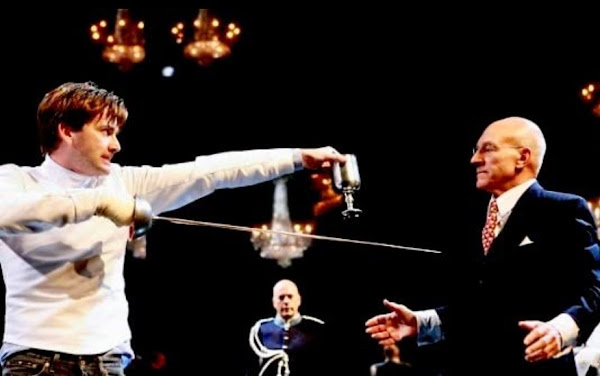
Does Shakespeare’s Hamlet depict religiously shaped or motivated regicide? [1] Given its many religious and biblical allusions and plot echoes, I would argue that it does. [David Tennant (L) as Hamlet and Patrick Stewart (R) as Claudius in the 2009 film, Hamlet , dir. Gregory Doran. Source: IMDB . Fair use.] Dr. Arthur F. Marotti gave a talk at Fordham in late October of 2013 in which he noted, “In the last years of Elizabeth’s rule people believed something was rotten in England—though perhaps not rotten enough to justify regicide. ” [2] Marotti has written numerous books [3] about Early Modern literature and religion, including a 2004 essay with Ken Jackson on “The Turn to Religion” in Shakespeare studies. In an abstract for a more recent (2017) essay [4], Marotti notes that “Shakespeare's plays may not stage religiously motivated regicides…,” with “may” being the operative word here: Scholars may disagree on this point. But what about Hamlet? Recognizing that H...

The Black Rubric and Hamlet’s Feminizing of a Distant, Indifferent Divine

Image
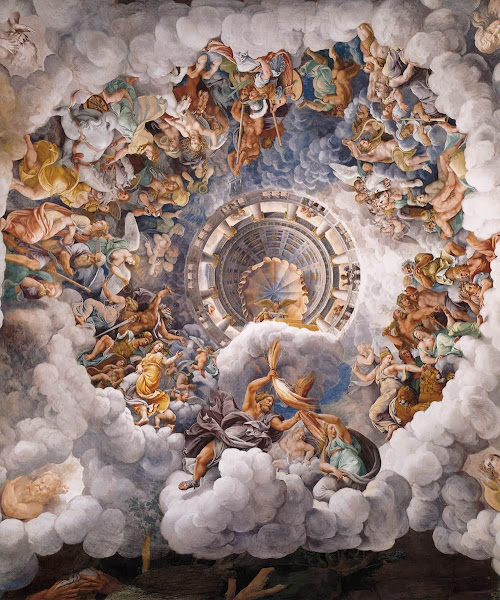
Consider two moments in Hamlet when it is made explicit: Maybe God is not paying attention to human suffering? THE FIRST is when the First Player tells the revenge tale of Priam’s death at the hands of Pyrrhus (2.2). Hecuba, Priam’s wife, watches. [See note #1 below: "Who in Shakespeare's England was like Hecuba, witness to a brutal killing of a loved one?"] The First Player says that the “synod” of the gods (like bishops and cardinals?) should take away the powers of the goddess Fortune (like an excommunicated Elizabeth I?), breaking her wheel, and “bowling” her “down the hill of heaven, / As low as to the fiends!” First Player: But if the gods themselves did see her [Hecuba] then, [/...] The instant burst of clamour that she made (Unless things mortal move them not at all) Would have made milch [milk] the burning eyes of heaven.... [In a fresco (circa 1532-1534) by Giulio Romano (1499–1546), the image above depicts the gods overcoming the titans. Public ...

Where's the body? Kings, Beggars, Worms, Excrement, Eucharist, Buddha Bunny, and Lazarus in Hamlet 4.3 (part 17)

Image
In Hamlet 4.3, Claudius is disturbed that Hamlet, for some inexplicable reason, has hidden the body of Polonius. Perhaps a main reason is to allow for some fascinating dialogue between Hamlet and Claudius about bodies, supper, worms, kings, and beggars, and to hint at more than this, regarding the Diet of Worms, and perhaps about Eucharist. The dialogue sounds a bit like a "Who's on First?" comic skit by Abbott and Costello: [Image from 1950s recording via Amazon.com , cropped. Fair use.] King: Now Hamlet, where's Polonius? Hamlet: t supper. King: At supper? Where? Hamlet: Not where he eats, but where 'a is eaten. A certain convocation of politic worms are e'en at him. Your worm is your only emperor for diet. We fat all creatures else to fat us, and we fat ourselves for maggots. Your fat king and your lean beggar is but variable service: two dishes but to one table. That's the end. King: Alas, alas! Hamlet: A man may fish with t...