Posts

Showing posts with the label Holy Thursday

INDEX: Hamlet and Holy Week Bible Allusions

Image
This week (April 16, 2022) I've been posting about allusions in Shakespeare's Hamlet to various biblical passages and traditions associated with what Christians call "Holy Week," which begins with Palm Sunday and ends with Easter Sunday. I’ve compiled this post from my previous posts about Holy Week allusions and plot echoes in Hamlet. (Updated, 2026.) Some of these are clearly allusions in a traditional sense; Others are plot echoes, as with the Jonah echoes in Hamlet’s sea voyage. Others involve how the play appeals to what the national religion(s) conditioned playgoers to think and feel about certain elements, such as “They know not what they do,” or Gertrude’s “Veronica complex,” wiping the face of Hamlet… This blog post contains links to the following posts. In summary: ~~~ PALM SUNDAY: Hamlet's Palm Sunday Allusion & Cognitive Dissonance: "preaching to stones, Would make them capable." [Image: Pietro Lorenzetti (1280–1348), Untitl...
Hamlet, Footwashing, Maundy Thursday, Hobbits, and Revelation

Image
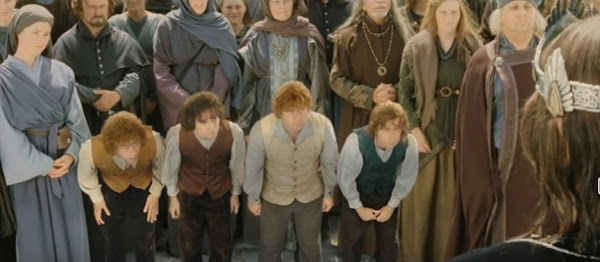
Echoes of Maundy Thursday in Hamlet (and Hobbits): [Image: Screen capture from YouTube clip of The Lord of the Rings: The Return of the King (2003), directed by Peter Jackson, Warner Bros. based on the book by J.R.R. Tolkien. Fair use.] [UPDATED 26 March, 2026] Maundy Thursday (or Holy Thursday, 2 April, 2026) begins what the Catholic Church calls the Triduum (Paschal or Easter Triduum).  “Maundy” comes from the Latin word for “command,” so Maundy Thursday gets its name from the Latin words once used at the opening of the Thursday service during Holy Week, and the gospel in which Jesus commands his disciples to love and serve others as he loved and served them.  It includes a ritual remembrance of Jesus washing the disciples’ feet  (John 13:1–17), with Jesus “New Commandment” to love and serve, an idea used by (sometimes antisemitic) Christians to differentiate from the Ten Commandments of Moses. [1] There are echoes of this in Hamlet 1.2, when Horatio enters, he has t...