Posts

Showing posts with the label Allusion

Shakespeare's Hamlet, Sydney, and Allusion as cultural conversation

Image
How do we understand an allusion, such as Shakespeare's Hamlet using a play to catch the conscience of the king, like the prophet Nathan catching the conscience of King David? Especially after the New Critics, the "death of the author," and disillusionment with “old historicism,” there was a tendency to ignore many aspects of historical-cultural contexts in favor of only what is immediately clear in the text. This may have seemed a more objective, even empirical approach: If the text doesn't say "Nathan" or "David" or "Bathsheba," or use the same phrasing as the Bible, shall we assume there is no such biblical allusion present? The more subtle the allusion, the more reason to doubt it? What if we know that many other writers in Shakespeare's time were alluding to or retelling the David story? Did that allow for a kind of shorthand in making allusions? Last week’s post [1] noted that Shakespeare didn't always have to be explicit;...

Jonah swallowed by Fish, Hamlet by Pirate Ship, Christ by Tomb

Image
Years ago, prompted by a student question, I noticed that Hamlet’s westward sea-voyage toward England - and change of mode of transportation mid-sea - was like Jonah’s. I thought others had probably noticed and considered this at length, but never found any. Hannibal Hamlin notes that a popular play, “A Looking Glass for London and England,” featured the prophet Jonah [1] (performed when Shakespeare was with The Lord Strange's Men), and that Elizabeth I named one of her ships Elizabeth Jonas, with a speech that (strangely?) read the Jonah story as a triumph over enemies [2]. Two gospels quote Jesus speaking of the “sign of Jonah” [3]. English citizens were required to attend church, and would have heard these every year of their lives [4]. Many people only know that Jonah was swallowed by a fish. Fewer know that, even after being saved from the fish’s belly, Jonah would rather witness the destruction of Nineveh than see them repent and be saved by God’s mercy. Dennis Taylor notes t...

Claudius and his Mini-Me in Hamlet and Chaucer (Claudius series, Part 14)

Image
In Part 4 of this series [1] I noted that Chaucer in “The Physicians Tale” has a lecherous villain named Appius Claudius who desires a young woman who has no interest in him, and who with his servant (also named Claudius) schemes to make her his slave [2]. The repetition of the name Claudius may imply both that the servant is like a fawning courtier, and that Appius Claudius was vain to hire a servant who shared his name. The villain-with-a-sidekick is a tradition also tapped into by the Austin Powers spy-comedy, Goldmember, with its villain, Dr. Evil, who has a sidekick Mini-Me (played by Verne Jay Troyer) [3]. I mentioned in Part 4 that scholars note the influence of Chaucer in as many as nine Shakespeare plays [4]. So it’s clear that Shakespeare knew Chaucer’s work. But did he know of Claudius-times-two in that tale? It would be easier to believe that he did, and was indicating so in Hamlet, if only he had included some servant of Claudius who was also named Claudius.... Hmmm.... ...

Bullough, Jenkins, Asimov on Claudius as changed name of Hamlet's uncle Feng (Part 13, Claudius series)

Image
Geoffrey Bullough (1957-1972), Isaac Asimov (1970), and Harold Jenkins (1982) all noted Shakespeare having changed the name of Hamlet's uncle “Feng” to “Claudius”: Asimov: "The reigning King of Denmark, who has succeeded the elder Hamlet[...] is Claudius. Shakespeare has chosen an aristocratic Roman name for the purpose. (It was the name of a patrician family in the time of the Republic and one from which several of the early emperors were descended—including Claudius, the fourth Emperor, under whom Britain was conquered in the years following Cymbeline's death.[1]) In Saxo Grammaticus' original tale, the new King was named Feng, and perhaps Shakespeare did well to change that." (87)  [2] Jenkins: "The King's name is knows from his first entry-direction and first speech-heading, after which, however, it is never used again."  [3] Jenkins continues: "It was evidently suggested by that of the Roman emperor who married Agrippina, his niece and th...

Claudius, Hamlet, and Nero, roads diverging in allusive woods (Part 12, Claudius series)

Image
Hamlet's relation to his step-father, King Claudius, and Nero's to *his* step-father, Claudius I, offer key similarities and contrasts: Many note that Hamlet in 1.2 dislikes Claudius calling him "son" so soon after his father's death. Memorable lines: KING ... But now, my cousin Hamlet and my son— HAMLET [aside] A little more than kin and less than kind. KING How is it that the clouds still hang on you? HAMLET Not so, my lord; I am too much in the sun. (1.2.66-69) “Cousin" in Shakespeare's time could apply loosely to a nephew. "...too much in the sun." [son - pun] Although the name is not spoken in the play, in the 1604 Second Quarto and later editions, at the start of 1.2 (his first entrance), he is named: "Enter Claudius, King of Denmark...." In 3.2, Hamlet mentions Nero: Claudius I, Emperor of Rome, married the daughter of his brother, his niece, who already had a son, Nero; Claudius adopted Nero as a son and heir; so Nero was grand...

Part 54: Ophelia, like Jesus, preaching against hypocritical libertines (deconstructed?)

Image
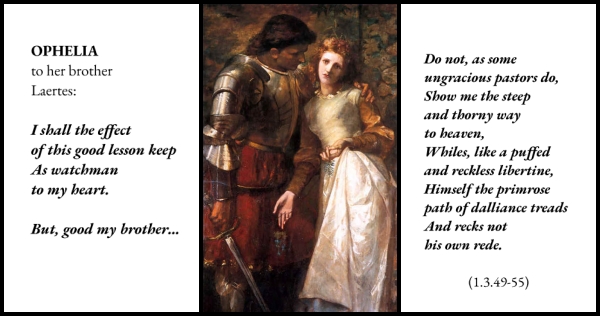
Ophelia’s first biblical allusion made her sound, to Elizabethan ears, like Jesus condemning hypocrisy and corruption of authorities. She targets her brother as a potential hypocrite and “libertine.” Laertes warns her not to get too close to Hamlet, that he is above her station, warning her not to lose her chastity to him. Ophelia responds kindly but strongly: I shall the effect of this good lesson keep As watchman to my heart. But, good my brother, Do not, as some ungracious pastors do, Show me the steep and thorny way to heaven, Whiles, like a puffed and reckless libertine, Himself the primrose path of dalliance treads And recks not his own rede.[1] In Matt. 7:13-14, Jesus’ cautions: Avoid the “wide gate” (of too much freedom). “Straight and narrow” for Ophelia becomes “steep and thorny.” In Matt. 23:1-4 Jesus says, do all that “teachers of the law” and Pharisees teach, as they sit in the “seat of Moses” as authorities, but not to do as they do, for they are hypocrites.[2]  ...

Interview with Paul by ArtMakers on KYMN Radio, March 7, 9 A.M. CST

Image
Tomorrow, March 7 at 9 a.m. CST, KYMN Radio in Northfield, Minnesota, will broadcast an interview of me, pre-recorded by Betsy Spethman and Andrew Rossow of ArtMakers (Disabilities - Arts - Community). Andrew has been one of my music students for at least nine or 10 years; he is blind and handicapped, so he is unable to play guitar, but he can play a number of other musical instruments, including autoharp (the focus of our lessons). He has a great ear for music, remembers chords and lyrics very well, and can transpose on the fly. Andrew’s parents, Jim Rossow and Betsy Spethman, started the organization, ArtMakers, to help people with disabilities have opportunities to be involved in arts and community. Betsy and Andrew regularly interview people in Northfield, Minnesota, a two-college town (where I live, also home to St. Olaf and Carleton colleges); the interviews are broadcast and archived on KYMN Radio in a show called “Townies Radio.” Andrew and his father Jim performed together i...

Religious and Biblical allusions and plot echoes in Hamlet 1.2

Image
Here are a few key religious and biblical allusions in Hamlet 1.2 (not an exhaustive list): ~~~~~ CLAUDIUS: ...our sometime sister, now our queen,/ [...] Taken to wife. (1.2.8-14) For Shakespeare’s English audience, this would have struck a nerve: Henry VIII had married his dead brother’s widow, Katherine of Aragon, but later (after no living sons and an affair with Anne Boleyn) claimed it was a biblically forbidden marriage.  [For more on the biblical passages related to "incestuous marriage" see this link: https://pauladrianfried.blogspot.com/2022/06/the-bible-henry-viii-claudius-and.html ] Therefore he claimed he needed an annulment, which triggered the English Reformation and many executions of Protestants as heretics (by Mary I) and of Catholics as treasonous (by Henry, Edward, Elizabeth). So audiences would have viewed Claudius as being like a Henry VIII who had not repented of his incestuous marriage. ~~~~~ CLAUDIUS: Young Fortinbras, Holding a weak supposal of our...

(Part 12) TRY THIS: One Method for Considering Biblical Allusions

Image
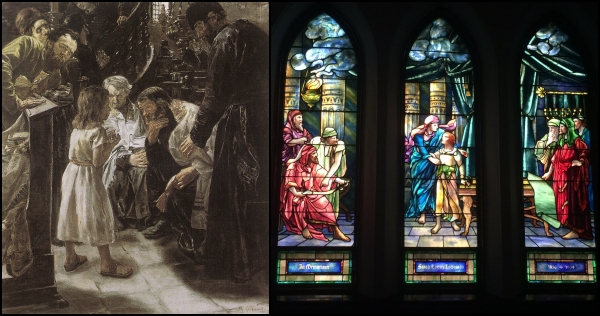
~~~~~~~~~~~~~~~~~~~~~~ INDEX OF POSTS IN THIS SERIES: https://pauladrianfried.blogspot.com/2023/01/index-hamlet-in-32-as-boy-jesus-lost.html ~~~~~~~~~~~~~~~~~~~~~~~~~~~~~~~~~~~~~~~~~~~~~~~~ In this recent series,[1] I’ve explored one scripture allusion in a Shakespeare play (Hamlet in 3.2 alluding to the boy Jesus among temple elders from Luke 2). Readers of literature can explore allusions on their own, or instructors can do so with their students. There are many ways to do this, many possible starting points. Below is an outline of the method I used in this series. In many ways I only scratched the surface. Some tasks listed below might benefit from working on as a whole group. Then a class might divide tasks # 3 - # 7 among groups, and then later meet to discuss results, before # 8. 1. IDENTIFY what seems to be a scripture allusion. - People long familiar with a religion’s sacred texts may have an advantage, but religious belief is not required to identify allusions. Fa...

(Part 11) Cordelia is about her father's business in Shakespeare's King Lear

Image
~~~~~~~~~~~~~~~~~~~~~~ INDEX OF POSTS IN THIS SERIES: https://pauladrianfried.blogspot.com/2023/01/index-hamlet-in-32-as-boy-jesus-lost.html ~~~~~~~~~~~~~~~~~~~~~~~~~~~~~~~~~~~~~~~~~~~~~~~~ This series has considered Hamlet’s allusion to Luke 2:46-52, the tale of the boy Jesus amazing temple elders and his parents.[1] Last week we considered a similar thematic echo in Macbeth , when the son of Lady Macduff amazes and humors his mother with wit and grace while also catching her conscience, like a court fool. But Hamlet and Macbeth are not the only Shakespeare plays that echo or allude to the Luke 2 story: King Lear contains an allusion to this gospel story, spoken by Lear’s exiled daughter, Cordelia.[2] We might recall how in Luke 2, Jesus tells his parents that he went to the temple because he had to be about his (heavenly) “father’s business.” Hamlet also believes he must be about his father’s business, but he is confused, at first striving reluctantly to be about the ghost’...