Posts

Showing posts with the label Shakespeare's Allusive Practices

Shakespeare's Hamlet, Jonah, and Looking Glass as cultural conversation

Image
When Shakespeare has his Hamlet abbreviate his sea voyage to England (compared to the Saxo Grammaticus source c. 1185–1208) and change mode of transportation mid-sea, it seems an implied allusion to Jonah not present in Saxo. Jonah also changed mode of transport mid-sea, swallowed by a fish doing the will of a merciful God; Hamlet was figuratively swallowed by a pirate ship; they imprisoned him, but he described the pirates as "thieves of mercy" [1] Shakespeare's Hamlet never mentions Jonah explicitly, and neither does the Disney film, Pinocchio (1940) [2], but Pinocchio and Geppetto are actually swallowed by a whale, whereas the pirate ship only figuratively swallows Hamlet, so critics (who are, yes, sometimes far too literal) have been more likely to see Jonah in Pinocchio than in Hamlet's sea voyage. One might ask: Why was Shakespeare being so subtle instead of being more explicit about his Jonah echo? Was it an artistic/aesthetic choice? Or were there other fact...

Shakespeare's Hamlet, Sydney, and Allusion as cultural conversation

Image
How do we understand an allusion, such as Shakespeare's Hamlet using a play to catch the conscience of the king, like the prophet Nathan catching the conscience of King David? Especially after the New Critics, the "death of the author," and disillusionment with “old historicism,” there was a tendency to ignore many aspects of historical-cultural contexts in favor of only what is immediately clear in the text. This may have seemed a more objective, even empirical approach: If the text doesn't say "Nathan" or "David" or "Bathsheba," or use the same phrasing as the Bible, shall we assume there is no such biblical allusion present? The more subtle the allusion, the more reason to doubt it? What if we know that many other writers in Shakespeare's time were alluding to or retelling the David story? Did that allow for a kind of shorthand in making allusions? Last week’s post [1] noted that Shakespeare didn't always have to be explicit;...

Why Hamlet didn't need too-explicit Davidic allusions in 1599-1604

Image
Shakespeare didn’t need to be too explicit about some biblical allusions: He knew his Bible-influenced audiences would experience his play through lenses of scripture. When modern critics split hairs about whether something is explicit enough to count as an allusion [1], they're imposing modern expectations on Elizabethan texts. This is true of Hamlet’s Davidic influences: In 1599 George Peele’s popular play “David and Bathsebe” was published in quarto after stage success (c. 1595-9). David was a trending topic [2]. In this context Shakespeare wrote his Hamlet (1599-1601-04): King Hamlet fought Old Fortinbras in single combat, as David fought Goliath [3]. Claudius killed King Hamlet to take his wife Gertrude, as King David arranged for Uriah’s death to steal his wife, Bathsheba [4]. The sentinels and Horatio [5], and also the Danish public [6] may have thought Prince Hamlet the rightful heir denied the throne, like David, chosen by God via the prophet Samuel to be the next king...

Delay in four Hamlet biblical echoes

Image
At least four biblical echoes in Hamlet besides the fall of Adam and Eve involve delay, and Elizabethans would have known each story[1]: 1. After King David’s affair with Bathsheba and arranging for the death of her husband, the prophet Nathan could have simply confronted David with his sins, but delayed to use a story to catch the king’s conscience (2 Sam 12:1-7). [2] - This is echoed in Hamlet’s use of the play to catch the conscience of the king [2.2.634]. ~~ 2. David spared King Saul when he had two chances to kill him, which delayed David’s ascension to the throne [3]. - These David-Saul tales are echoed (with a dark twist) in Hamlet’s choice not to kill Claudius at prayer [3.3.80-100]. ~~ 3. Jonah fled west to Tarshish when he was called to prophesy to Nineveh (Jonah 1:1-3), delaying his prophecy. After a storm and being thrown overboard, Jonah is swallowed by a fish God sends to take him back east to do his task [4]. - Jonah’s westward voyage and east-bound transfer from ship ...

Claudius and his Mini-Me in Hamlet and Chaucer (Claudius series, Part 14)

Image
In Part 4 of this series [1] I noted that Chaucer in “The Physicians Tale” has a lecherous villain named Appius Claudius who desires a young woman who has no interest in him, and who with his servant (also named Claudius) schemes to make her his slave [2]. The repetition of the name Claudius may imply both that the servant is like a fawning courtier, and that Appius Claudius was vain to hire a servant who shared his name. The villain-with-a-sidekick is a tradition also tapped into by the Austin Powers spy-comedy, Goldmember, with its villain, Dr. Evil, who has a sidekick Mini-Me (played by Verne Jay Troyer) [3]. I mentioned in Part 4 that scholars note the influence of Chaucer in as many as nine Shakespeare plays [4]. So it’s clear that Shakespeare knew Chaucer’s work. But did he know of Claudius-times-two in that tale? It would be easier to believe that he did, and was indicating so in Hamlet, if only he had included some servant of Claudius who was also named Claudius.... Hmmm.... ...

Bullough, Jenkins, Asimov on Claudius as changed name of Hamlet's uncle Feng (Part 13, Claudius series)

Image
Geoffrey Bullough (1957-1972), Isaac Asimov (1970), and Harold Jenkins (1982) all noted Shakespeare having changed the name of Hamlet's uncle “Feng” to “Claudius”: Asimov: "The reigning King of Denmark, who has succeeded the elder Hamlet[...] is Claudius. Shakespeare has chosen an aristocratic Roman name for the purpose. (It was the name of a patrician family in the time of the Republic and one from which several of the early emperors were descended—including Claudius, the fourth Emperor, under whom Britain was conquered in the years following Cymbeline's death.[1]) In Saxo Grammaticus' original tale, the new King was named Feng, and perhaps Shakespeare did well to change that." (87)  [2] Jenkins: "The King's name is knows from his first entry-direction and first speech-heading, after which, however, it is never used again."  [3] Jenkins continues: "It was evidently suggested by that of the Roman emperor who married Agrippina, his niece and th...

Claudius, Hamlet, and Nero, roads diverging in allusive woods (Part 12, Claudius series)

Image
Hamlet's relation to his step-father, King Claudius, and Nero's to *his* step-father, Claudius I, offer key similarities and contrasts: Many note that Hamlet in 1.2 dislikes Claudius calling him "son" so soon after his father's death. Memorable lines: KING ... But now, my cousin Hamlet and my son— HAMLET [aside] A little more than kin and less than kind. KING How is it that the clouds still hang on you? HAMLET Not so, my lord; I am too much in the sun. (1.2.66-69) “Cousin" in Shakespeare's time could apply loosely to a nephew. "...too much in the sun." [son - pun] Although the name is not spoken in the play, in the 1604 Second Quarto and later editions, at the start of 1.2 (his first entrance), he is named: "Enter Claudius, King of Denmark...." In 3.2, Hamlet mentions Nero: Claudius I, Emperor of Rome, married the daughter of his brother, his niece, who already had a son, Nero; Claudius adopted Nero as a son and heir; so Nero was grand...

Prodigal is Oedipal spelled badly - Biblical Allusions as Lenses for Hamlet

Image
HAMLET AS PRODIGAL (OEDIPAL SPELLED BADLY) OEDIPAL [1]: Freud claimed that men want to kill their fathers and possess their mothers, like Oedipus, whose father (Laius) was in fact a jerk. Laius made bad karma, abandoning his son to die.[2] - Oedipus doesn't know he was saved and adopted, so he thinks the prophecy means he will kill his adoptive father and marry his adoptive mother. He doesn't want that, so he flees. - While fleeing, his biological father is cruel to him on the road, and Oedipus kills him, not knowing it is his father. - Having suffered trauma as a child, Oedipus may be lashing out in revenge at a stranger who happens to be his father. All fathers die, most before their sons. But the tale is also a metaphor for how children need to establish their own identities as distinct from their parents (though some sons may "want a girl / just like the girl / that married dear old Dad," as the song says.[3]) We can follow Freud and read Hamlet as Oedipal. PRODIG...

Hamlet, All Saints, and Discourse with the Dead

Image
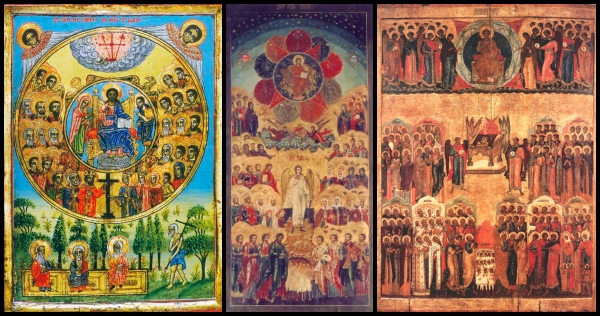
Shakespeare’s Hamlet is a play that is in part about how we relate to the dead: What, if anything, do we owe the dead? What can we do for them, or they for us? The play bears the scars of the Reformation. The ghost seems to be Catholic, but his son was sent to study at Wittenberg, made famous in part by Martin Luther. Long before Calvin and Luther, the Catholic Church had made efforts at reform in fits and starts, some successful, many not. Many Catholic theologians and historians believe that reformation thinkers like Martin Luther were correct in their perception of abuses in need of reform, and of stubborn resistance. Protestantism cut off many of the faithful from the idea that they could ask saints to intercede for them, to pray with them, to advocate for them. The first of the Ten Commandments said that there was only one God, and that believers were to worship that God alone. And yet the creed also taught that there was a resurrection, and that living Christians were united in...

(Part 12) TRY THIS: One Method for Considering Biblical Allusions

Image
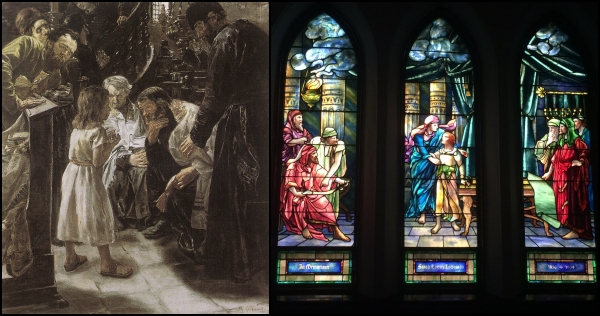
~~~~~~~~~~~~~~~~~~~~~~ INDEX OF POSTS IN THIS SERIES: https://pauladrianfried.blogspot.com/2023/01/index-hamlet-in-32-as-boy-jesus-lost.html ~~~~~~~~~~~~~~~~~~~~~~~~~~~~~~~~~~~~~~~~~~~~~~~~ In this recent series,[1] I’ve explored one scripture allusion in a Shakespeare play (Hamlet in 3.2 alluding to the boy Jesus among temple elders from Luke 2). Readers of literature can explore allusions on their own, or instructors can do so with their students. There are many ways to do this, many possible starting points. Below is an outline of the method I used in this series. In many ways I only scratched the surface. Some tasks listed below might benefit from working on as a whole group. Then a class might divide tasks # 3 - # 7 among groups, and then later meet to discuss results, before # 8. 1. IDENTIFY what seems to be a scripture allusion. - People long familiar with a religion’s sacred texts may have an advantage, but religious belief is not required to identify allusions. Fa...