Posts

Showing posts with the label Homer

INDEX: Holding up The Odyssey as mirror in Hamlet

Image
From August 4-23, 2022, I did a series exploring how Shakespeare seems to have had The Odyssey in mind when he named Ophelia's brother Laertes (the father of Odysseus also had that name): In the same way that the family of Odysseus tries to defend his wife Penelope against suitors while he is away at war, Polonius and Laertes try to defend Ophelia against suitors. This was prompted in part by Asimov's book on Shakespeare, in the section on Hamlet , where he briefly mentions this name, Laertes, which stand out like a sore thumb, and which does not sound very Danish. Below is the INDEX to these posts: 1. Laertes in Hamlet & the Odyssey - Part 1: https://pauladrianfried.blogspot.com/2022/08/laertes-in-hamlet-odyssey-part-1.html 2. Laertes in Hamlet & the Odyssey - Part 2: https://pauladrianfried.blogspot.com/2022/08/laertes-in-hamlet-odyssey-part-2.html 3. Seeking Penelope in Ophelia & Hamlet: Laertes & The Odyssey - Part 3: https://pauladrianfried...

Hamlet and Homer - part 8 (Louden, Aguirre, Hornback)

Image
Names, common themes, and similar incidents in Homer* and Hamlet are too explicit and numerous to avoid (Laertes, Hyperion, Pyrrhus, Priam, Hecuba... See my previous posts in this series).[1] The text of Hamlet expects readers and audiences to view Hamlet through the lens of Homer, both for its similarities and for the ways it diverges from the old heroic texts. (*When I say Homer in this instance, it's shorthand for all the sources Shakespeare used, including Virgil, Ovid; Chaucer, and Chapman's partial translation of the Iliad, as well as other secondary sources.) Bruce Louden observes [2] that among the many new characters and plot elements in Hamlet that are not found in the Saxo Grammaticus and Belleforest sources, four of them are found in Homer: 1. the Ghost; 2. the coming of the actors to Elsinore; 3. the play-within-the-play; 4. the pirates who intercept the ship…. (33-34) Louden notes that Hamlet identifies with Pyrrhus, who wears black in mourning for the d...

Seeking Penelope in Ophelia & Hamlet: Hamlet & The Odyssey - Part 3

Image
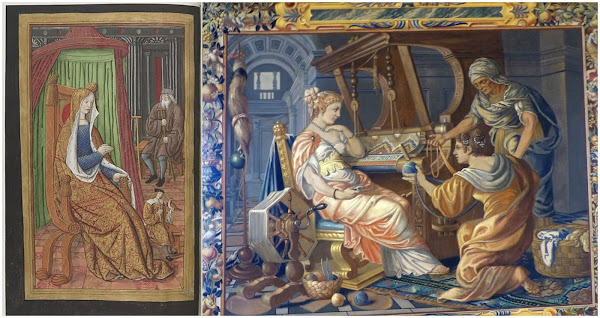
In The Odyssey, the weaving of Penelope, as a ruse to avoid her 108 suitors* later seems to find parallels not only in Ophelia and her sewing and reading, but also in Prince Hamlet. (Penelope and others fending off 108 suitors makes me think of the Buddhist idea of the importance of quieting the "monkey mind" of distractions!) Katherine Goodland has noted: Polonius wants Ophelia reading, to look like common images of Mary at the Annunciation. ( See this post .) [1] So now we have to think loosely, of Ophelia as associated in her sewing with Penelope, and in her reading, with Mary at the Annunciation; In a way, we might consider Penelope's weaving as a kind of compromised involvement with the world (to fend off suitors) and then a kind of prayer or repenting (unweaving, undoing the work), but also a kind of scheming for survival. Hamlet and Ophelia both have rhythms of compromised involvement in their world, followed by types of repenting or undoing: They weave...