Posts

Showing posts with the label Peter Milward

Peter Milward on academic "gobbledygook" (jargon) in Shakespeare scholarship

Image
Peter Milward (1925-2017) makes an interesting point about the growth of academic jargon ("gobbledygook") in scholarly writing. Milward is the author of Biblical Influences in Shakespeare's Great Tragedies (1987), which is helpful in some ways that similar books by other authors sometimes are not. The following quote is from Milward's review of a book by Gillian Wood (whose work I've enjoyed), Shakespeare's Unreformed Fictions: ...maybe she is content, or her publisher is content, with a readership of like-minded scholars as being (in Milton’s words) a ‘fit audience, though but few’. All too evidently, she likes to puzzle or muddle the general reader with such phrases as ‘characterological interiority’ (p. 129), ‘disjunctions in the drama’s representational logic’ (p. 170), ‘the ontological confusion inherent in the moment of animation’ (p. 181), and ‘the axiomatic knowledge of the binary distinction’ (p. 201). Admittedly, these phrases make more sense in thei...
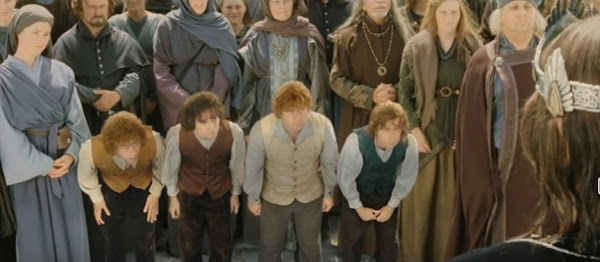
Hamlet, Footwashing, Maundy Thursday, Hobbits, and Revelation

Image
Echoes of Maundy Thursday in Hamlet (and Hobbits): [Image: Screen capture from YouTube clip of The Lord of the Rings: The Return of the King (2003), directed by Peter Jackson, Warner Bros. based on the book by J.R.R. Tolkien. Fair use.] [UPDATED 26 March, 2026] Maundy Thursday (or Holy Thursday, 2 April, 2026) begins what the Catholic Church calls the Triduum (Paschal or Easter Triduum).  “Maundy” comes from the Latin word for “command,” so Maundy Thursday gets its name from the Latin words once used at the opening of the Thursday service during Holy Week, and the gospel in which Jesus commands his disciples to love and serve others as he loved and served them.  It includes a ritual remembrance of Jesus washing the disciples’ feet  (John 13:1–17), with Jesus “New Commandment” to love and serve, an idea used by (sometimes antisemitic) Christians to differentiate from the Ten Commandments of Moses. [1] There are echoes of this in Hamlet 1.2, when Horatio enters, he has t...