Posts

Showing posts with the label Ghost of Hamlet's father

Yorick & I bid you Happy Halloween, All Souls, All Saints

Image
With, hoo! such bugs and goblins in my life... - Hamlet 5.2.25 [1] This is my favorite Halloween-themed line in Hamlet, from the last scene, at the start of which Hamlet describes to Horatio how he discovered the letter with orders from Claudius for England to execute Hamlet (by beheading) upon their ship's arrival there. Frightening stuff! In many places around the world, some people will observe Halloween, the evening of 31 October, "All Hallows Eve," with its roots in Christian tradition of celebrating All Souls this day, and anticipating the Feast of All Saints tomorrow, November 1. It is harvest time, and so we also consider death as a harvest of souls. It is a good time of year for such stuff, with cold weather, and with leaves changing color in the Northern Hemisphere approaching winter. Hamlet famously converses with an apparition that claims to be the ghost of his father, after the apparition had been previously seen a number of times by sentinels, finall...

Life or Death by Ear: King Hamlet and Mary Queen of Scots

Image
In Hamlet, the ghost tells the prince that his brother Claudius poisoned him by pouring a vial of "cursèd hebona" (1.5.69) in his ear.[1] Yet the ghost first presents the poisoned ear as a metaphor for how Claudius lied about the cause of his brother's death: So the whole ear of Denmark Is by a forgèd process of my death Rankly abused. (1.5.43-45) It is possible that Prince Hamlet has had his own ear poisoned by what the ghost tells him: The ghost may be a demon in disguise, or a sinner in purgatory, not yet purged of his sinful and distorting assumptions, goals, and ways of viewing his own life.[2] In general, this idea of death by ear would have had other resonances for Elizabethan audiences: By the time Shakespeare's play was first published in the first quarto (1603) and expanded in the second of 1604, Mary, Queen of Scots had already been executed in 1587, the focus of alleged plots to overthrow Elizabeth and replace her on the English throne. Mary's first hu...

Horatio & Hamlet on How to Speak to Ghosts (Halloween post)

Image
For Halloween, what can we learn from Shakespeare’s Hamlet on how to speak to ghosts? First Horatio, and later, Hamlet, both try. HORATIO What art thou that usurp’st this time of night, Together with that fair and warlike form In which the majesty of buried Denmark Did sometimes march? By heaven, I charge thee, Speak. (1.1.54-58) Horatio calls the ghost a usurper of the night and of the appearance of the dead king. Marcellus thinks Horatio has offended the ghost (perhaps true, especially since Claudius, brother to the king, was the usurper). Soon the ghost appears again. This time Horatio’s attempts seem informed by his university learning, questioning the ghost, asking if can foresee Denmark’s future, or knows of buried treasure: HORATIO: Stay, illusion! [...] If thou hast any sound or use of voice, Speak to me. If there be any good thing to be done That may to thee do ease and grace to me, Speak to me. If thou art privy to thy country’s fate, Which happily foreknowing may avoid, O, ...

Part 1: Hamlet Before Freud ("Tough Love" for Gertrude and Ophelia)

Image
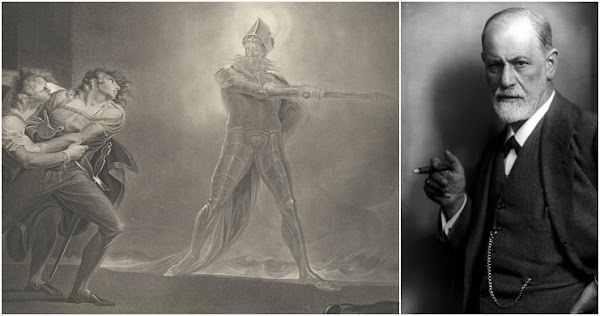
If we take seriously that Hamlet, Horatio and the sentinels saw a ghost from purgatory, [1] then we have to consider this possibility: Hamlet is harsh with his mother and Ophelia because he thinks he has seen his father’s ghost from purgatory who claims to be there because he had sinned, committed foul crimes. Hamlet doesn’t want the two women he loves most to end up in purgatory like his father, or worse, in hell. He scolds Ophelia and tells her to get to a nunnery; he scolds his mother, tells her to repent of her incestuous marriage, a relationship that began, according to the ghost, with adultery when his father was still alive. Hamlet feels a duty to be harsh with them because he fears for their eternal fate. If one encountered a ghost from purgatory as Hamlet did, and loved his mother and Ophelia, it makes sense that one might want to warn them, to spare them such a fate. [2] To be clear, while many in Shakespeare’s time believed in ghosts [3], there were also those who did not,...

Belief in Ghosts v. Blaming Hamlet's Madness

Image
This past week, three sources came together to nudge me toward thinking in new ways about the ghost in Hamlet . [Images: Left: Screen-shot of headline and Ian McKellen from Michael Billington article in The Guardian (see below). Fair use. Right: Michael Keaton in Beetlejuice , directed by Tim Burton, 1988, warner Brothers, image via IMDB . Fair use.] The first was an article in The Guardian by critic Michael Billington regarding a new film called The Hamlet Within . It mentioned productions of the play that portray the ghost as an inner voice of Hamlet rather than the manifestation witnessed by the sentinels and Horatio in the opening scene. The second was when Shobha Pawar sent a link to an excellent YouTube video by John Berger from the 1970s, about how our experience of art and of its meanings changes over time , especially after technological changes that allow mass replication of famous art images. The third was a “Speaking of Shakespeare” video on Shakespeare and th...