Posts

Showing posts with the label Epiphany

Is Twelfth Night a Christmas - Epiphany season play?

Image
If Shakespeare’s Twelfth Night is related to Christmas and Epiphany, how so? Some would say only by title [1] and only in a secular sense for having Sir Toby Belch as a “Lord of Misrule,” a secular Christmas tradition [2]. There’s no baby Jesus, no shepherds, no angels, no Magi.  But consider: Viola and Sebastian come from far away, like the Magi. They are shipwrecked, like St. Paul, saved from water, or like the inhabitants of Noah’s ark (which Sir Toby mentions) after storms and flood. The scripture readings for both St. Paul’s shipwreck and Noah’s ark were read every year in English churches during the Christmas season [3]. The twins are refugees in enemy land, like the Holy Family in Bethlehem under Herod the Great [4]. “Wise men/man” is spoken six times in the play by various characters [5].   The use of Sir Toby Belch as “Lord of Misrule,” and the downfall of the proud and Puritanical Malvolio, echo what the Virgin Mary says in reply to the angel Gabriel on being told ...

Feast of the Epiphany in Shakespeare's Time (Series, Part 14)

Image
The FEAST of the EPIPHANY in churches of Shakespeare’s time [1], JANUARY 6, celebrates the magi “from the east” who followed a star, met with Herod, paid homage to Jesus, and were warned in a dream to go home by another way [2]. City-dwellers may neglect the stars, but in Shakespeare they can be foreboding or determine fate; one can be “star-crossed” ( Romeo and Juliet ), or out of another’s star (Ophelia/ Hamlet ), or one might guide a ship by them; Shakespeare mentions them more than 100 times (a sample): “Look, the unfolding star calls up the shepherd.” - Measure for Measure “That I should love a bright particular star” - All's Well That Ends Well “O eastern star!” - Antony and Cleopatra “Our Jovial star reign'd at his birth” - Cymbeline “When yond same star that's westward from the pole Had made his course t' illume that part of heaven Where now it burns…” - Hamlet      “I am constant as the northern star” - Julius Caesar In the gospel, and in sleepless dreams of...

Epiphany and Balthazar in Shakespeare (Series, part 13)

Image
From a 2023 post [1]: ...Balthazar (the dark-skinned magi of the evolving Epiphany tradition) became a kind of touchstone or symbol of otherness, diversity, and tolerance. And so it is also perhaps no surprise that the name Balthasar occurs five times in Shakespeare’s plays, twice as servants (in Romeo and Juliet, and in The Merchant of Venice), once as a singer in Much Ado About Nothing, once as a merchant in The Comedy of Errors, and once as a lawyer, Portia’s courtroom disguise in The Merchant of Venice, where she is called a "Daniel"; a play in which Portia considers suitors from many lands. Shakespeare also has a play named after the night before the Epiphany, Twelfth Night. The three Magi are outsiders, foreigners, and so are the siblings in Twelfth Night who are shipwrecked on the island of Illyria, the land of their enemies. But by the end of that play, the siblings both marry leading personages from Illyria, contributing to themes of diversity, tolerance, reconcili...

Part 11: "Mad" Ophelia grasps "tricks i' th' world" and Denmark's corruption

Image
Too many critics, readers and viewers of Shakespeare’s Hamlet assume that Ophelia’s madness is merely an inability to deal with emotions, mostly about her father and Hamlet. Showlater cites Theodore Lidz (a typical example of this) who claims “Ophelia goes mad because she fails in the female developmental task of shifting her sexual attachment from her father ‘to a man who can bring her fulfillment as a woman.’” (294) [1] Too few consider that her madness may have been as much, or more, caused by a startling epiphany about Denmark’s corruption, understanding it perhaps even better than her father. Why would (mostly male) critics have neglected this possibility for so long? A tendency among critics to keep Ophelia out of politics, like keeping women out of voting booths? A “GENTLEMAN” and Horatio speak about Ophelia the first we hear of her having gone mad: GENTLEMAN: She speaks much of her father, says she hears There’s tricks i’ th’ world, and hems, and beats her heart, Spurns envious...

Balthasar and Epiphany in Shakespeare and Renaissance Paintings

Image
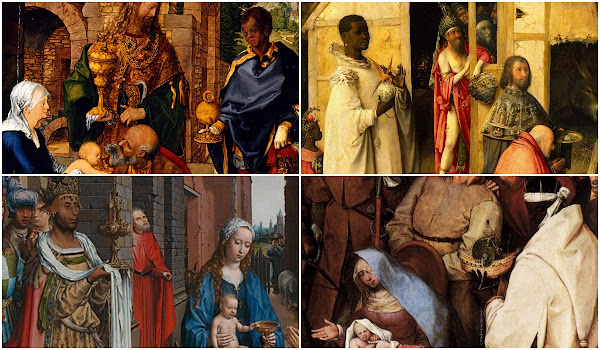
In a December 2020 article, Jonathan Jones explained how the idea of a black Balthazar among the magi or wise men visiting Jesus was an idea that began to blossom in the Renaissance among painters who portrayed the scene.[1] "Balthazar" was a new name given to the biblical Daniel. In a text attributed to the Venerable Bede of Northumbria (672/3 – 735), Balthazar was identified as coming from Africa, yet Jones claims that many in Bede’s time had little concept of what color skin an African might have. As Renaissance Europeans became more exposed to people from other parts of the world, the imagining of Balthazar as black expanded with the help of paintings. Jones notes, “Behind those dark daubs of paint lay a new curiosity about people and about peoples: the ‘humanist’ thinking of the Renaissance that inspired the great French philosopher Montaigne to declare that all global customs and beliefs are equally valid.” Given this expanding awareness, it is perhaps no surp...

Twelfth Night & Epiphany, Malvolio & the Cecils, and Antonio & Essex

Image
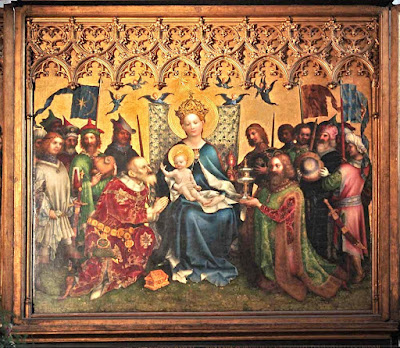
[ Cologne Cathedral, Altarpiece of the Magi ] Some may wonder why Shakespeare's Twelfth Night was named after the twelfth night of Christmas, eve of the Epiphany. The gospel tale is about wise men or Magi from the East who follow a star to pay homage to a new king of Israel, Jesus. The play has none of that stuff in it. But consider: In the gospel story, there is anticipation of a new king. This is why the Magi follow the star. In Shakespeare's England, there had long been hope and anticipation by many of an heir if Elizabeth would only have wed and given birth to a child. Today we might celebrate her independence and assertiveness to remain single, but many during her reign felt otherwise. In the play, Olivia is like Elizabeth (both three-syllable names): She is mourning the death of a father, and more recently, a brother (like Elizabeth, whose father Henry and brother Edward were kings of Protestant England before her and had both died before she assumed the...