Posts

Showing posts with the label St. Francis

HAMLET, SUPERMAN, and ST. FRANCIS WALK INTO A BAR

Image
HAMLET, SUPERMAN, AND FRANCIS OF ASSISI WALK INTO A BAR.  What do they talk about? Fathers.  Was it ever more honorable to disobey your father than to obey him?  SUPERMAN, in the latest film (dir. James Gunn, 2025), faces a choice: His biological father on Krypton had recorded messages for him. One had been damaged, at first thought irretrievable. When finally decoded, Superman learned that he was sent to earth because its inhabitants were weaker, so that he could dominate them.  Should he obey his biological father’s plans for domination?  He disobeys and heeds the advice of his adoptive parents, using his powers to serve.  The first sentinel in Hamlet?  FRANCISO, named after FRANCIS OF ASSISI, once a soldier and prisoner of war. His father, a rich merchant, was not quick to ransom him for early release.  Francis later heard a voice: “Repair my church.” At first he thought this was about church buildings, but soon realized it was about repairin...
Hamlet's Jewish & Christian Reformers

Image
In Shakespeare’s lifetime (as in ours for some), there was an anti-Semitic tendency among Christians to view Judaism as an inferior faith and to view Jesus, Son-figure of a Trinitarian God, as Judaism’s promised messiah sent to redeem humanity from their sins, establishing a "one true faith." An alternative view: Jesus was a Jew, and a reformer, who lived and preached at a time when Judaism had been corrupted in large part by the Roman occupation. Reformers like Jan Hus, Luther and Calvin may have thought it too proud to consider their own reformer-roles analogous to that of Jesus (Luther once referred to tales of medieval monks, including one about a monk who destroyed a chair he had made because he believed he had become too proud of it). But in fact we might consider that they attempted to do for Christianity something analogous to what Jesus attempted to do for Judaism. Hamlet contains references to many reformers: - St. Gis (Jesus). - Wittenberg, where Luthe...

Victors Wrote the Histories of Shakespeare and Francis of Assisi (Part 3: Religious Bias in Shakespeare Scholarship)

Image
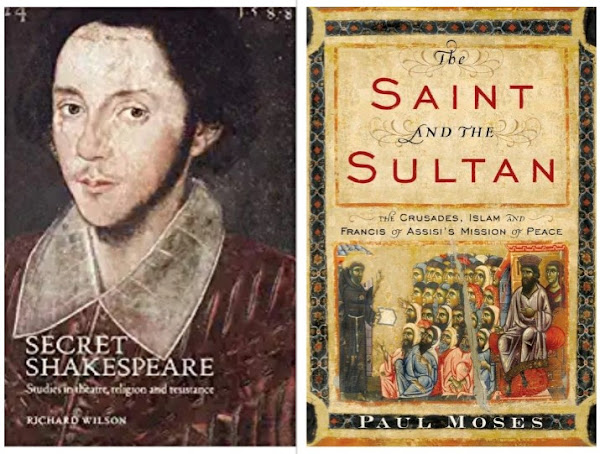
If scholarly bias is in some ways analogous to war between opposing camps, those who win certain battles for a time may not win the war in the long run. Or at least it sometimes seems that way. History is often written by victors whose crimes are erased along with the suffering of the vanquished. How does this apply to Shakespeare and Francis of Assisi? [Images, L-R: Secret Shakespeare by Richard Wilson (2004) , and The Saint and the Sultan by Paul Moses (2009). ] * Shakespeare incorporated not only Protestant, Puritan, and Catholic themes in his plays, but often specifically Franciscan themes. In both literal and figurative violence of religious and cultural wars in medieval and Early Modern Europe, Franciscans were twice the losers, first to Rome, then to England. Francis of Assisi (c.1181-1226) was a reformer in his own right who recognized ways that money, power, and violence had corrupted the Catholic church. He expressed solidarity with and love for the sick and poor. ...

Three Questions Inspired by PBS Romeo & Juliet

Image
In a recent National Theater/PBS production of Shakespeare's Romeo and Juliet , some of the most demanding, harsh lines scripted for Juliet's father, addressing Tybalt (1.5) and Juliet (3.5), were reassigned to her mother. [Screenshot from "The Making of Romeo and Juliet via PBS. Fair use.] - In 1.5, when Tybalt at the Capulet masque sees/hears Romeo, Tybalt says he wants to kill him on the spot. Instead of Juliet's father confronting him, her mother does, demanding Tybalt show better civility on this occasion, in her house. - In 3.5: Instead of Juliet's father demanding that Juliet (who has secretly married Romeo) must marry Paris or be disowned, again, Juliet's mother gets these lines; in the original text, Lady Capulet was merely given the chance to briefly assent to her husband's harsh castigation of the daughter. [Photo by Rob Youngson via PBS .] - The scenes were played convincingly, I thought. - On the one hand, Shakespeare would ...