Posts

Showing posts with the label Frank Ardolino

Religious and Political Meanings of the Annunciation and Susanna Allusions in Hamlet 3.1
Image
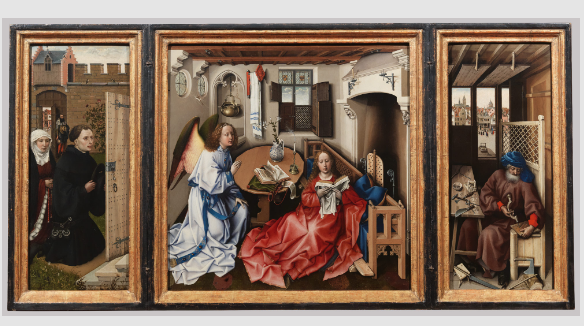
To prepare Ophelia as bait for eavesdropping, Polonius in 3.1 tells her, Read on this book, [...] [....] We are oft to blame in this, [...] that with devotion's visage And pious action we do sugar o'er The Devil himself. (49-55) So just look as if you’re devoted to reading, not bait for spying. But why “devotion's visage / And pious action”? “The Devil”? I’ve posted before about how Katharine Goodland (2006) [1] and Ruben Espinoza (2011) recognized that Polonius made Ophelia resemble a common image from old prayer books: the Virgin Mary is portrayed as reading a book of psalms when the angel Gabriel tells her that she is pregnant with Jesus (Lk 1: 26-38). [Robert Campin, Annunciation Triptych (Merode Altarpiece) in the MET museum (ca. 1427–32). Public domain. Image via Google Arts and Culture .] In Catholic prayer, the "Hail Mary" says, “Holy Mary, mother of God, pray for us sinners....” On seeing Ophelia, Hamlet says (aside), “in thy orisons...

Hamlet & The Spanish Tragedy as a Conversation

Image
If you ask actors about the influences, differences, and similarities between Thomas Kyd's The Spanish Tragedy and Shakespeare's Hamlet , some may respond that one could never prove the nit-picking speculations of academics, and that both are revenge plays with plenty of material for actors to bring to life, and for audiences to be drawn in. Shakespeare was an entertainer, and he wanted to make a good living, so if he borrowed elements from Kyd, as long as the shows are a success with audiences and at the box office, everyone is happy. [Images: The Spanish Tragedy via Wikipedia ; Hamlet Q2, via Folger Shakespeare Library .] Of course, in a way, they're right. Actors still bring very old plays to life for audiences who are moved, again and again, by something not only in the scripts, but in the actors and the audiences themselves. When things come together well in a live performance, why dig and speculate about historical questions that might never be answered? And y...

Ophelia's Prayer Book & the Annunciation of Mary

Image
In Hamlet act 3, scene 1, Ophelia's father Polonius asks her to read a book so that she might project "devotion's image" and "pious action" as well as her own loneliness when Prince Hamlet first sees her. In other words, he is using her for bait to trap Hamlet into conversation while Claudius and Polonius eavesdrop. I have written about this scene in a previous blog post regarding the echoes of the story of Suzannah and the Elders , from the book of Daniel. But today I want to note a visual echo of the Annunciation of Mary, when an angel visits to tell her that she is to bear a son, Jesus. [See Bridget Gellert Lyons, "The Iconography of Ophelia," page 61: "The woman with a book was reminiscent of countless representations of the Virgin, who was most commonly shown reading when the Angel of the Annunciation came to visit her." ELH , Spring, 1977, Vol. 44, No. 1, pp. 60-74 https://www.jstor.org/stable/2872526 ] In her remarka...

Suzannah & the Elders: Ophelia, Eliz I, & the Nunnery Scene

Image
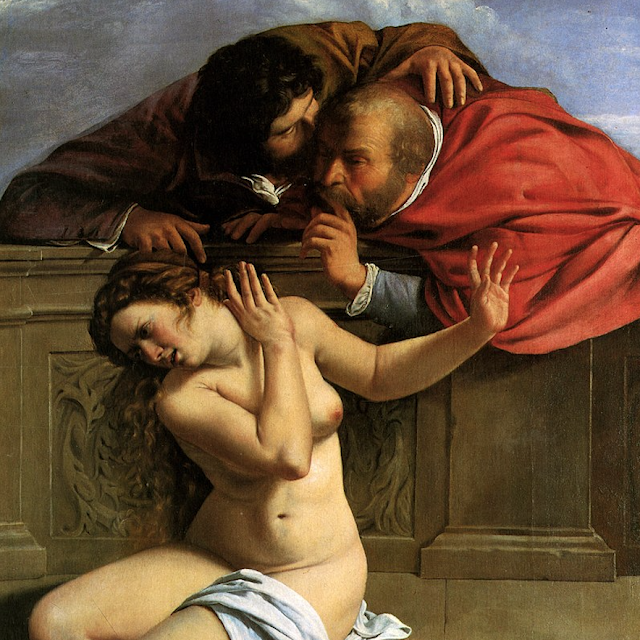
Painting, 1610 Artemisia Gentileschi What if we're missing something important in our understanding of the nunnery/eavesdropping scene (3.1), with Ophelia and Hamlet spied on by Polonius and Claudius? —What if it has more to do with Elizabethan politics and propaganda than with Freud? —What if Elizabethans may have understood the scene very differently because of current events of the Elizabethan age, but which has been lost over time? —What if the missing clue is that the scene offers a radical variation on the tale in Daniel 13, about the virtuous Suzannah, whom two judges tried to coerce into having sex with them? Frank Ardolino (author of Apocalypse & Armada ) says the eavesdropping scene in Kyd's Spanish Tragedy echoes the biblical tale of Suzannah & corrupt judges (Daniel 13), a tale often used to defend Elizabeth I from her critics: Her defenders compared the Virgin Queen Elizabeth to the virtuous Suzannah, and compared her critics to the corrupt jud...