Posts

Showing posts with the label vows

Part 25: Ophelia's Self-Catching Conscience in the Mirror of her Arts
Image
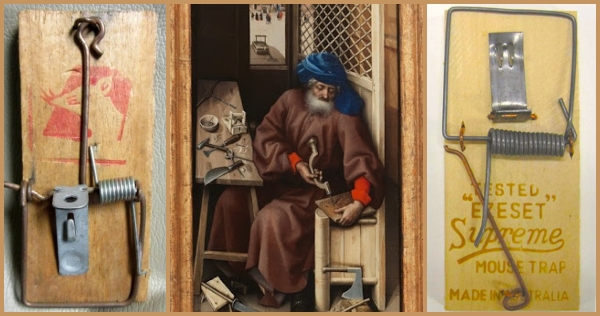
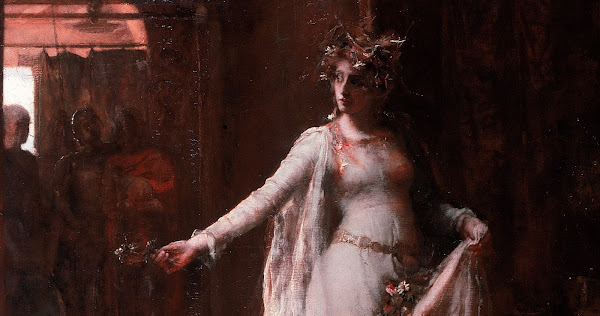
Unlike Claudius, who ignored qualms of conscience to murder his brother and usurp the throne, Ophelia’s relationship to her conscience is more healthy, rich, and self-directed.   Claudius just doesn’t get it, so he needs Hamlet to catch his conscience in The Mousetrap, [1] which reenacts Claudius poisoning his brother and wooing his victim’s wife. Hamlet says playing holds a mirror up to the age [2], and he uses the playlet to hold a mirror up to Gertrude and Claudius, showing what they’ve done. But Ophelia gets it, and doesn’t need someone to hold up a mirror for her conscience. She chooses her own songs, stories, and allusions to reflect upon her sadness and conscience. [3] She knows her father died, but doesn’t know that Hamlet killed him thinking it was Claudius. She sings songs of mourning for perhaps her father and/or the dead king [4], songs of her own choosing. Ophelia knows Hamlet made to her “almost all the holy vows of heaven” [5] perhaps the equivalent of a handfast w...
Part 23: Queen Ophelia and the male gatekeepers defining her madness

Image
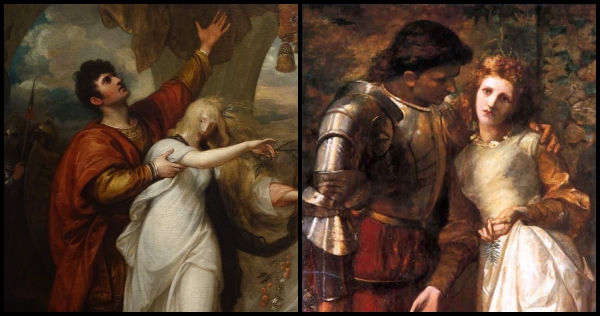
Ophelia is too often portrayed as limp, soft, and either blank-eyed in her apparent innocence, or wide-eyed in her madness, as shown in these paintings by William Gorman Wills (c.1880) and Benjamin West (detail, 1792). This is based more on artistic and dramatic assumptions than on the text of the play. When we first see her brother Laertes in 1.2, he is reluctant to speak in an audience with the king who asks him repeatedly about his requested permission to return to France and scolds him for his shyness:   CLAUDIUS: What is ’t, Laertes? You cannot speak of reason to the Dane And lose your voice. What wouldst thou beg, Laertes, That shall not be my offer, not thy asking? [...] What wouldst thou have, Laertes? (1.2.43-51) Claudius is a bully, and also bullies Hamlet later in the same scene about his mourning of his father. (1.2.96-109) But Ophelia in her “mad” scene shows no shyness, and asks the first question: OPHELIA: Where is the beauteous Majesty of Denmark? (4.5.26) And if Ha...

Part 22: Ophelia's Opening Questions

Image
Shakespeare occasionally reminds us of the Elizabethan slang, that men have a “thing” and women a “nothing.” Ophelia’s name begins with an “O,” an emptiness at least potentially waiting to be filled. Questions are analogous to this. Nature abhors a vacuum; many questions seek answers, or are at least open to mysteries, first attempts to name their boundaries. Hamlet is famous for asking, To be or not? But he also resists certain questions, telling Rosencrantz and Guildenstern not to assume they can pluck the heart of his mystery. Bridget Gellert Lyons (1977), R. Chris Hassel, Jr. (1998),  Katharine Goodland (2006), and Ruben Espinosa (2011) are among those who notice in Ophelia early in the nunnery scene an echo of the ubiquitous images of Mary reading a book, perhaps of psalms, when visited by the angel at the Annunciation. In Luke’s gospel, Mary’s first sentence to the angel is a question: ““How shall this be?” But Mary is open to the angel’s mystery: “be it unto me accordi...

Part 20: Ophelia and the Mousetrap of her Family’s Protectiveness

Image
Shakespeare makes a mousetrap for the audience regarding Ophelia’s family and Hamlet. We could call this mousetrap, “Much Ado About Ophelia Marrying Hamlet.” Near the play’s end, Gertrude says in 5.1 that she’d rather have decorated Ophelia and Hamlet’s wedding bed with flowers than Ophelia’s grave. The Queen seems to have liked Ophelia and thought her a good match for her son.  Rewind to the start: After seeing the ghost, Horatio and the sentinels think so highly of Prince Hamlet that they report the sighting to him, and not to King Claudius or Polonius. [1] In 1.2, Horatio calls Prince Hamlet “my lord,” presenting himself to his friend as “your servant ever.” Hamlet replies that he would “change those names” [2]: He’d rather be Horatio’s servant, and Horatio his lord. When Horatio and the sentinels speak of their duty to him, Hamlet would rather have them think of their mutual love.[3]  Shakespeare presents Hamlet as a prince who desires to serve, to love and to be loved, ...

Jephthah, Cecil, & Three Instruments in Hamlet

Image
There are three occurrences of the word "instrument" in Shakespeare's Hamlet , one on the lips of Claudius, a second from Prince Hamlet, and a third from a dying Laertes. Each of these, considered in their contexts in the play as well as together, may strengthen the argument for Polonius being based at least in part on William Cecil, Lord Burghley, and the Jephthah allusion as pointing at least in part to what scholars usually call The Bond of Association (full text of which is provided below, near the end of this blog post, with some highlights for emphasis).  I have blogged recently about Polonius and Cecil, on November 24 of this year , and also on December 8 . This connection between Polonius and Cecil is not new or original with me, as many other scholars have noted the same thing for many years since at least 1869 when George Russell French suggested it (as noted by Connie Beane).[1] Scholars have also long associated the swearing of vows in the play (and in its all...

Is Hamlet's Jephthah remark in part about Cecil & the Bond of Association?

Image
Shakespeare's Hamlet has numerous words, phrases, and allusions that seem to have been more familiar to its original audiences in Shakespeare's lifetime than they are to ours. This includes not only references to hunting and falconry ("a hawk from a handsaw") and classical literature and mythology (Priam, Didi, Pyrrhus), but also numerous Biblical allusions. One of the more explicit Biblical allusions in Hamlet is when prince Hamlet implies that Polonius is like Jephthah, whose tale is told in the 11th and 12th chapters of the book of Judges. Jephthah is the son of a prostitute and is treated like an outsider, but he has a reputation of being an excellent warrior. When the Israelites need him to fight the Ammonites, Jephthah promises God that, if God helps him achieve victory, he will sacrifice to God the first thing to cross his threshold. When he returns victorious from battle, it is his daughter who first crosses his threshold. Preaching during the English ...

INDEX OF POSTS on Love's Labour’s Lost

Image
INDEX OF POSTS on Love's Labour’s Lost In 2021, I did a series of posts exploring a few religious and historical themes in Shakespeare's Love's Labour's Lost , with the second post in the series also dipping into the presence of the same theme in Henry V : Begging & Poor (& Chastity & Pregnancy) in Love's Labour's Lost (1594-1597) - October 12, 2021 https://pauladrianfried.blogspot.com/2021/10/begging-poor-chastity-pregnancy-in.html Good & Grace from Evil & Sin in Love's Labor's Lost & Henry V - October 24, 2021 https://pauladrianfried.blogspot.com/2021/10/good-grace-from-evil-sin-in-loves.html Women Priests Assigning Penance in Love's Labor's Lost? - November 02, 2021 https://pauladrianfried.blogspot.com/2021/11/women-priests-assigning-penance-in.html Elizabeth I, Popes, & Ferdinando I de' Medici in Love's Labor's Lost - November 09, 2021 https://pauladrianfried.blogspot.com/2021/11/is-loves-...