Posts

Showing posts with the label debt

The 9th Day of Christmas in Shakespeare's Time, January 2 (Series, Part 9)

Image
FOR THE 9TH DAY OF CHRISTMAS IN SHAKESPEARE’S TIME, the church assembly would hear the next [1] consecutive psalm, Psalm 2, for which the Geneva translation introduction reads: “David …exhorteth kings and rulers, that they would humbly submit themselves under God’s yoke, because it is in vain to resist God. Herein is figured Christ’s kingdom.” - Many of Shakespeare’s plays involve monarchs and rulers who resist, if not God, at least circumstances, ill fortune, and sometimes their own foolishness. Today begins a cycle with Genesis 1, God shaping creation. - Christian doctrine taught that God made creation out of nothing: This may remind us of King Lear, telling Cordelia in 1.1. that the “nothing” of her refusal to play his game is unacceptable, because “"Nothing will come of nothing.” It may also remind us of “Much Ado About Nothing” [2]. Matthew 1 tells of the genealogy of Jesus, Mary’s pregnancy by the Holy Spirit, and Joseph’s dream in which he is told to marry her in spite of...

Part 37: Sts. Gertrude, pilgrim's lovers, & mousetraps (Interlude D.4)

Image
Gertrude is more associated with “mousetrap” than many scholars have allowed. Previously [1], I argued that Gertrude suspects a poison cup but doesn’t know for certain, so she signals publicly that she will drink in order to mousetrap Claudius. He tells her not to drink; she replies, “I will, my lord; I pray you pardon me.” [2] Hamlet said he would catch the conscience of the king, but first, his playlet sought to catch Gertrude’s conscience. I am grateful to Federico La Sala for mentioning saints by the name of Gertrude whose legends were familiar in the middle ages and Shakespeare’s time. These included  Gertrude the Great from the monastery of Helfta, a mystic who, with other sisters, explored a spirituality in which they believed they were “brides of Christ.” In The Herald of Divine Love, she speaks of paying a debt, [3] which sounds like the widow helped by the prophet Elijah (2 Kings 4:1-7), which Hamlet associated with his mother. [4] Gertrude as a “bride of Christ” also rel...

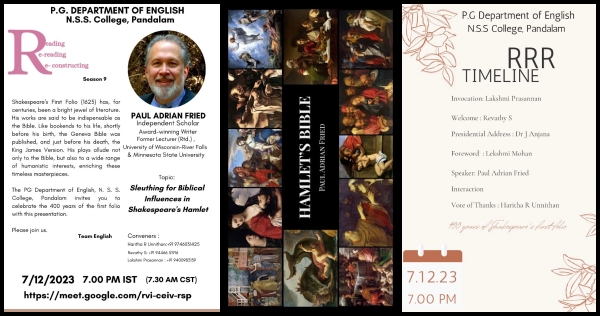
TRANSCRIPT: Presentation for Post Graduates, N.S.S. College, Kerala, India, 7 December, 2023

Image
TRANSCRIPT: Presentation for Post Graduates, N.S.S. College, Kerala, India, 7 December, 2023 Edited planned transcript of remarks delivered on 7 December, 2023, in an online presentation for the Post Graduate program, N.S.S. College, Kerala, India, 7 P.M. IST, 7:30 A.M. CST. (A few words and points below were cut from the live presentation for time considerations, and I made a few additional extemporaneous remarks, but for the most part, this is the transcript.) (I did not have time to talk about allusions that fit into the theme of orphaned children who find transcendent parents in others or in a heavenly parent, but perhaps some other time....) ~~~~~~~~~~~~~~~~~~~~~~~~~~~~~ Informal outline (followed by transcript): INTRODUCTION: [Disclaimers] - Contested times, contested scripture LIST OF BOOKS cataloging Bible allusions in Shakespeare, some open-access: Sleuthing scripture allusions in Hamlet CHANGE THOSE NAMES WITH YOU: Servant-Prince, & Renunciation of Fruits DOUBTING ...

Part 2, Hamlet and inherited debt (2 Kings 4:1-7): "when you are desirous to be blest, I’ll blessing beg of you"

Image
Last week I began considering Hamlet’s line to Gertrude, “when you are desirous to be blest, I’ll blessing beg of you” (3.4.192-3). [1] The idea of asking a blessing of a person in need led to Hebrew stories of Elijah and Elisha and the widow(s): Elijah asks a favor before doing the needed miraculous work. This week, I will consider a third prophet-and-widow story of Elisha (successor to Elijah, in 2 Kings 4:1-7) [2] in which a woman’s husband died and left the family in debt. The widow’s sons are to go into debt slavery to repay the husband’s debts. Elisha asks what she has (a jar of oil), and tells her to collect vessels from neighbors. She collects as many as they will give her. Elisha tells her to fill these with oil from her jar, which she does. The oil does not run out until all of the vessels she collected from her neighbors are full. As further instructed from Elisha, she sells these, and in this way, she pays off her dead husband’s debts, and her sons are thereby save...