Posts

Showing posts with the label Madness

Hamlet and Claudius I as nearly mirror images (Part 10, Claudius series)

Image
CLAUDIUS I, EMPEROR OF ROME, IS IN MANY WAYS A MIRROR IMAGE OF HAMLET, making “Claudius” a fascinating name choice for Hamlet’s uncle. In 1948, E. G. Berry explained this, drawing on Suetonius [1]: Claudius, like Hamlet, pretended to be mad or stupid as a survival strategy (74). [2] “Like Hamlet, Claudius is delayed and obstructed in his coming to his rightful authority [...]; Claudius has to remain in a state of pupillage to a late age, kept in that state by his uncle Tiberius, and Hamlet [...] spent a longer time than usual at Wittenberg and then [...] is detained a virtual prisoner by his uncle Claudius.” (76) Hamlet’s “extraordinarily loose, even obscene language in addressing Ophelia in III, i  and in the play scene” resembles Suetonius’ description of Claudius’ behaviors. (76) “In [...] ability and scholarship there is [...] likeness between Hamlet the scholar and the talented and scholarly Claudius. [...] denied authority and recognition by the usurping emperor.” (76-77) “...


Carl Jung, Saul's road to Damascus, and Hamlet's madness

Image
This Carl Jung quote made me think of Hamlet's dilemma and his descent into vengeful thoughts and actions:  "But what if I should discover that the least amongst them all, the poorest of all beggars, the most impudent of all offenders, yeah, the very fiend himself, that these are within me, and that I myself stand in need of the alms of my own kindness, that I myself am the enemy who must be loved. What then? Then, as a rule, the whole truth of Christianity is reversed: there is then no more talk of love and long-suffering; we say to the brother within us “Raca,” and condemn and rage against ourselves. We hide him from the world, we deny ever having met this least among the lowly in ourselves, and had it been God himself who drew near to us in this despicable form, we should have denied him a thousand times before a single cock had crowed. Anyone who uses modern psychology to look behind the scene not only of his patients’ lives, but more especially of his own life—and the m...

Part 45: Ophelia's Terrible Awakening and Liberation

Image
Part 45: Ophelia's Terrible Awakening and Liberation Ophelia and Gertrude awaken from earlier naivete and become liberated from aspects of an oppressive and inauthentic patriarchy, Ophelia from her father, and Gertrude from her husband. Consider Ophelia: Ophelia had been excited to spend “free and bounteous” time with Hamlet [1], to be wooed by him “in honorable fashion” [2], to receive from him “almost all the holy vows of heaven” [3], probably a marriage proposal, not snares [4] to steal her “chaste treasure” [5] as her brother and father fear and suspect. She is forbidden by Polonius to see Hamlet or receive his letters [6], but used as bait by him and Claudius for their spying [7]. Gertrude tells her that she hopes Ophelia’s “virtues” will help to heal Hamlet [8]. Hamlet does not tell her that he has spoken with an apparition like the ghost of his father, but seems to fear that those he loves most may be at risk at least of suffering purgatory for sins, apparently like his fa...

Part 41: Love Madness: Ophelia, Gertrude, and Helen of Troy

Image
QUEEN: [...] for your part, Ophelia, I do wish That your good beauties be the happy cause Of Hamlet’s wildness. So shall I hope your virtues Will bring him to his wonted way again, To both your honors. OPHELIA  Madam, I wish it may.  (3.1.42-47)   Queen Gertrude expresses hope that Ophelia’s father Polonius may be correct in thinking that Hamlet is mad for the loss of Ophelia’s love. Shakespeare often described love as a madness in need of a cure.[1] This may be more significant than one might assume at first glance, for at least three reasons.   First, Gertrude’s comments apply not only to her son but also to her new husband, even if she doesn’t know it. For Claudius to kill his brother and take the throne and his brother’s wife seems a kind of madness. Gertrude’s “virtues” were not enough to cure him. Secondly, “The face that launched a thousand ships” is the famous Christopher Marlowe line describing the beauty of Helen of Troy. To steal her, Paris risked war, w...

Part 23: Queen Ophelia and the male gatekeepers defining her madness

Image
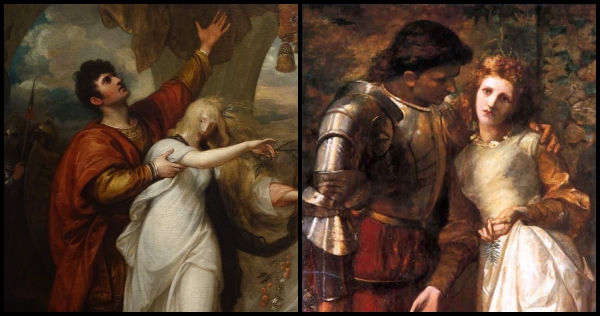
Ophelia is too often portrayed as limp, soft, and either blank-eyed in her apparent innocence, or wide-eyed in her madness, as shown in these paintings by William Gorman Wills (c.1880) and Benjamin West (detail, 1792). This is based more on artistic and dramatic assumptions than on the text of the play. When we first see her brother Laertes in 1.2, he is reluctant to speak in an audience with the king who asks him repeatedly about his requested permission to return to France and scolds him for his shyness:   CLAUDIUS: What is ’t, Laertes? You cannot speak of reason to the Dane And lose your voice. What wouldst thou beg, Laertes, That shall not be my offer, not thy asking? [...] What wouldst thou have, Laertes? (1.2.43-51) Claudius is a bully, and also bullies Hamlet later in the same scene about his mourning of his father. (1.2.96-109) But Ophelia in her “mad” scene shows no shyness, and asks the first question: OPHELIA: Where is the beauteous Majesty of Denmark? (4.5.26) And if Ha...

Part 22: Ophelia's Opening Questions

Image
Shakespeare occasionally reminds us of the Elizabethan slang, that men have a “thing” and women a “nothing.” Ophelia’s name begins with an “O,” an emptiness at least potentially waiting to be filled. Questions are analogous to this. Nature abhors a vacuum; many questions seek answers, or are at least open to mysteries, first attempts to name their boundaries. Hamlet is famous for asking, To be or not? But he also resists certain questions, telling Rosencrantz and Guildenstern not to assume they can pluck the heart of his mystery. Bridget Gellert Lyons (1977), R. Chris Hassel, Jr. (1998),  Katharine Goodland (2006), and Ruben Espinosa (2011) are among those who notice in Ophelia early in the nunnery scene an echo of the ubiquitous images of Mary reading a book, perhaps of psalms, when visited by the angel at the Annunciation. In Luke’s gospel, Mary’s first sentence to the angel is a question: ““How shall this be?” But Mary is open to the angel’s mystery: “be it unto me accordi...

Part 13: Ophelia, Hamlet, and 13 ways of looking at madness

Image
Often we speak of Ophelia as having really gone mad, while Hamlet only pretends . But in fact the play uses the word “mad” in many ways, as do critics. So, with a nod to Wallace Stevens’ poem title [1], a list: MADNESS AS DEMONIC POSSESSION: Horatio worries that the ghost is demonic and “might deprive [Hamlet] sovereignty of reason / And draw [him] into madness” (1.4.77-82). MADNESS AS FEIGNED: After meeting with the ghost (1.5), Hamlet says he will “put on” “an antic disposition” (1.5.189-192), as did Odysseus, King David, and Amleth in the Saxo Grammaticus source; but Hamlet’s encounter with the ghost may actually be driving him insane… [Edit 9/24/2023: In 3.1.7-10, Guildenstern also comments on Hamlet's feigned madness: "Nor do we find him forward to be sounded, But with a crafty madness keeps aloof When we would bring him on to some confession Of his true state." ] MADNESS AS WHAT LOST LOVE CAN DO: Polonius believes Hamlet has been made insane by the los...

Part 11: "Mad" Ophelia grasps "tricks i' th' world" and Denmark's corruption

Image
Too many critics, readers and viewers of Shakespeare’s Hamlet assume that Ophelia’s madness is merely an inability to deal with emotions, mostly about her father and Hamlet. Showlater cites Theodore Lidz (a typical example of this) who claims “Ophelia goes mad because she fails in the female developmental task of shifting her sexual attachment from her father ‘to a man who can bring her fulfillment as a woman.’” (294) [1] Too few consider that her madness may have been as much, or more, caused by a startling epiphany about Denmark’s corruption, understanding it perhaps even better than her father. Why would (mostly male) critics have neglected this possibility for so long? A tendency among critics to keep Ophelia out of politics, like keeping women out of voting booths? A “GENTLEMAN” and Horatio speak about Ophelia the first we hear of her having gone mad: GENTLEMAN: She speaks much of her father, says she hears There’s tricks i’ th’ world, and hems, and beats her heart, Spurns envious...

Part 10 (B): Ophelia via Elaine Showalter’s 1985 “Representing”

Image
Excerpts from Elaine Showalter, “Representing Ophelia: Women, Madness, and the Responsibilities of Feminist Criticism” [1]: …Though she is neglected in criticism, Ophelia is probably the most frequently illustrated and cited of Shakespeare’s heroines.(282) …Why has she been such a potent and obsessive figure in our cultural mythology? [...] how should feminist criticism represent Ophelia in its own discourse? What is our responsibility towards her as character and as woman? …Shakespeare gives us very little information from which to imagine a past for Ophelia.  [...] Her tragedy is subordinated in the play; unlike Hamlet, she does not struggle with moral choices or alternatives. [283] [PF note: Showalter’s essay is an important one, but on this point I would disagree: Ophelia struggles to know what to think of Hamlet’s love and perhaps her good fortune, to grasp what it may mean to become Denmark’s next queen; she struggles against disapproval of her brother and father, against ...