Posts

Showing posts with the label Anne Boleyn

Hamlet's Use of the Trojan War & Consequences of the Judgment of Paris

Image
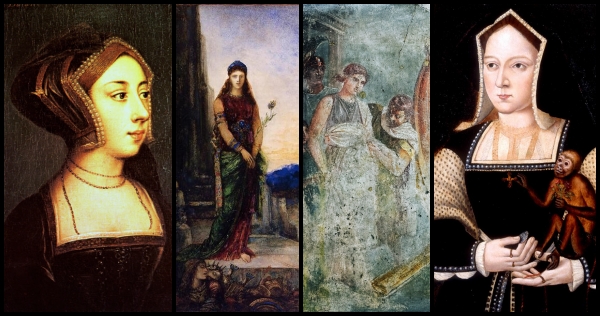
Why does Shakespeare’s “Hamlet” refer to the Trojan war? Some may think that Trojan War references in Shakespeare merely represented a Renaissance obsession with things Greek. But the Trojan War speech in Hamlet also alludes to (1) a Greek-themed Marlow play [1]; (2) the widow Hecuba’s grief [2] (a contrast with Gertrude); (3) the pause of Pyrrhus (like Hamlet hesitating to kill Claudius at prayer) [3]. When the players arrive in Elsinore and perform a speech at Hamlet’s request, he asks for a speech about Hecuba, mother of Paris, witnessing the revenge killing of her husband, King Priam. Priam is about to be killed by Pyrrhus, son of Achilles, in revenge for Priam's son Paris having killed Pyrrhus’ father. Revenge begets revenge and more grieving widows, a terrible cycle. Appropriate for Hamlet. “The Judgment of Paris” involves Paris having to choose the fairest goddess. Each goddess offers bribes, with Aphrodite promising Helen of Troy. Paris chooses Aphrodite, and soon abducts ...
Part 41: Love Madness: Ophelia, Gertrude, and Helen of Troy

Image
QUEEN: [...] for your part, Ophelia, I do wish That your good beauties be the happy cause Of Hamlet’s wildness. So shall I hope your virtues Will bring him to his wonted way again, To both your honors. OPHELIA  Madam, I wish it may.  (3.1.42-47)   Queen Gertrude expresses hope that Ophelia’s father Polonius may be correct in thinking that Hamlet is mad for the loss of Ophelia’s love. Shakespeare often described love as a madness in need of a cure.[1] This may be more significant than one might assume at first glance, for at least three reasons.   First, Gertrude’s comments apply not only to her son but also to her new husband, even if she doesn’t know it. For Claudius to kill his brother and take the throne and his brother’s wife seems a kind of madness. Gertrude’s “virtues” were not enough to cure him. Secondly, “The face that launched a thousand ships” is the famous Christopher Marlowe line describing the beauty of Helen of Troy. To steal her, Paris risked war, w...

The Affair of Gertude and Claudius in light of Anne Boleyn

Image
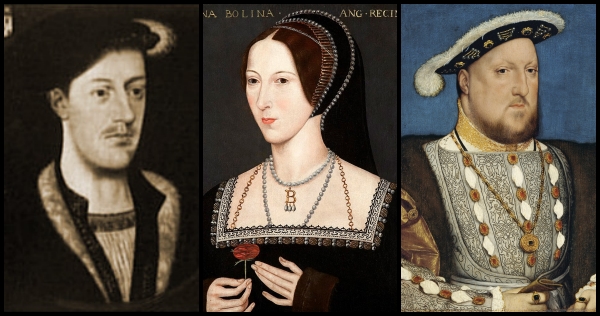
When audiences and readers in our time encounter Hamlet, they may wonder: What is the fuss about a royal affair, and a queen marrying the brother of her dead husband? Royals had affairs often, and it’s now legal in many places to marry the sibling of a deceased spouse. I have blogged in the past about Claudius, Gertrude, and the adulteries and alleged incest of Henry VIII [1], but it is also important to consider Gertrude and Claudius in light of the accusations of adultery and incest against Anne Boleyn. Many know that Henry’s second wife, Anne Bolelyn, was accused of adultery, incest, and treason, and beheaded for it. Fewer are aware that five men were accused of various things in association with Anne’s scandal (adultery, incest, treason, plotting assassination), and were also executed. These included George Boleyn, Viscount Rochford (the Queen’s brother); Henry Norris, Mark Smeaton (musician at court), William Brereton, and Francis Weston (thought to be his image at left). So not o...

How Hamlet toyed with Elizabethan expectations: Incestuous marriage, adultery, right succession

Image
If Londoners in Shakespeare’s England heard that his play, Hamlet, was in part about the incestuous marriage of a king, what did they expect? Elizabeth was still queen when it was first performed, and still remembered long after James took the throne. Some thought she was only legitimate if her father, Henry VIII, had been right to divorce his first wife, Catherine of Aragon, over claims that the marriage violated biblical laws.[1] There had been a popular earlier play, A Looking Glass for London, about a king saved from an incestuous marriage by an act of God (lightning bolt). The king heeds a prophet sent by God and repents. Happy ending. Such a play could affirm Protestant Elizabethan hopes, that yes, biblically incestuous marriage is wrong, and Henry VIII was right to divorce Catherine, although the pope disagreed. And yes, he was right to break with Rome to get his divorce. Therefore, his second marriage was legitimate, Elizabeth was legitimate, and all was right with the ...

Hamlet and the Incestuous Marriages of Claudius and Henry VIII - via John Erskine Hankins

Image
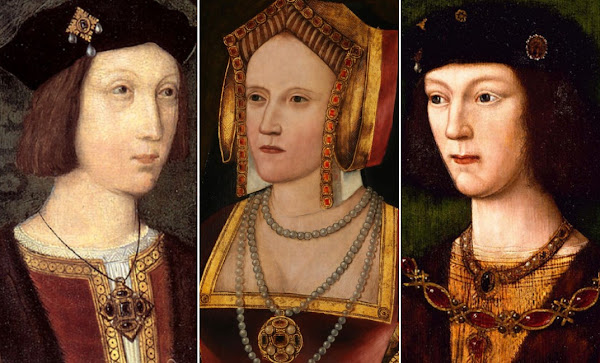
Shakespeare certainly wrote of Claudius and Gertrude’s “incestuous” marriage with Henry VIII in mind. Early audiences recognized it. In teaching the play, is it a mistake to omit that context? [Left: Arthur Tudor, Prince of Wales (1486-1502), "regarded as the only surviving contemporary portrait"; circa 1500. Anglo-Flemish School. Private collection, Hever Castle, Kent. Public domain. Image via Wikimedia . Center: Catherine of Aragon (1485–1536), originally identified as Catherine Parr, but now recognized as Catherine of Aragon. Unidentified painter. 16th Century. Lambeth Palace. Public domain, via Wikimedia . Right: Henry VIII of England (1491-1547), circa 1509. Attributed to Meynnart Wewyck. Denver Art Museum. Public domain. Image via Wikimedia ]. From “The Character of Hamlet,” by John Erskine Hankins* (1941), p.101: ~~~ It will be remembered that Henry VII's eldest son Arthur was married to Katherine of Aragon to cement an alliance between England and Spa...