Posts

Showing posts with the label Cassandra

Hamlet's Use of the Trojan War & Consequences of the Judgment of Paris

Image
Why does Shakespeare’s “Hamlet” refer to the Trojan war? Some may think that Trojan War references in Shakespeare merely represented a Renaissance obsession with things Greek. But the Trojan War speech in Hamlet also alludes to (1) a Greek-themed Marlow play [1]; (2) the widow Hecuba’s grief [2] (a contrast with Gertrude); (3) the pause of Pyrrhus (like Hamlet hesitating to kill Claudius at prayer) [3]. When the players arrive in Elsinore and perform a speech at Hamlet’s request, he asks for a speech about Hecuba, mother of Paris, witnessing the revenge killing of her husband, King Priam. Priam is about to be killed by Pyrrhus, son of Achilles, in revenge for Priam's son Paris having killed Pyrrhus’ father. Revenge begets revenge and more grieving widows, a terrible cycle. Appropriate for Hamlet. “The Judgment of Paris” involves Paris having to choose the fairest goddess. Each goddess offers bribes, with Aphrodite promising Helen of Troy. Paris chooses Aphrodite, and soon abducts ...
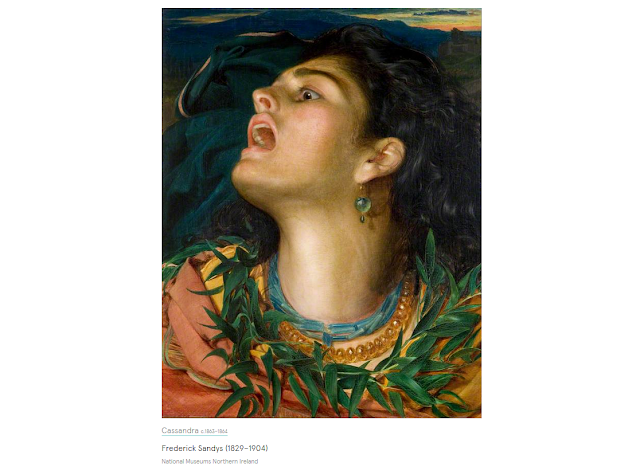
Hamlet as Cassadra

Image
Shakespeare’s Hamlet doesn’t merely have a number of allusions to prophets among its many biblical allusions; the play may serve as a reflection on what it means to be prophetic, and to strive to be more effectively and authentically prophetic, for both individuals and for art, and perhaps especially in politically dangerous contexts.  What does it help to oppose immoral and criminal behavior among the powerful, or in a corrupt system, if the result is that one’s life is snuffed out without reforming the corruption one spoke out against? What does it help to claim one is a prophet, sent to correct injustices and corruption, if one is part of the corruption (prince Hamlet in a reckless moment kills Polonius), or if one drives people away (Hamlet bids Ophelia get to a nunnery, offends his mother and uncle) instead of winning them over to one’s view? (In this way, many prophets are dismissed because they are imperfect messengers. Instead of heeding or debating the message, the st...