Posts

Showing posts with the label Pericles

Fifth Day of Christmas, Paul and Agrippa, Dec 29 (Series, Part 5.c.)

Image
Paul and Agrippa, not Becket? Fifth Day of Christmas, December 29: Bible readings for morning and evening prayer in Shakespeare’s England followed their own schedule, unrelated to feasts such as St. Thomas Becket (removed by Henry VIII and the English Reformation) [1]. Morning: Psalm 29 - Geneva Introduction: “The Prophet exhorteth the princes and rulers of the world (which for the most part think there is no God.)” [2]. Lesson 1: Isaiah 61 speaks of God’s anointed (which Christians interpreted to be Jesus) setting prisoners free. - At least six Shakespeare plays involve prisoners, real or figurative, some set free only in death [3]. - The point here is not that each of these plays alludes to Jesus as liberator of prisoners, but that the Bible readings in English churches (where Shakespeare’s attendance was required by law) shaped and influenced the development of religious and literary motifs related to prisoners and their liberation. Lesson 2: Acts 26 - Prisoner St. Paul encoun...

Shakespeare's Pericles - Royal Shakespeare Company on Tour in Chicago

Image
We went on pilgrimage to Chicago over the weekend to see Shakespeare's 𝙋𝙚𝙧𝙞𝙘𝙡𝙚𝙨 performed by the Royal Shakespeare Company at the Chicago Shakespeare Theater on Navy Pier. The production was absolutely stunning: - Its set features dramatic use of ropes (as seen in the CST post below) which evokes a sailing ship for the sea-journeys of Prince Pericles. - A surprising number of key scenes incorporate masterfully choreographed dance to convey the competition for, and wooing of, a princess to be the wife of the prince. - The acting was excellent, making the words and lines clear, but also conveying their emotion, and also adding humor and fun. - The performance also included music in very effective ways! This was not merely pre-recorded, but performed live by the actors themselves. - Some members of the playing company had to play more than one (strongly contrasting!) role: they switched with seeming effortlessness and brought each new role to life. Even the smallest grunt o...

Part 14: Ophelia's figuratively incestuous family

Image
Ophelia’s brother and father are overly protective of her chastity [1], too suspicious that Hamlet might take advantage of her. Like a lover or spouse, Laertes leaving for France tells Ophelia, “do not sleep, But let me hear from you” [2]. Biblical sayings urge welcome for strangers, which involves risk; but they also discourage fear [3]. Laertes, in contrast, repeatedly urges Ophelia to fear Hamlet [4]. After warning her to be chaste, Laertes tells Ophelia to remember his advice. Ophelia replies, "'Tis in my memory lock'd, / And you yourself shall keep the key of it."[5] Chastity can be a virtue, keeping something of great value secret, disclosed only in an intimate, faithful relationship. Ophelia’s promise to Laertes is analogous: she has the feminine lock and he the masculine key, suggesting a figuratively incestuous relationship. Polonius mistrusts his children’s secret, so he figuratively rapes Ophelia's memory by demanding she disclose it. [6] Ten lines ea...

Begging and Poor in The Comedy of Errors (1594)

Image
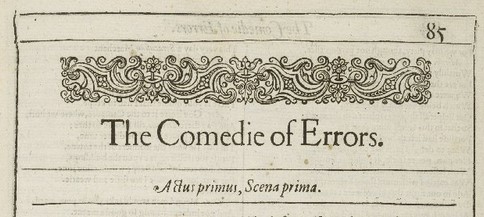
In The Comedy of Errors, "beg" occurs only four times; "poor," 10. The story contains two sets of twins, and each set bears the same name: Two of Antipholus, two of Dromio, the former raised to be masters, the latter bought and raised to be servants (slaves). - Because "their parents were exceeding *poor*," the Dromio twins were "bought and brought up to attend" Egeon's sons (1.1, an act of charity, or exploitation, or both). - But Egeon of Syracuse has traveled to Ephesus as a refugee to find his later-separated sons, risking death by execution because Syracuse and Ephesus are at war. - Solinus, Duke of Ephesus, tells Egeon to *beg* or borrow the money for his ransom to spare his life (1.1). - Luciana, sister-in-law to Antipholus of Ephesus, tells her sister that the love she *begged* for her sister from the Antipholus she believed was her sister's husband, he begged of her (4.2, because unknown to her, the Antipholus who begged lov...