Posts

Showing posts with the label Jephthah

Claudius, Hamlet, and Chaucer's Physician's Tale (Part 4, Claudius series)

Image
Scholars note as many as nine Shakespeare plays either based on Chaucer tales, or strongly influenced by them [1]. So finding points of similarity between Hamlet and Chaucer’s “The Physician’s Tale” may come as no surprise to fans of the two poets [2]. Chaucer may have influenced Shakespeare’s naming of Hamlet’s uncle, “Claudius,” as there are two Claudiuses of questionable moral character in the Chaucer tale. - In Chaucer, Appius Claudius lusts after Virginia and is willing to act immorally to possess her. - In Hamlet , Claudius wants to possess both the throne and his brother’s wife, and is willing to kill to obtain and keep them. - Chaucer’s Appius Claudius employs another Claudius, a “churl,” to lie for him in court. - Hamlet’s uncle Claudius enlists the help of Polonius, Rosencrantz, and Guildenstern, to spy on the prince. - Chaucer’s Virginia is virtuous and hopes to be saved from scandal. - In Hamlet , Gertrude and Ophelia are virtuous (or “seeming virtuous” as the ghost calls h...
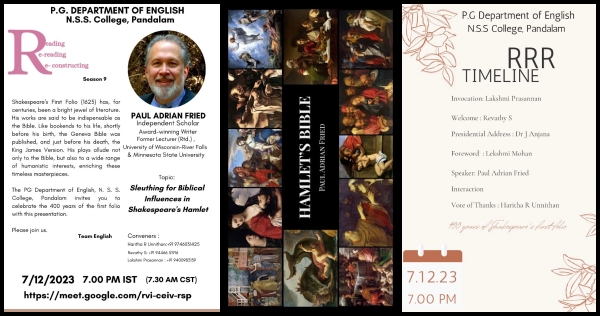
TRANSCRIPT: Presentation for Post Graduates, N.S.S. College, Kerala, India, 7 December, 2023

Image
TRANSCRIPT: Presentation for Post Graduates, N.S.S. College, Kerala, India, 7 December, 2023 Edited planned transcript of remarks delivered on 7 December, 2023, in an online presentation for the Post Graduate program, N.S.S. College, Kerala, India, 7 P.M. IST, 7:30 A.M. CST. (A few words and points below were cut from the live presentation for time considerations, and I made a few additional extemporaneous remarks, but for the most part, this is the transcript.) (I did not have time to talk about allusions that fit into the theme of orphaned children who find transcendent parents in others or in a heavenly parent, but perhaps some other time....) ~~~~~~~~~~~~~~~~~~~~~~~~~~~~~ Informal outline (followed by transcript): INTRODUCTION: [Disclaimers] - Contested times, contested scripture LIST OF BOOKS cataloging Bible allusions in Shakespeare, some open-access: Sleuthing scripture allusions in Hamlet CHANGE THOSE NAMES WITH YOU: Servant-Prince, & Renunciation of Fruits DOUBTING ...

Religious and Biblical allusions and plot echoes in Hamlet 1.2

Image
Here are a few key religious and biblical allusions in Hamlet 1.2 (not an exhaustive list): ~~~~~ CLAUDIUS: ...our sometime sister, now our queen,/ [...] Taken to wife. (1.2.8-14) For Shakespeare’s English audience, this would have struck a nerve: Henry VIII had married his dead brother’s widow, Katherine of Aragon, but later (after no living sons and an affair with Anne Boleyn) claimed it was a biblically forbidden marriage.  [For more on the biblical passages related to "incestuous marriage" see this link: https://pauladrianfried.blogspot.com/2022/06/the-bible-henry-viii-claudius-and.html ] Therefore he claimed he needed an annulment, which triggered the English Reformation and many executions of Protestants as heretics (by Mary I) and of Catholics as treasonous (by Henry, Edward, Elizabeth). So audiences would have viewed Claudius as being like a Henry VIII who had not repented of his incestuous marriage. ~~~~~ CLAUDIUS: Young Fortinbras, Holding a weak supposal of our...

Part 6: Ophelia's Long Purples

Image
In Act 4, scene 7, Gertrude mentions a particular purple flower that Ophelia includes in the garlands she hangs on the willow: “...long purples, That liberal shepherds give a grosser name, But our cold maids do dead men's fingers call them.” (4.7.193-196) [1] The Queen wishes to avoid saying the “grosser name” that “liberal shepherds” have for a purple flower that looks like “dead men’s fingers”: What might the grosser name be? Not too hard to guess: phallus flowers, purple penises. These “long purples” are not the only flower Ophelia includes in her “fantastic garlands,” but they are the only flowers Gertrude uses 19 words to describe instead of one. In a 1970 essay, J.G. McManaway [2] wrote of how Ophelia in her madness resembles Jephthah’s daughter “bewailing” her virginity, or in other words, mourning the fact that she would soon die childless, never having known the joys of being a spouse and mother. But Ophelia’s garlands with “long purples” are more festive than Jephthah’s d...

Fortuna & Gambling in Hamlet & its Biblical Echoes

Image
Sometimes what looks like a gamble may be a risk taken in faith. (Does gambling for money parody such faith?) FORTUNE AND GAMBLING IN HAMLET : THE DEAD KING HAMLET GAMBLED, in an agreement with Old Fortinbras, to engage in single combat, described by Horatio in 1.1. The survivor won the loser’s land. We learn in 5.1 that this combat took place on the day that Hamlet was born.[1] CLAUDIUS BETS that Hamlet will win the duel with Laertes in 5.2, though he and Laertes plan to kill Hamlet. Claudius takes his chances that the plot will succeed, but to increase his chances, a poison cup is a back-up plan, and instead of Laertes merely using an "unbaited" rapier (with no blunt safety tip), Laertes also anoints the rapier with poison. This combines cheating with gambling. [EDIT: Grace Tiffany of Western Michigan University adds to the list of gambling references: Gertrude's marriage vows are "false as dicers' oaths" (3.4), referring to how gamblers, wh...