Posts

Showing posts with the label Agony in the Garden

Does Shakespeare’s Hamlet depict religiously shaped or motivated regicide?
Image
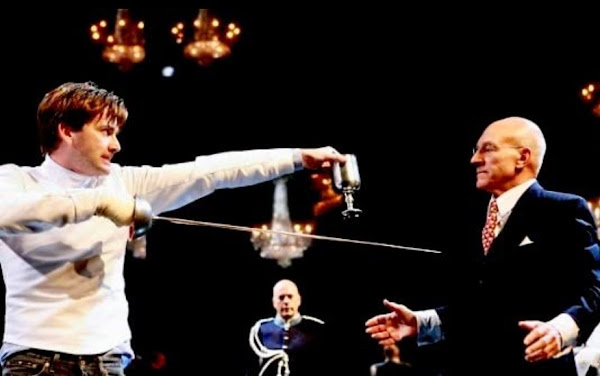
Does Shakespeare’s Hamlet depict religiously shaped or motivated regicide? [1] Given its many religious and biblical allusions and plot echoes, I would argue that it does. [David Tennant (L) as Hamlet and Patrick Stewart (R) as Claudius in the 2009 film, Hamlet , dir. Gregory Doran. Source: IMDB . Fair use.] Dr. Arthur F. Marotti gave a talk at Fordham in late October of 2013 in which he noted, “In the last years of Elizabeth’s rule people believed something was rotten in England—though perhaps not rotten enough to justify regicide. ” [2] Marotti has written numerous books [3] about Early Modern literature and religion, including a 2004 essay with Ken Jackson on “The Turn to Religion” in Shakespeare studies. In an abstract for a more recent (2017) essay [4], Marotti notes that “Shakespeare's plays may not stage religiously motivated regicides…,” with “may” being the operative word here: Scholars may disagree on this point. But what about Hamlet? Recognizing that H...
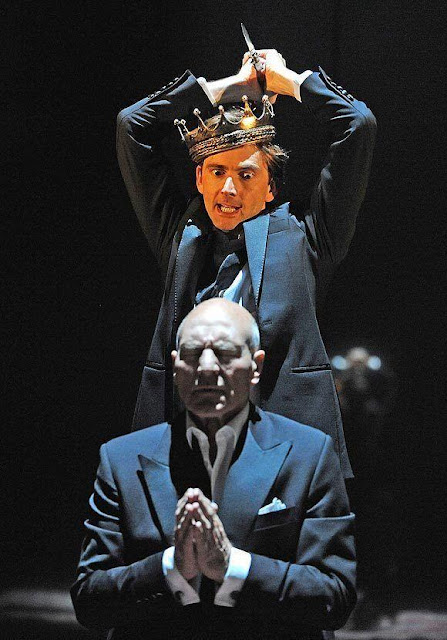
HAMLET PRAYER SCENE: IRONIC & CLASHING BIBLICAL ECHOES

Image
Claudius at prayer (3.3) echoes (and parodies) Jesus’ agony in the garden, praying that “this cup” pass from him. —But Jesus ends with “thy will be done.” —The echo is ironic for Claudius: He knows what he must do to repent, but refuses to give up the throne and queen he acquired by killing his brother. —Unlike Jesus, Claudius ends, *My* will be done, not God’s. Hamlet has a chance to kill Claudius in this scene, but spares him. —This echoes the biblical David who twice spared King Saul (1 Sam 24 & 26). —Yet the echo is ironic: Whereas David spared Saul out of mercy and respect for the king as God’s anointed, Hamlet intends to catch Claudius later and kill him when he’s doing something unholy, thereby damning him. As others have noted, Hamlet here wants to play God. —Ã…lso ironic: Hamlet misinterprets Claudius’ effort to pray. Like the play in general, this scene reminds us that looks can be deceiving: a king at prayer and a prince sparing a life may both be prisoners of ...