Posts

Showing posts with the label Lewis Hyde

Part 47: Ophelia's “O” and the Virtues of Nothingness

Image
Ophelia in Hamlet represents a paradox about both the injustice and virtue of nothing, emptiness, poverty: Ophelia is an intelligent young woman [1], lectured, silenced [2], taken for granted [3], told what to do, where to go [4], and whose death is linked to crown-envy [5], a cautious way for Gertrude to blame the envious actions of Claudius for Ophelia’s death. When Hamlet makes bawdy remarks at the playlet, “The Mousetrap,” Ophelia says, “I think nothing” [6]. In Elizabethan slang, women have “nothing” between their legs, while men have a “thing.”[7] “Nothing” is a theme in other Shakespeare plays: - A self-centered Richard II, losing his throne, says, “I must nothing be” [8]. - King Lear wants his favorite daughter Cordelia to be best at expressing her love for her father, but she refuses to play the game. Lear tells her “Nothing can come of nothing” [9]. By the end, Lear will be emptied and learn poverty. Many world religions emphasize the virtue of humility and spiritual povert...

Illegal to be Beggar Lazarus in Shakespeare's England (Part 3)

Image
The ghost in Shakespeare's Hamlet says that the poison Claudius poured in his ear made his skin all "lazar-like," referring to a gospel parable about a beggar with sores all over his skin. But if the parable from Luke 16 about the beggar Lazarus and the Rich Man had taken place in the Elizabethan England of Shakespeare's time, it would have been illegal to be the beggar Lazarus. [Restored Frieze Panel, Lincoln Cathedral, UK (about 99 miles northeast of Shakespeare's home in Stratford Upon Avon): Originally dating from the 12th Century. The death of Lazarus (top) and Dives (the rich man) in Hell (below). © Copyright J.Hannan-Briggs and licensed for reuse under Creative Commons Licence .] Otherwise, we might observe that the gospel story of a poor man lingering outside a rich man's gate could not have taken place in England, because the beggar Lazarus would likely be placed in stocks on display to be publicly humiliated, whipped, and sent back to...

SAA Seminar: “Shakespeare & the Mind: Cognition, Emotion, Affect"

Image
SAA Seminar-by-Zoom This past Saturday (13 June) I participated in a Zoom meeting for the seminar, “Shakespeare and the Mind: Cognition, Emotion, Affect,” which had been postponed due to COVID-19 and the demands it created for those switching to online instruction. The seminar was for the 2020 conference of the Shakespeare Association of America, which had been scheduled for 15-18 April 2020 in Denver, Colorado, but the in-person element of the conference had been canceled because of the pandemic. Many of the events met over Zoom, and some posted these on social media for others to audit, but this was a bonus not in the original job description for seminar and workshop leaders (no one expected last June that there would be a pandemic, so familiarity with Zoom or other online conferencing platforms was not a requirement, and doing the extra work of managing auditors was also not expected, understandably, but it was unfortunate to miss out on so many of the conference events). Sem...

Doubting Thomas in Hamlet: Choosing Reductionism or the Rabbit Hole?

Image
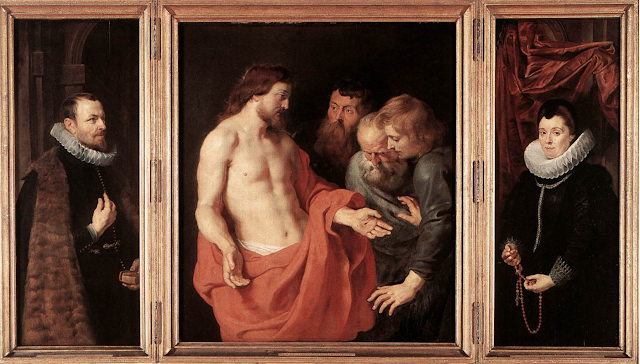
Sometimes a scholar says something about a Shakespeare play that is not meant as a final answer, but one of many possible insights. Then someone takes it the wrong way, and like a bad game of telephone, others are repeating it, also taking it the wrong way. Oops. [Image: Peter Paul Rubens, ca. 1613-1615. Royal Museum of Fine Arts, Antwerp, via Wikipedia .] Example: Let’s say some reader of Hamlet centuries ago observed that Horatio in the first scene is treated like a doubting Thomas (Thomas being the one who, according to the Gospel of John, was absent when the risen Jesus supposedly appeared to the disciples; he would not believe until he saw it himself, and put his hands in the wounds, he said). The early reader observes, “Look how Shakespeare has used the doubt of a skeptical Horatio regarding the ghost to help convince perhaps an otherwise skeptical audience that this play will assume ghosts or supernatural specters are real!” This doesn’t mean that the doubting Thomas...

WHY GIFT-DYNAMICS MATTER FOR HAMLET & THE BIBLE: (Part 16) Labors of Gratitude and Regret in Hamlet

Image
This is the latest installment in a multi-part series examining how characters interact in Hamlet, offering opportunities, gifts, planting seeds for future inspiration, or for changes of heart & mind. It follows ideas from Lewis Hyde (“The Labor of Gratitude,” a chapter in his book, The Gift: Imagination and the Erotic Life of Property) . For more notes on the series and an index of previous posts in this series, see the end of this post. ~~~~~~~~~~~~~ WHY GIFT-DYNAMICS MATTER FOR HAMLET & THE BIBLE Why might it matter whether, or how, characters in Shakespeare’s Hamlet demonstrate labors of gratitude and regret, or interact in ways that seem to conform to the transformative dynamics of gift exchange? Why does it matter that Claudius repeatedly refuses such moments of grace? What does it matter that so many other characters seem inclined toward some kind of transformation? And how might such interactions relate to biblical influences in the play? The answer to these questi...

Hamlet & Horatio's Friendship: Mutual, Reciprocal, Transformative, Free: (Part 15) Labors of Gratitude and Regret in Hamlet

Image
This is the latest installment in a multi-part series examining how characters interact in Hamlet, offering opportunities, gifts, planting seeds for future inspiration, or for changes of heart & mind. It follows ideas from Lewis Hyde (“The Labor of Gratitude,” a chapter in his book, The Gift: Imagination and the Erotic Life of Property) . For more notes on the series and an index of previous posts in this series, see the end of this post. ~~~~~~~~~~~~~~~~~~~~~~~~~~~~~~~~~~~~~~~~~~~~~~~ [Detail from 1839 painting by Ferdinand Victor Eugène Delacroix (Public Domain)] Horatio and Hamlet enjoy a special friendship , though perhaps any friendship with a prince might at times seem one-sided. Horatio seems to have left Wittenberg of his own free will to honor the death of his king, his friend’s father. He was not commanded to come. When Hamlet asks in 1.2 what brings him to Denmark, Horatio jokingly says “A truant disposition,” an answer Hamlet will not accept because he knows Hora...