Posts

Showing posts with the label Rosencrantz & Guildenstern

Hamlet, hero to the English for Rosencrantz and Guildenstern's deaths?

Image
English audiences - after recent attempted invasions by the Spanish Armada, and anticipating more - may have felt Hamlet was their hero, to change Claudius’ secret letter that ordered Hamlet's death so that Rosencrantz and Guildenstern are executed instead. Early audiences may have opposed any suggestion of oppression by a foreign power, Spanish or Danish. Hamlet and his former school-friends-turned-spies had been sent by Claudius, who claimed they must collect England’s "neglected tribute" (3.1), like insurance payments to organized crime: Pay, and we won't hurt you. It may have seemed to them satisfying that the rebellious, "mad" Danish prince would change the letter intended to bring about his own death, so that Rosencrantz and Guildenstern would be executed by the very English from whom the three were told to collect this tribute. Although Elizabeth prohibited speculation about her successor, many knew that James of Scotland, who had married Princess A...
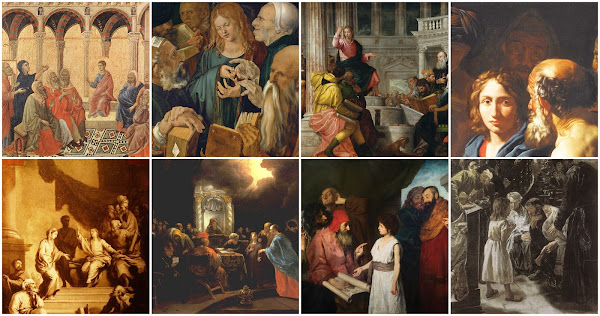
INDEX: Hamlet in 3.2 as the boy Jesus lost and found (Luke 2)

Image
In January of 2023, I began a 12-part series of posts regarding Hamlet's allusion to himself as like the boy Jesus, lost and found in the temple, amazing and astonishing the temple elders and his parents, a story from Luke 2:46-52. This is a very ironic allusion. The index of posts is below: Posts in this series: (Part 1) Hamlet as the Boy Jesus among Temple Elders https://pauladrianfried.blogspot.com/2023/01/hamlet-as-boy-jesus-among-synagogue.html (Part 2) Hamlet as boy Jesus among Temple Elders: Historical-Artistic Background https://pauladrianfried.blogspot.com/2023/02/hamlet-as-boy-jesus-among-temple-elders.html (Part 3) Hamlet as the boy Jesus among Temple Elders: A closer look https://pauladrianfried.blogspot.com/2023/02/hamlet-as-boy-jesus-among-temple-elders_14.html (Part 4 ) Dissonance and Irony in Hamlet's 3.2 Allusion to Luke 2 https://pauladrianfried.blogspot.com/2023/02/part-4-dissonance-and-irony-in-hamlets.html (Part 5) The targets of ...

(Part 1) Hamlet as the Boy Jesus among Temple Elders

Image
~~~~~~~~~~~~~~~~~~~~~~ INDEX OF POSTS IN THIS SERIES: https://pauladrianfried.blogspot.com/2023/01/index-hamlet-in-32-as-boy-jesus-lost.html ~~~~~~~~~~~~~~~~~~~~~~~~~~~~~~~~~~~~~~~~~~~~~~~~ After the play-within-the-play, in conversation with Rosencrantz, Hamlet implies that he has amazed and astonished his mother like the boy Jesus did when his parents found him with the elders in the Temple. I’ve omitted some parts of the Hamlet text so as to focus more closely on the applicable parts below. Compare the text from the play, below, to the text from 2:46-52 (Geneva), which was read every January in Shakespeare's lifetime on the Sunday after Epiphany: [1] GUILDENSTERN: The King … Is …marvelous distempered.... The Queen your mother, in most great affliction of spirit, hath sent me to you. ...your behavior hath struck her into *amazement* and admiration. HAMLET: O wonderful son that can so *’stonish* [astonish] a mother! (3.2.325-356) [2] Compare Luke 2:46-52 (Geneva): 46 And i...

Hamlet and Cicero on Conscience

Image
“Conscience” in Hamlet is often in dialectic, or even process of formation; in Cicero, more idealized. Compare: HAMLET : O...that the Everlasting had not fix'd His canon 'gainst self-slaughter! (1.2.133-6) HAMLET : The play’s the thing Wherein I’ll catch the conscience of the King. (2.2.633-4) POLONIUS : We are oft to blame in this (’Tis too much proved), that with devotion’s visage And pious action we do sugar o’er The devil himself. CLAUDIUS (aside): ’tis too true! How smart a lash that speech doth give my conscience. (3.1.52-8) HAMLET : Thus conscience does make cowards of us all, And thus the native hue of resolution Is sicklied o’er with the pale cast of thought, And enterprises of great pitch and moment With this regard their currents turn awry And lose the name of action. (3.1.91-6) LAERTES : ...I’ll not be juggled with. To hell, allegiance! Vows, to the blackest devil! Conscience and grace, to the profoundest pit! I dare damnati...

Hamlet’s Unnamed Ghost of Jonah, and Elizabethan Executions

Image
In Hamlet, Shakespeare adapts the Saxo Grammaticus source tale by shortening the hero’s sea-voyage to England, having Hamlet change mode of transportation mid-sea to a pirate ship, like Jonah changing from a ship to the belly of a fish. I have written about this before , and about the Christian typology that viewed Jonah as prefiguring Jesus in the tomb . [Image: Pieter Lastman (1583–1633), "Jonah and the Whale," 1621. Museum Kunstpalast. Public domain. Via Wikipedia .] Yet in Hamlet , Jonah goes unnamed. Shakespeare is more explicit about other allusions in the play, as to Jephthah and other biblical figures. Yet he is strangely silent/implicit on others such as Jonah. Why leave Jonah unnamed? Is this merely an aesthetic/dramatic choice, or more? (More on that later.) Shakespeare also combines these Jonah elements of the sea-voyage with other elements, such as Hamlet’s discovery of Claudius’ letter ordering England to execute him, and his changing of the lette...

Irony & anxiety in Hamlet about the missing body of Polonius: Three Marys at the Tomb

Image
In Shakespeare’s Hamlet, three characters express anxiety about the missing body of Polonius: Rosencrantz (with Guildenstern), and Claudius. Strangely, this echoes what, in Christian tradition, came to be known as “the three Marys” at the tomb of Jesus, with Mary Magdalene in John 20:11-15 being especially verbal about her anxiety about the missing body. [More information below on these three images.] [Left: العربية: أيقونة المريمات الثلاثة. Icon of The Three Marys. 11th century, Nea Moni of Chios (Byzantine monastery, Greece). Public domain. Via Wikipedia . Right: Three Marys at the Tomb (Polski: Trzy Marie u grobu). Circa 1470, Nicolaus Haberschrack  (1454–1484). National Museum, Kraków. Public domain. Via Wikipedia .] This perhaps offers an ironic and even humorous feminizing of Claudius, Rosencrantz, and Guildenstern in the comparison. If Shakespeare offers such an ironic and playful contrast to evoke something in his audiences, what is the purpose? First,...

Why Rosencrantz & Guildenstern Must Die: Notes on Asimov on Hamlet, Part 6

Image
When a country's leader is responsible for many crimes, either in secret or publicly known, including the murder of one or the deaths of many, and he shrouds his actions in lies, what is to be done with old school-friends who tried to hitch their wagons to the dark star of the corrupt regime? Are they, essentially, complicit in the crimes and deserving some share of any punishment, should it come? Or were they just human beings who had average human ambitions to get ahead, and should not be held responsible for the evils in which they participated, even knowingly? These were questions asked by the Nuremberg trials after World War II, and that some asked after the Bush-Cheney regime with its scandals of torture and lies that got the U.S. into a war with Iraq that violated international law. They are questions that may soon be asked if Trump is replaced by Biden as U.S. president. And they are questions we might consider regarding Rosencrantz and Guildenstern in Shakespeare's Ha...