Posts

Showing posts with the label Weaving

Seeking Penelope in Ophelia & Hamlet: Hamlet & The Odyssey - Part 3
Image
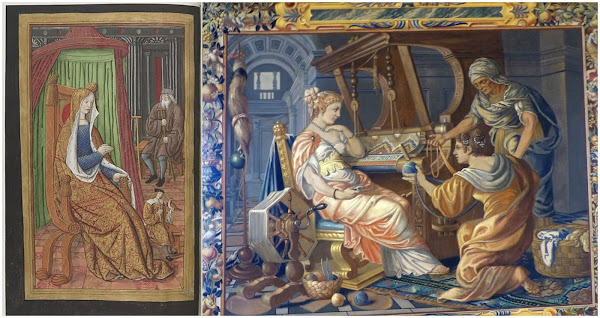
In The Odyssey, the weaving of Penelope, as a ruse to avoid her 108 suitors* later seems to find parallels not only in Ophelia and her sewing and reading, but also in Prince Hamlet. (Penelope and others fending off 108 suitors makes me think of the Buddhist idea of the importance of quieting the "monkey mind" of distractions!) Katherine Goodland has noted: Polonius wants Ophelia reading, to look like common images of Mary at the Annunciation. ( See this post .) [1] So now we have to think loosely, of Ophelia as associated in her sewing with Penelope, and in her reading, with Mary at the Annunciation; In a way, we might consider Penelope's weaving as a kind of compromised involvement with the world (to fend off suitors) and then a kind of prayer or repenting (unweaving, undoing the work), but also a kind of scheming for survival. Hamlet and Ophelia both have rhythms of compromised involvement in their world, followed by types of repenting or undoing: They weave...

Laertes in Hamlet & the Odyssey - Part 2

Image
Can anyone recommend good books or articles that explore connections between Laertes in Hamlet and Laertes in The Odyssey ? Yesterday (8/4/2022) I posted about Shakespeare’s choice of the name Laertes for the son of Polonius . [1] (If that link doesn't work, try here: https://pauladrianfried.blogspot.com/2022/08/laertes-in-hamlet-odyssey-part-1.html ) I observed: - in The Odyssey , Laertes and his funeral shroud are the alleged excuse Penelope uses for fending off suitors; Laertes helps Odysseus deal with the families of Penelope’s suitors; - in Hamlet, Laertes and Polonius fend off Hamlet as suitor for Ophelia, and fend off Ophelia as love interest for Hamlet, perhaps similar to the way William Cecil and other advisors micromanaged suitors for Elizabeth, preferring foreign princes over domestic suitors; - like Penelope at her weaving, Ophelia is at her sewing when Hamlet visits her in her closet, perhaps disguised in feigned madness; - like Odysseus disguised as beggar...

Laertes in Hamlet & the Odyssey - Part 1

Image
Federico La Sala recently reminded me that the name Laertes in Hamlet comes from Homer's Odyssey. [1] I am grateful to him for pointing me in this direction. Allusions for Shakespeare are usually not all-encompassing, and don’t align on every point, but seem chosen for what limited light they shed. I usually focus on biblical allusions, but here’s a detour (some possible Odyssey allusions or influences): 1. DEFENDER OF WOMEN AND PRINCES: ODYSSEY: Laertes defends Penelope, wife of his son Odysseus (gone 20 years), from suitors who believe he is dead. HAMLET: Laertes defends his sister from a possible affair with Prince Hamlet, and defends the prince, in case Hamlet must marry to secure a foreign alliance (1.3). (Polonius is widely believed to be a satire of William Cecil, and therefore Laertes may be a satire of his son Robert Cecil, who became a key advisor to Elizabeth even before his father's death; to call a satire of Robert Cecil "Laertes," may be the ...