Posts

Showing posts with the label Changeling

Works vs. Faith in Hamlet: Changeling Letter vs. the Mercy of Pirates

Image
When Shakespeare's Hamlet was first produced, a hot topic in reformation England was faith vs. works: Are we justified in the eyes of heaven by our faith, or our works? All English Christians (Catholic, Protestant, and others) used bible translations featuring St. Paul who wrote of salvation by faith (e.g. Romans 3:28, 5:1; Galatians 2:16). But a letter of James said that "faith without works is dead" (2:14-26) and that "a person is justified by works and not by faith alone" (v.24). This apparent contradiction is similar to what Shakespeare's Richard II notes while imprisoned, comparing what seem to be incompatible scripture phrases: "...thoughts of things divine, are intermixed With scruples, and do set the word itself Against the word..." (5.5.12-14). On faith v. works, Protestants preferred Paul's formulations, while Catholics preferred James. Events on Hamlet's sea voyage relate to this debate without ever using the words “faith” or “...

Letter and Mousetrap, Twelfth Night and Hamlet

Image
Letter and Mousetrap, Twelfth Night and Hamlet: Shakespeare’s comedy, Twelfth Night, and his tragedy, Hamlet, were written around the same time: Certain details of themes, motifs, and plot mechanics suggest a variety of connections (in addition to Hamlet feigning madness and Viola feigning being a young man...). One of these is the function of the letter that brings about the demise of the steward Malvolio in Twelfth Night, and “The Mousetrap” playlet used by Hamlet to catch the conscience of his monarchs. Both are used to entrap a powerful person, both artifacts of writing (letter) or based on them (playlet). The letter in Twelfth Night is written in the hand of Maria for how it resembles that of Olivia, so it is like a forgery, but never called that. Some form of the word forgery occurs three times in Hamlet, spoken by the ghost, Polonius, and Claudius, usually in a metaphorical rather than literal sense [2]. Hamlet on the ship to England finds the letter from Claudius to England...

The Winter’s Tale & Hamlet: Common Themes & Political Concerns?

Image
If you have viewed the recently available Shakespeare's Globe production of The Winter's Tale (more information near the end of this blog post), you may have noticed many themes and story elements in common with Hamlet (and perhaps other Shakespeare plays as well). In fact, Hamlet and The Winter’s Tale share a number of important features that are perhaps instructive regarding the political interests and moral concerns of the time. [Image via Shakespeare's Globe] Consider: Both Hamlet and The Winter’s Tale are about what is appropriate mourning for the dead: - In Hamlet , the mourning by Gertrude of her husband's death, and by Claudius, of his brother's death, are too short in Hamlet's opinion. - In The Winter’s Tale , in spite of the real need for Leontes to demonstrate a very real repentance for his grave mistakes, the mourning may seem too long. - Hamlet involves suspected adultery, poisoning, conspiracy to poison, and revenge. - The Winter...

Hamlet & the Gerasene Demoniac: Using Subversive, "Changeling" Words

Image
Sometimes a single word can be politically subversive. BAPTISTA: Prince Hamlet claims the wife of the player queen (actually of a poisoned Italian duke) was named "Baptista," an Italian name in an otherwise mostly English play. An actual, historical figure, he claims. But this is not true. "Battista" was the wife of a predecessor of the poisoned duke, not the wife of the poisoned duke himself. [See the long note, p. 507, bottom, in the 1982 Arden Hamlet edited by Jenkins.] Did Hamlet and Shakespeare mess up the history, or is something else going on here? Something else, I think. Hamlet makes a point of it to mention her name because she is named after John the Baptist, the prophet mentioned in the gospels who opposed the marriage of Herod Antipas to his brother's divorced wife. Hamlet wants to use this name because, like John the Baptist who opposed an incestuous marriage, Hamlet opposes the incestuous marriage of Claudius and Gertrude. Shakespeare's ...

Strange Angels, a Cherub, & Jacob Wresling in Hamlet: Too Many Angels?

Image
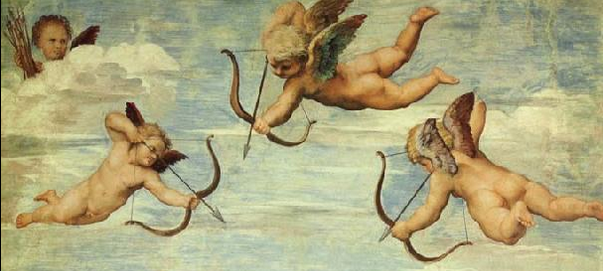
There are ten angels in Shakespeare's Hamlet and one cherub, a changeling with an angel in its heart, strangely, strangely.... What does it all mean? [Cherubs from Raphael's "Triumph of Galatea," detail. Image source: Wikipedia ] Friday of this week is Valentine's day, bringing with it many images of that angelic and mischievous little guy, son of Venus, the goddess of love. Yes, you guessed it: Cupid is coming. Cupid, often depicted as a crossover between Greek mythology and those baby Christian angels, cherubs. It didn't have to be that way, but that's what we've got. There are ten angels in Shakespeare's Hamlet  (or instances of the word, perhaps many others implied), and one cherub - though an unnamed cupid may have left his mark on Hamlet, as we see from his love-gushing letters, and on Ophelia, whose attention for Hamlet her father Polonius describes as follows: 'Tis told me he hath very oft of late Given private time ...