Posts

HOW IT WENT AT VANDERBILT

Image
My Vanderbilt University presentation/dinner/discussion sponsored by the VU Chaplain's office went very well tonight, a small but good group. Twitter thread summarizing some insights that came together for me as I prepared for the event: https://twitter.com/padrianfried/status/1090478362676600832 It also became more clear to me that while some of the biblical & religious allusions/plot echoes reflect more on Hamlet's movement toward mercy and a merciful providence, others reflect more on the sin & corruption in Denmark & the play's main characters. I was surprised and delighted to find that among those attending were Victor Judge, Assistant Dean for Academic Affairs, Denice Hicks, Artistic Director of the Nashville Shakespeare Festival, and Jim Warren, Co-Founder and former Artistic Director of the American Shakespeare Center in Staunton, VA. Jim is in Nashville as a consultant and teaching an auditioning class in February. [L-R: Victor Judge, De...


Shaming Ophelia: Getting the Prodigal Wrong in Hamlet 1.3

Image
In Hamlet 1.3, both Laertes and Polonius use the word “prodigal” to dissuade Ophelia from a romantic relationship with Hamlet: —Laertes warns her about opening her “chaste treasure” to Hamlet and twice tells her, “Fear it”: The chariest maid is prodigal enough, If she unmask her beauty to the moon —Polonius tells her not to believe Hamlet’s vows of love to her, implying that such vows are "prodigal" and not to be believed, and that perhaps Polonius had once made such false vows in his youth, so he assumes that Hamlet was being a kind of prodigal by making such vows: I do know, When the blood burns, how prodigal the soul Lends the tongue vows But both Laertes and Polonius miss the heart of the prodigal son story from in Luke 15:11–32: It’s not about fear, or fearing being prodigal, but rather, about the generous mercy of the father in the parable who welcomes home the son, shadowed a bit by the self-righteous envy of the brother. The prodigal son story perhaps ap...

IS HAMLET DAMNED OR NOT? Four (or five?) approaches

Image
There are two kinds of people in the world: Those who think there are only two kinds, and those who are sane. The joke applies to all generalizations, but if I had to list categories for types of interpretations of Hamlet, these would come to mind: 1. The Ghost is released from purgatory by God to commission Hamlet to execute a usurping, incestuous murderer, Claudius. If Hamlet refuses to kill Claudius, he disobeys heaven. Hamlets main flaws: He waits too long, hurts and kills too many, but is right to kill Claudius in the end. [Popular with Catholic critics.] 2. The Ghost is from hell; Hamlet is tricked into killing Claudius & causing other deaths. Vengeance is God’s alone, so Hamlet is hell-bound. Some in this group think Claudius is a pretty effective king. Kill him and be damned. Many of these also consider any hint of turning in Hamlet after the sea voyage and graveyard scene to be superfluous or delusory on Hamlet's part. [Roy Battenhouse ( Shakespear...
Adrienne Darvay Nagy on Hamlet & Dracula One of my favorite Hamlet-related LinkedIn connections is Adrienne Darvay Nagy, who brings whole new realms of Shakespeare research and literary observation to my attention, as well as continental European Shakespeare performance history, of which I'd otherwise be unaware. If you're a Hamlet fan, you should follow her posts. https://www.linkedin.com/feed/update/urn:li:activity:6492044564071739392 #Hamlet #Shakespeare #Dracula

Ophelia: "The false steward that stole his master's daughter"

Image
OPHELIA: "THE FALSE STEWARD THAT STOLE HIS MASTER'S DAUGHTER" In recent years, scholars* have identified a cryptic statement Ophelia makes: “It is the false steward that stole his master's daughter” (4.5). They now think this points to a Ben Jonson play in which a young girl is taken by a steward and passed off as his own while the father is away at war. Years later, she falls in love but is told she is unworthy of the match, when in fact she is worthy by her true parentage. This changeling theme resembles the story of Jesus, apparent son of a carpenter, but actually of a heavenly father. I have posted before of how Francisco of Assisi (see sentinel name) renounced his earthly father in favor of a heavenly one, and how, after his Jonah-like sea-voyage, Hamlet finds a heavenly father in Providence. Ophelia is told by Laertes that she is "unvalued"/unworthy of marriage to Hamlet, who made to her “almost all the holy vows of heaven” (a marriage propo...

Hamlet at Chicago Shakespeare Theater

Image
Chicago Shakespeare Theater (on Navy Pier) is doing Hamlet April 17 - June 9, 2019, as I'm told by Michael Hayden, who is playing Claudius. It will be produced by founder and artistic director Barbara Gaines, who is "Internationally renowned for her populist and dynamic interpretations of Shakespeare." There is a free enrichment program/lecture an hour before the May 4-June 9 Sat & Sun matinees, and a Pub Cast Call an hour before the Friday evening performances May 17 & 24. The poster has the traditional skull, but it's wearing a green jester's hat, as Yorick was both the king's jester and a sort of affectionate surrogate father figure for Hamlet, a nice touch. For more information at CTS, click HERE: https://www.chicagoshakes.com/plays_and_events/hamlet

DON’T FEAR JARGON-USERS

Image
If a scholar uses jargon heavily, this doesn’t mean they’re smarter than you or using the jargon correctly. Maybe they use it well as a kind of shorthand, and maybe simply looking up the unfamiliar words can help with the jargon. But sometimes they may be assuming too much about their understanding of the jargon, covering for weaknesses in their argument, or using jargon to impress and appeal to other scholars who use the same jargon. I’m reading an otherwise good book in which the author claims that a scene in a Shakespeare play offers a new semiotics (theoretical-philosophical understanding of interpreting signs and symbols). Actually, no. The play might inspire a scholar to a new theory or new insights about semiotics. But Shakespeare plays don’t offer semiotics. (See Webster definition below the Princess Bride meme.) It brought to mind a certain line (and internet meme) from “Princess Bride.” Poet William Stafford advised that when reading poetry, if you don’t like or unde...

SURVEILLANCE & HAMLET

Image
In recent years, notable productions of Hamlet in the UK and Washington DC have highlighted the topic of Surveillance: The picture below is from Shakespeare Magazine, issue 14, July 2018, with Andrew Scott as Hamlet at the Harold Pinter Theatre in London. Scott played Moriarty in the BBC series, Sherlock, with Benedict Cumberbatch and Martin Freeman. —The king sends for Hamlet’s friends, Rosencrantz and Guildenstern, to act as spies. —In a particularly chilling scene, Polonius, whose son Laertes departed for France after listening to a long list of fatherly advice ending with “this above all: to thine own self be true,” sends a spy after his son to plant mildly scandalous rumors in order to discover news of his son’s scandalous exploits. —Ophelia agrees to act as bait while Claudius and Polonius eavesdrop. After 9/11/01, the USA and other governments used the events of that day to justify greatly increased spending on global surveillance, much of which violates rights to priva...
CFP: RMMRA Conference Call for papers: 2019 Rocky Mountain Medieval & Renaissance Assoc. conference, Denver, CO, April 11-13: RMMRA Call 2019 The Rocky Mountain Medieval and Renaissance Association invites proposals for papers and panels at our Annual Conference to be held April 11-13 in downtown Denver, Colorado, at the SpringHill Suites Marriott adjacent to the Metropolitan State University of Denver. In addition to welcoming all paper and session proposals related to Medieval and Renaissance studies across all disciplines, the organizers will be creating a series of panels specifically focused on papers encoding Leonardo da Vinci’s belief in the essentiality of sapere videre on this the 500th anniversary of his death (1452-1519). For More Information: Click HERE or copy and paste into your browser: http://www.rmmra.org/2019-cfp-sapere-videre-knowing-how-to-see-denver-co-april-11-13-2019/ #Literature #LiteraryCriticism #Drama #Theatre #EarlyModern #Renaissance...
CFP: NPCEBL Call For Papers: Northern Plains Conference on Early Brit Lit 12-13 April 2019 Deadline March 11, 2019 Sponsored by Minnesota State U—Moorhead & Concordia College; sessions will be held at The Comstock Memorial Union, at the MSUM campus, Moorhead, MN. For more information : http://www.npcebl.org/NPCEBL2019CFP.pdf #Literature #LiteraryCriticism #Drama #Theatre #EarlyModern #Renaissance #EnglishLiterature #BritishLiterature #Britlit

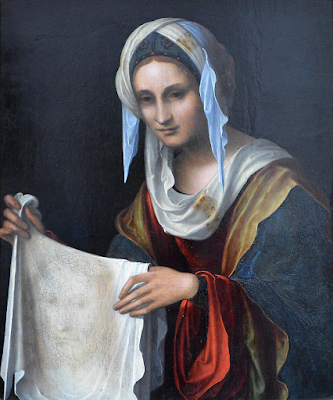
THE GHOST OF VERONICA HAUNTS HAMLET [or, did Gertrude have a Veronica complex?]

Image
In his book, “Images of Christ in Art,” British art historian and museum director Robert Neil Macgregor notes that from 1200 CE on, “wherever the Roman Church went, the Veronica would go with it." In legend, after St. Veronica wiped the face of Jesus on his way to crucifixion, the image of Christ’s face (“the Veronica”) remained on the cloth. Her act later became part of the stations of the cross ritual in Roman Catholic and English churches. Note: In the Christian legend, Jesus is doing strenuous physical activity of cross-carrying when a woman, Veronica, wipes his face as he goes to his death; in Hamlet 5.2, the prince is doing strenuous physical activity of a fencing match when a woman, Gertrude, wipes his face as he goes to his death: GERTRUDE: He's fat, and scant of breath. Here, Hamlet, take my napkin, rub thy brows [….] / Come, let me wipe thy face. What was the Bard thinking? Not that Gertrude = Veronica, but that Shakespeare, immersed in his cultu...
Image
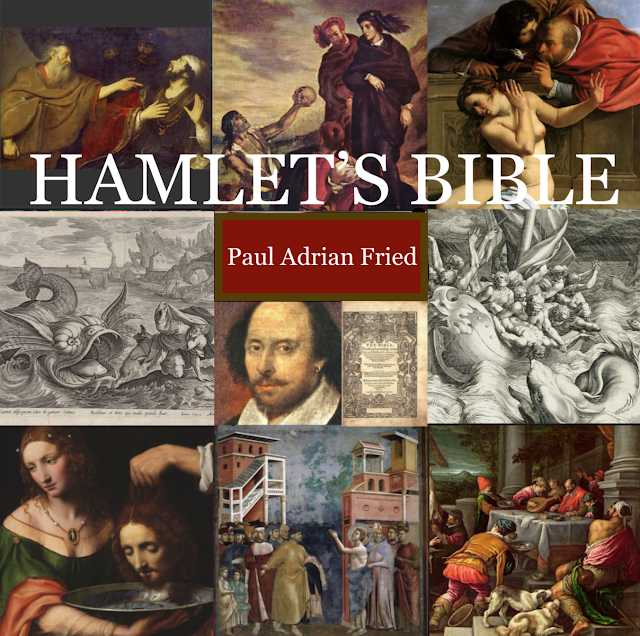
HAMLET’S BIBLE / Dinner-discussion: I will be speaking at a Tues., Jan. 29 dinner at Vanderbilt University about biblical allusions & plot echoes in Shakespeare’s Hamlet (my book project). Rev. Gretchen Person, Associate Chaplain & Associate Dir. of Religious Life at Vanderbilt, was key in arranging this (many thanks!). The poster for the event includes the following images from Renaissance & medieval art (L-R) (see notes below the pic): Top: 1. The prophet Nathan catching the conscience of King David (with a story about a shepherd boy) 2. Hamlet & Horatio, graveyard (two Danes on road to Elsinore—like disciples to Emmaus) 3. Suzannah & corrupt (eavesdropping) elders/judges, from the Book of Daniel (Apocrypha) Middle: 4. Jonah, spit out by fish (Hamlet's pirate ship) 5. Shakespeare & title page of Geneva Bible 6. Jonah thrown from boat (fish about to swallow) Bottom: 7. Salome & head of John the Baptist 8. Francis of Assisi, renounc...
John R. Yamamoto-Wilson . Yet another departure from Shakespeare and the Bible during the holidays, I want to share a Youtube video by John R. Yamamoto-Wilson . This one is about a John Donne poem, but he has many others on his channel, all nicely instructive. I would say his channel deserves many more views and subscribers, so do consider it. ~~~~~~~~~~~~~~~~~~~~~~~~~~~~~~~~~~~~~~~~~~~ [Originally posted around the week of 12/25/18 on LinkedIn ] ~~~~~~~~~~~~~~~~~~~~~~~~~~~~~~~~~~~~~~~~~~~ Links to a description of my book project: On LinkedIn : https://lnkd.in/eJGBtqV On this blog : https://pauladrianfried.blogspot.com/2017/05/hamlets-bible-my-book-project-im.html ~~~~~~~~~~~~~~~~~~~~~~~~~~~~~~~~~~~~~~~~~~~ #Shakespeare #Bible #Hamlet #Literature #LiteraryCriticism #Drama #Theatre #EarlyModern #religion #Renaissance #EnglishLiterature
My third Holiday Post is about the UK's Shakespeare Magazine, which is online for free, and a wonderful resource. You can follow them on Twitter @UKShakespeare, and their web page is at They are seeking donations at this time of year, and if you've ever read any of their 15 issues, they are a worthy cause. Consider donating. http://www.shakespearemagazine.com/ ~~~~~~~~~~~~~~~~~~~~~~~~~~~~~~~~~~~~~~~~~~~ Links to a description of my book project: On LinkedIn : https://lnkd.in/eJGBtqV On this blog : https://pauladrianfried.blogspot.com/2017/05/hamlets-bible-my-book-project-im.html ~~~~~~~~~~~~~~~~~~~~~~~~~~~~~~~~~~~~~~~~~~~ #Shakespeare #Bible #Hamlet #Literature #LiteraryCriticism #Drama #Theatre #EarlyModern #religion #Renaissance #EnglishLiterature
Melissa Hudler Blog The second of my holiday season posts - straying from Shakespeare - is about Melissa Hudler and her blog . - Melissa teaches at Lamar University but is on leave developing a writing program for cancer patients at a nearby hospital. - You don't have to be a scholar or cancer patient to read and benefit from her blog posts and to try her writing prompts. - Melissa's choice to explore and create this program makes me think of many other academics whom I respect greatly for how they view themselves as servants to their communities. - Her recent blog post, "Receiving as Giving," made me think of times I've received gifts from children or the elderly, gifts I may not have needed or been that fond of, but it was important to receive the gifts with grace and to honor the spirit of the gift and giver. -Parents also have to consider the importance of teaching this to their children at holiday times. - And imagine, if you were a cancer patient, you...
The Ghost of Shakespeare blog by John Langdon is one I highly recommend. (In a departure from my regular posts about Hamlet, Shakespeare, or Hamlet and the Bible, for the holiday season I want to promote some literature and writing blogs I especially like.) John's teaching experience includes the University of Birmingham in the UK where they have a world-renowned Shakespeare program. He often begins with a Shakespeare quote, or a clip from some other literary source, such as Herman Melville in this case, and then weaves his way into reflections on current events and culture, often weaving his way back into literary sources again. John's imagination is wonderfully wide and weaves its way through many ideas that are in need of visiting or revisiting. Please consider visiting and subscribing. I like getting email reminders that he has a new post, and always look forward to reading them. #writing #literaure #literary #blogging #blogger #blog #english #poetry #reflection #Sha...

ELIZABETH I & HAMLET

Image
Elizabeth, who often referred to herself as a "prince": "I may not be a lion, but I am a lion's cub, and I have a lion's heart." Like Hamlet, Elizabeth I was (figuratively) haunted by her father: Henry VIII broke from Rome to obtain an annulment from his first wife so that he could marry Elizabeth’s mother Anne; he later had Anne executed (on trumped-up charges? Bored with her, tired of her assertiveness, already courting a replacement). Called by some a "bastard queen," conceived before her parents' marriage, Elizabeth spoke highly of her father in public but wore a locket with her mother’s picture. Laertes says that if he doesn’t avenge his father, he proclaims himself bastard. - If Elizabeth didn’t adhere to her father’s separation from Rome, she would have proclaimed herself bastard: her legitimacy depended to some extent on her father’s break from Rome to get his first marriage annulled. Hamlet says to Ophelia, “we will have no...

SHAKESPEARE SCHOLARS’ PREFERENCE FOR SECULAR EXPLANATIONS OVER BIBLICAL/RELIGIOUS ONES

Image
Some may wonder: Why haven’t more scholars associated Elizabethan melancholy like that of Hamlet with “The Dark Night of the Soul” instead of with Robert Burton’s “The Anatomy of Melancholy”? Burton’s work (1621) came two decades after Shakespeare is thought to have revised the Ur-Hamlet, and was more unique to the time than ancient mysticism. While Spanish author John of the Cross wrote “The Dark Night of the Soul” in 1577-9, it was a Roman Catholic work, as was its 14th Century English predecessor, “The Cloud of Unknowing.” England after Shakespeare wanted to develop its own national identity and claim the Bard for the English Church. A few have long claimed Shakespeare was secretly Catholic, but this was always disputed. Some English authors popularized anti-Catholic ideas that monks and nuns were sexually promiscuous and that confessor priests had sex with women parishioners, cuckolding husbands. This may have helped rationalize Henry VIII's dissolution of monasteries af...

HAMLET’S (Mystical?) MELANCHOLY (or PTSD?)

Image
Discussion of Elizabethan melancholy often turns to Robert Burton’s 1621 work, The Anatomy of Melancholy. Others claim melancholy was fashionably pretended by lovers, poets and scholars. Or Hamlet might be in a mystical dark night of the soul as described by John of the Cross (1577-9) and earlier mystics such as the English 14th century author of The Cloud of Unknowing. The dark night included a purgation of sense and spirit; it resembles not only Hamlet’s “man delights not me” speech (2.2), but also St. Francis's melancholy as a young man. We find traces of it also in the Song of Songs, often thought an allegory for the love of Christ for his church, and the longing for union with a divine beloved. Another explanation: Many members of Shakespeare's audiences were traumatized, probably suffering from PTSD after brutal public executions of Catholics under Henry VIII & Edward VI, of Protestants under Mary I, and Catholics again under Elizabeth, contributing to a disillu...

HAMLET PRAYER SCENE: IRONIC & CLASHING BIBLICAL ECHOES

Image
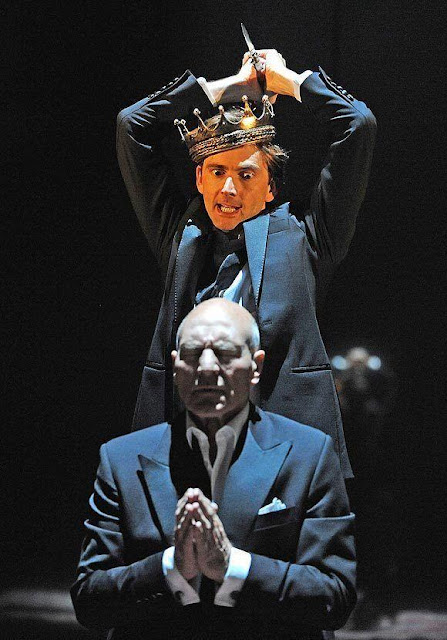
Claudius at prayer (3.3) echoes (and parodies) Jesus’ agony in the garden, praying that “this cup” pass from him. —But Jesus ends with “thy will be done.” —The echo is ironic for Claudius: He knows what he must do to repent, but refuses to give up the throne and queen he acquired by killing his brother. —Unlike Jesus, Claudius ends, *My* will be done, not God’s. Hamlet has a chance to kill Claudius in this scene, but spares him. —This echoes the biblical David who twice spared King Saul (1 Sam 24 & 26). —Yet the echo is ironic: Whereas David spared Saul out of mercy and respect for the king as God’s anointed, Hamlet intends to catch Claudius later and kill him when he’s doing something unholy, thereby damning him. As others have noted, Hamlet here wants to play God. —Ålso ironic: Hamlet misinterprets Claudius’ effort to pray. Like the play in general, this scene reminds us that looks can be deceiving: a king at prayer and a prince sparing a life may both be prisoners of ...

TO HAMLET, “DELICATE & TENDER” ISN’T ABOUT GOOD STEAK:

Image
Many scholars assume Hamlet in 4.4 praises Fortinbras, calling him a “delicate and tender prince.” But bible translations available to Shakespeare show otherwise. —In Luke 16:19 (Geneva, “The Rich Man and Lazarus”), the hell-bound rich man is described: “There was a certain rich man, which was clothed in purple and fine linen, and fared well and delicately every day.” He is pampered and spoiled while neglecting the beggar Lazarus. —Deut 28:54-57 (Bishop’s bible) describes a “ delicate and tender ” man and woman who fail to follow Mosaic law, pamper themselves, neglect spouse and children, and who, if the city was under siege, would eat their own children: "the man (that is tender and exceeding delicate among you) [...] 56 Yea, and the woman that is so tender and delicate [..] —Proverbs 19:10 The Douay-Rheims uses a form of the word "Delicate" in Proverbs 19:10: " Delicacies are not seemly for a fool: nor for a servant to have rule over princes." The Cover...

HAMLET’S “LET BE” DOESN’T QUOTE THE BEATLES

Image
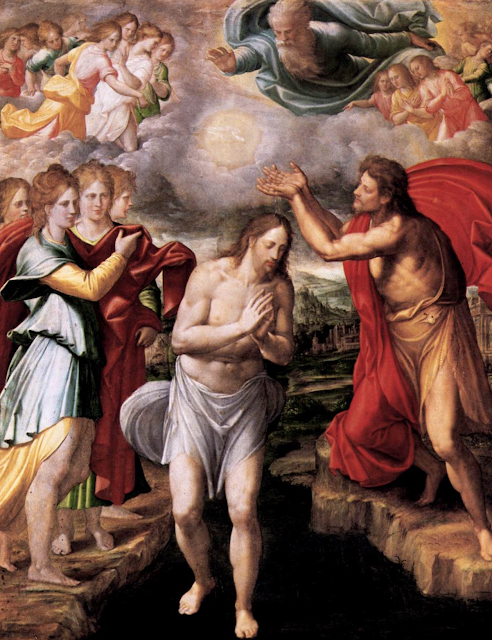
In Hamlet 5.2 (Q2), the prince tells Horatio, “Let be,” accepting the danger of the duel. Some may consider Hamlet’s “Let be” an allusion to the words Mary, mother of Jesus, speaks to the angel Gabriel, who tells her she will bear a son. And certainly, there is a strong thematic connection. But in both the Bishop’s (church) bible and the Geneva (home) #translation, Mary’s words are “be it unto me according to thy word” (Lk 1:38). Close, but no "let". Yet in Shakespeare’s (prefered) Geneva bible, when Jesus seeks to be baptized by John, at first, John protests, saying it should be Jesus baptizing *him.* Jesus replies, “Let be now: for thus it becometh us to fulfill all righteousness” (Mt 3:15). Common theme: acceptance of divine will, of the great “I am who am” (another form of "be"). But it’s interesting to note that Shakespeare may have been alluding (yet again) to John the Baptist, who disapproved of King Herod Antipas’s marriage to his brother’s wife. ...

HAMLET: WHICH HEROD, WHICH BAPTISTA? (JOHN the BAPTIST?)

Image
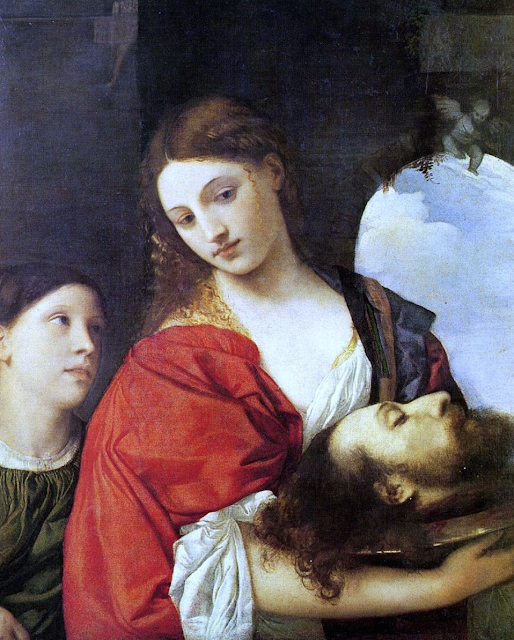
In Shakespeare’s Hamlet, when the prince advises the players against over-acting and says it “out-Herods Herod,” which Herod is he referring to? —Herod I who ordered the slaughter of male children in the gospel tale of the wise men and the birth of Jesus (Mt 2:16-18)? This makes sense, but is that all? —Or Herod Antipas, who said he’d give his stepdaughter (Salome, by tradition) anything she wished, up to half of his kingdom, after she danced pleasingly for him and his guests (Mk 6:21–29)? —(Or both?) Later, when the players are acting out The Murder of Gonzago, why does Hamlet say the murdered duke’s wife is named Baptista? Merely because an Italian Duke of Urbino was murdered by poison, and one of his historical predecessors had a wife named Baptista (a stretch)? Or is the common thread the fact that Herod Antipas granted Salome’s wish for the head of John the Baptist (to whom the name "Baptista" points), who condemned the marriage of Herod Antipas to his brother’s ...

Hamlet Footnotes in Need of Updates: Herod, Gonzago, & Baptista

Image
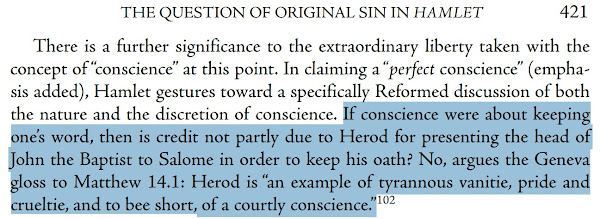
In many editions of Shakespeare's Hamlet, when the prince gives advice to the actors and says they should avoid the kind of bad acting that "out-Herods Herod," footnotes often explain it by referring to the older Herod I, supposedly responsible for a "slaughter of innocents," a killing of male children at the time of the Nativity of Jesus—and also a biblical literary allusion to the slaughter of male infants at the time of the birth of Moses as related in Hebrew scriptures. But Herod I is not the only Herod editors could have chosen: They could have noted a later Herod, Herod Antipas. Why might this be a poor editorial decision, to mention only Herod I, and omit mention of Herod Antipas? Because as the Christian scriptures tell the tale (Mk 6:14-29, Mt 14:1-12), Herod Antipas divorced his first wife and married Herodias, the divorced wife of his brother. When his new stepdaughter danced for Herod Antipas and his guests, she danced so well that he offered he...
Image
Sixteenth Century Society Conference in Albuquerque: I will present a paper this Fri., Nov. 2, 1:30pm at this conference in New Mexico, on panel 93 with Prof. Emeritus Gayle Gaskill of Minnesota and Prof. Dean Clement of Oklahoma. Naseeb Shaheen (1931-2009, in the panel title) wrote a large and important work on Shakespeare's biblical influences, but like his predecessors, focused primarily on phrasing and not paraphrase or plot echo. My paper will include insights incubated here about Hamlet, plot echoes of Jonah, Emmaus, Lazarus & the rich man, and sentinel Francisco, whose namesake (Francis of Assisi) foreshadows the other allusions. Shakespeare will be the *main* focus in numerous other panels at the conference, including 75 F-8:30 Tragedy 145 Sa-10:30 & Religion 172 Sa-3:30 Shakespeare’s Dramatic Works & Their Legacy Shakespeare among other areas of focus: 53 Th-3:30 88 F-10:30 162 Sa-3:30 170 Sa-3:30 171 Sa-3:30 185 Sn-8:30 Join us if you'r...