Posts

Part 12: Ophelia and Hamlet as Orpheus and Eurydice

Image
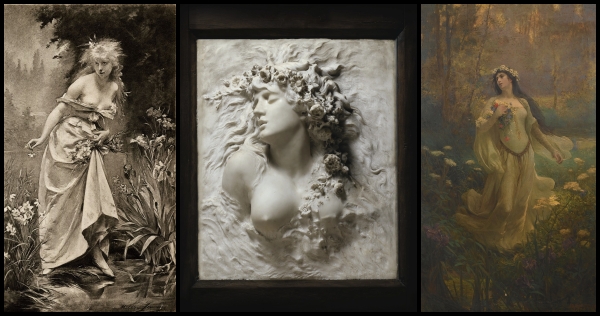
To her father in 2.1, Ophelia describes Hamlet’s frightening visit to her closet. In Ophelia’s description of Hamlet’s exit, Jonathan Bate finds an allusion to Orpheus' glance back at Eurydice as he leaves the underworld (left image), a Greek myth recently adapted for the Broadway musical, Hadestown. Ophelia describes Hamlet: [...] with a look so piteous in purport As if he had been loosèd out of hell To speak of horrors—he comes before me. [...] He took me by the wrist and held me hard. Then goes he to the length of all his arm, And, with his other hand thus o’er his brow, He falls to such perusal of my face As he would draw it. Long stayed he so. At last, a little shaking of mine arm, And thrice his head thus waving up and down, He raised a sigh so piteous and profound As it did seem to shatter all his bulk And end his being. That done, he lets me go, And, with his head over his shoulder turned, He seemed to find his way without his eyes, For out o’ doors he went without their he...

Part 11: "Mad" Ophelia grasps "tricks i' th' world" and Denmark's corruption

Image
Too many critics, readers and viewers of Shakespeare’s Hamlet assume that Ophelia’s madness is merely an inability to deal with emotions, mostly about her father and Hamlet. Showlater cites Theodore Lidz (a typical example of this) who claims “Ophelia goes mad because she fails in the female developmental task of shifting her sexual attachment from her father ‘to a man who can bring her fulfillment as a woman.’” (294) [1] Too few consider that her madness may have been as much, or more, caused by a startling epiphany about Denmark’s corruption, understanding it perhaps even better than her father. Why would (mostly male) critics have neglected this possibility for so long? A tendency among critics to keep Ophelia out of politics, like keeping women out of voting booths? A “GENTLEMAN” and Horatio speak about Ophelia the first we hear of her having gone mad: GENTLEMAN: She speaks much of her father, says she hears There’s tricks i’ th’ world, and hems, and beats her heart, Spurns envious...

Part 10 (B): Ophelia via Elaine Showalter’s 1985 “Representing”

Image
Excerpts from Elaine Showalter, “Representing Ophelia: Women, Madness, and the Responsibilities of Feminist Criticism” [1]: …Though she is neglected in criticism, Ophelia is probably the most frequently illustrated and cited of Shakespeare’s heroines.(282) …Why has she been such a potent and obsessive figure in our cultural mythology? [...] how should feminist criticism represent Ophelia in its own discourse? What is our responsibility towards her as character and as woman? …Shakespeare gives us very little information from which to imagine a past for Ophelia.  [...] Her tragedy is subordinated in the play; unlike Hamlet, she does not struggle with moral choices or alternatives. [283] [PF note: Showalter’s essay is an important one, but on this point I would disagree: Ophelia struggles to know what to think of Hamlet’s love and perhaps her good fortune, to grasp what it may mean to become Denmark’s next queen; she struggles against disapproval of her brother and father, against ...

Part 10: Ophelia via Elaine Showalter’s 1985 “Representing”

Image
Excerpts from Elaine Showalter, “Representing Ophelia: Women, Madness, and the Responsibilities of Feminist Criticism” [1]: …Though she is neglected in criticism, Ophelia is probably the most frequently illustrated and cited of Shakespeare’s heroines.(282) …Why has she been such a potent and obsessive figure in our cultural mythology? [...] how should feminist criticism represent Ophelia in its own discourse? What is our responsibility towards her as character and as woman? …Shakespeare gives us very little information from which to imagine a past for Ophelia.  [...] Her tragedy is subordinated in the play; unlike Hamlet, she does not struggle with moral choices or alternatives. [283] [PF note: Showalter’s essay is an important one, but on this point I would disagree: Ophelia struggles to know what to think of Hamlet’s love and perhaps her good fortune, to grasp what it may mean to become Denmark’s next queen; she struggles against disapproval of her brother and father, against her...

Part 9: Ophelia, "mad rogue" court fool

Image
When Hamlet acts mad like a court fool during The Mousetrap , he talks so much that Ophelia says he is “as good as a chorus” [1]. After he kills Polonius and is sent to England, Ophelia starts acting mad in Hamlet’s absence. Ophelia becomes like a mad fool-queen regent in the fool-king’s absence, the most verbose person among the court; she commands its attention like a court fool. Long (1971), Holleran (1989) and Olivas (2015) have recognized Ophelia in the role of the fool. Holleran cites Long who “suggests that in her madness Ophelia plays the traditional role of the 'fool' (a role she shares with Hamlet), whose songs serve as mirrors to reflect the personality of the listener” [2]. Olivas notes that Ophelia’s madness seems to free her up to be more outspoken, and through songs and symbolic gifts of flowers with traditional meanings, she speaks uncomfortable truths about the court. Court fools were not obligated to flatter members of the court, but rather, obligated by tradi...

Thanks to readers, 1-31 July, 2023

Image
Thanks to readers, 1-30 July, 2023 ~~~~~~~ Thank you to readers of this blog for this past month, which the blog's analytics say came to 662 views from the following countries: Thank you for your interest. I am grateful and humbled. ~~~~~~~~~~~~~~~~~~~~~~~~~~~~~~~ ~~~~~~~~~~~~~~~~~~~~~~~~~~~~~~~ INDEX OF OPHELIA POSTS : My 2023 series on Ophelia, and earlier Ophelia posts: https://pauladrianfried.blogspot.com/2023/10/index-of-ophelia-posts-2023-series-and.html ~~~~~~~~~~~~~~~~~~~~~~~~~~~~~~~ ~~~~~~~~~~~~~~~~~~~~~~~~~~~~~~~ YOU CAN SUPPORT ME on a one-time "tip" basis on Ko-Fi: https://ko-fi.com/pauladrianfried IF YOU WOULD PREFER to support me on a REGULAR basis, you may do so on Ko-Fi, or here on Patreon: https://patreon.com/PaulAdrianFried ~~~~~~~~~~~~~~~~~~~~~~~~~~~~~~~ ~~~~~~~~~~~~~~~~~~~~~~~~~~~~~~~ Disclaimer: If and when I quote or paraphrase bible passages or mention religion in many of my blog posts, I do not intend to prom...

Part 8: Ophelia to Claudius: "God yield you"

Image
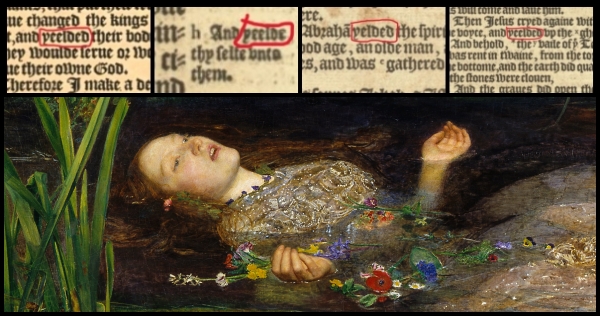
Ophelia to Claudius: “God dild [yield] you.” [1] * Some claim "God yield you" means "God reward you," which sounds a lot like "God bless you".... But yield? To whom does the verb apply? Is God the one yielding by being merciful and withholding anger and wrath, a common biblical theme? Or is this grammatically inverted, saying "You (should/must) yield (to) God"? In their ritual repetition of "The Lord's Prayer," over and over, Christians say, as if in a covenant or vow, "Forgive us our sins (or debts) as we forgive (our debtors)." This repeats another biblical idea: As we judge others, so shall we be judged. As we forgive (and yield, instead of taking revenge), so shall we be forgiven by a God who will yield in mercy instead of wrath. So in fact it seems that "God yield you" involves the verb "yield" being applied both to "you" and to "God." The tradition rep...

Part 7: Ophelia's Gravedigger: They "sat on her"

Image
We should resist the temptation to treat the gravediggers and their clowning in Hamlet 5.1 as mere comic relief: They prepare audiences and readers to view the “churlish priest” more critically. GRAVEDIGGER  Is she to be buried in Christian burial, when she willfully seeks her own salvation? [1] (Shouldn’t all people seek their own salvation? “Willfully” suggests a parody of the Protestant idea that we are saved by “faith alone,” not by works. But by Gertrude's account, it is not at all clear that Ophelia committed suicide - it is a mystery - so why assume?)   OTHER  I tell thee she is. Therefore make her grave straight. The crowner hath sat on her and finds it Christian burial. GRAVEDIGGER  How can that be, unless she drowned herself in her own defense? [2][3] (The gravedigger mangles “The coroner’s inquest sat to consider her death,” which becomes “The crowner hath sat on her.” Funny but disturbing, to sit on the corpse of a drowned woman. The original spelling wa...