Posts

Holy Saturday and Harrowing of Hell in Shakespeare and Christianity

Image
Today is Holy Saturday, traditionally a day Jesus spends in the underworld, the “Harrowing of Hell,” referenced in the Apostles Creed: “He descended into hell,” or “to the dead.” Ancient sources claimed that after his death, Jesus went to the underworld to free the souls of the just, all who died in faith before the life and death of Jesus. The use of the word “harrowing” has old English roots [1]. Shakespeare parodies a medieval Mystery play based on the harrowing of hell in the porter scene of Macbeth [2] [3]. He uses the word “harrow” three times, once in Coriolanus, and twice in Hamlet, first by Horatio (1.1.51), and second, by the ghost (1.5.21). Some might claim that this was quite nice of Christians. Although to them, salvation and eternal life are only through Christ, how generous to say that Jesus descended to the dead to free the souls of the just. How inclusive. But this warrants greater scrutiny. The Christian claim that eternal life can only be obtained through Christ is...

Part 38: Christ figures in Hamlet: Ophelia, Gertrude, Hamlet (Good Friday 2024 post)

Image
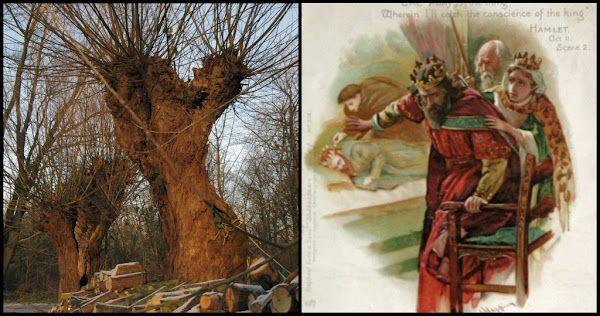
Today is Good Friday. In Shakespeare’s England, church rituals spoke of baptism as a dying to self in Christ, so as to be made new in him [1]. Contrary to some Shakespeare scholars who explicitly resist the idea of Christ-figures in the plays (including Harold Jenkins, Arden editor), all the baptized are called to be Christ-figures [2], imitators of Christ. The spiritual rhythm in medieval mystery, morality and miracle plays assumes all are sinners, but if they express sorrow for their sins, they can know God’s mercy and be saved. [3] Any drama in which a person who dies is saved, is a comedy; the only tragedies are those in which a sinner resists salvation. In her madness, Ophelia expresses regret through her story of the baker’s daughter [4]. Gertrude explains that Ophelia falls in the brook because of an “envious sliver” of willow [5]. Willows in Psalm 137 were incorporated weekly in Christian vespers and associated by St Benedict of Nursia [6] and Martin Luther [7] with the cruci...

Part 37: Sts. Gertrude, pilgrim's lovers, & mousetraps (Interlude D.4)

Image
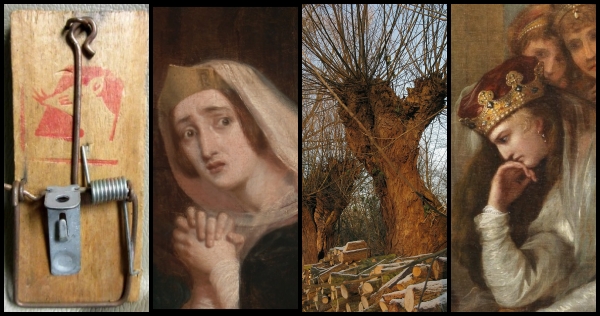
Gertrude is more associated with “mousetrap” than many scholars have allowed. Previously [1], I argued that Gertrude suspects a poison cup but doesn’t know for certain, so she signals publicly that she will drink in order to mousetrap Claudius. He tells her not to drink; she replies, “I will, my lord; I pray you pardon me.” [2] Hamlet said he would catch the conscience of the king, but first, his playlet sought to catch Gertrude’s conscience. I am grateful to Federico La Sala for mentioning saints by the name of Gertrude whose legends were familiar in the middle ages and Shakespeare’s time. These included  Gertrude the Great from the monastery of Helfta, a mystic who, with other sisters, explored a spirituality in which they believed they were “brides of Christ.” In The Herald of Divine Love, she speaks of paying a debt, [3] which sounds like the widow helped by the prophet Elijah (2 Kings 4:1-7), which Hamlet associated with his mother. [4] Gertrude as a “bride of Christ” also rel...

Part 36: Gertrude builds a better mousetrap for Claudius (Interlude D.3)

Image
In Hamlet 5.2, Gertrude suspects poison, [1] but doesn't know for certain — a dangerous mystery: she avoids openly accusing Claudius. This scene is a variation of King Aegeus, saving son Theseus from a poison cup from stepmother, Medea — with some genders switched and stakes raised.[2] Gertrude will test the wine by drinking it, without saying that is her reason for doing so. In this she sets a better, simpler mousetrap for Claudius: If it is poison, he could stop her and confess. If not, maybe “mad” Hamlet was mistaken about Claudius? Hamlet’s “Mousetrap” foreshadows (and sheds light on) Gertrude’s. She cannot pluck the mystery’s heart without drinking from the cup to test it, and to test Claudius. By drinking, in effect, Gertrude tells Claudius: If you would poison my son, you must go through me first. In her closet, Hamlet had told her that he would later beg a blessing of her [3]. Testing the wine for poison is the blessing she offers her son, without his having to ask. This ...

Part 35: Why Gertrude likely suspects a poison cup (Interlude D.2)

Image
Why might Gertrude suspect a poison cup in Hamlet 5.2? 1. In 3.2, she saw The Mousetrap, arranged by her son, showing a man poisoning a king, then wooing his victim’s widow. The analogy implies that Claudius poisoned King Hamlet to usurp the throne and marry Gertrude. Gertrude tells Hamlet in her closet that the play “much offended” [1] Claudius, meaning they understood perfectly what Hamlet implied that Claudius had done. 2. Hamlet makes this more clear in his mother’s closet, and Gertrude says, O Hamlet, speak no more! Thou turn’st my eyes into my very soul, And there I see such black and grainèd spots As will not leave their tinct.[2] Gertrude knows she is caught up in the sins of her envious, murderous, usurping husband. 3. Just before she speaks to Ophelia in 4.5, Gertrude says, “To my sick soul (as sin’s true nature is), Each toy seems prologue to some great amiss. So full of artless jealousy is guilt, It spills itself in fearing to be spilt.[3] Gertrude fears to spill the secret...

Interview with Paul by ArtMakers on KYMN Radio, March 7, 9 A.M. CST

Image
Tomorrow, March 7 at 9 a.m. CST, KYMN Radio in Northfield, Minnesota, will broadcast an interview of me, pre-recorded by Betsy Spethman and Andrew Rossow of ArtMakers (Disabilities - Arts - Community). Andrew has been one of my music students for at least nine or 10 years; he is blind and handicapped, so he is unable to play guitar, but he can play a number of other musical instruments, including autoharp (the focus of our lessons). He has a great ear for music, remembers chords and lyrics very well, and can transpose on the fly. Andrew’s parents, Jim Rossow and Betsy Spethman, started the organization, ArtMakers, to help people with disabilities have opportunities to be involved in arts and community. Betsy and Andrew regularly interview people in Northfield, Minnesota, a two-college town (where I live, also home to St. Olaf and Carleton colleges); the interviews are broadcast and archived on KYMN Radio in a show called “Townies Radio.” Andrew and his father Jim performed together i...

Part 34: Why Gertrude personifies the envious sliver of willow (Interlude D.1)

Image
The fact that Gertrude personifies the sliver of willow that sends Ophelia to her death is curious and deserving of more attention. She says an envious sliver breaks [1], sending Ophelia into the water — meaning that it was not Ophelia’s choice to set in motion the events that would lead to her drowning, but that these were caused by an act of envy by something outside herself. Why envious? Envious that it was not given a floral crown (“coronet”) [2] like other branches. Tree branches or slivers can’t feel envy, so Gertrude’s personification of the sliver as “envious” implies a belief that human envy was ultimately the cause of Ophelia’s drowning. Who in the play was envious of another’s crown? - Primarily Claudius, who poisoned his brother, usurped the throne and stole his brother’s wife.[3] Ophelia had bestowed crowns on branches and triggered the envy of one “sliver”; she could have been Hamlet’s wife and borne him another heir, helping to bestow that heir’s crown. What does this en...

Titus Andronicus, revenge, and child-eating in Shakespeare's Bible

Image
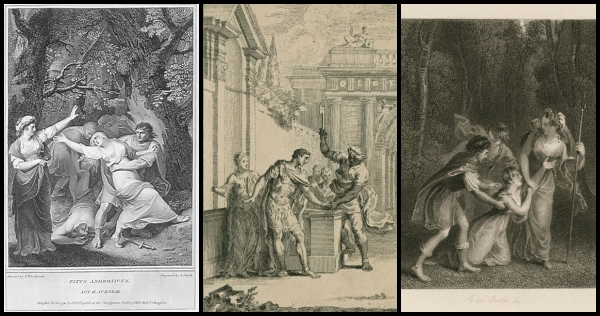
In Titus Andronicus, Titus has Chiron and Demetrius restrained and killed, to be baked up and served to their mother for revenge, a deception of cannibalism (vaguely similar to the deception at the end of The Spanish Tragedy). In The Bloody Banquet, by T.D., as punishment, an adulterer must eat the flesh of her lover.   Why the fascination with revenge and cannibalism? CANNIBALISM: Many Catholics believed in transubstantiation (that the bread and wine actually became the body and blood of Christ). Protestant polemics claimed it was a form of cannibalism, which Catholics denied. “EAT THEIR OWN CHILDREN” Deut 28:54-57 (Bishop’s Bible trans.) notes note people who are “delicate and tender” (entitled, pampered, spoiled), who - if the city were under siege and food limited - would eat their own children. [1] When Hamlet calls Fortinbras a “delicate and tender prince,” it is not a compliment, but a reference to this passage. Titus stabs his own daughter, and Tamora wants the mixed-race c...

Part 33: A Suicidal Gertrude (Interlude C)

Image
[In an earlier post , I mentioned four contrasting interpretations of Gertrude, the third being a suicidal Gertrude as portrayed by Lia Williams in a 2018 BBC production with Andrew Scott as Hamlet, dir. Icke. This post considers that third reading of Gertrude.] Some consider Gertrude drinking the poison cup in Hamlet 5.2 as an act of suicide. But for it to be suicide, Gertrude at least needs to suspect that the cup has been poisoned: If she is ignorant of poison and unsuspicious, it cannot be suicide; a reaction of surprise would then make sense. If she merely suspects and is testing the cup for poison intended for her son, an act of risk and selflessness, it is not strictly suicide.[1] For suicide as sole intention, she must not merely suspect, but know for certain that the cup has been, poisoned. The texts of the play do not support certainty for Gertrude that the cup has been poisoned: Claudius and Laertes conspired about the poison apart from her; she had no way of knowing. But a...

Part 32: A Surprised and Sentimental Gertrude (Interlude B)

Image
[An earlier post said that the next set would explore four different interpretations of Gertrude; this post explores the second of those interpretations in greater detail, a Gertrude who is surprised at finding herself poisoned, blinded by her own sentimentality.] Productions that portray Gertrude as unsuspicious and surprised to find in 5.2 that the cup from which she drank had been poisoned are not convincing to me: They ignore too many textual details. But many find it compelling.[1] We might well ask: Why do some people prefer an unsuspicious Gertrude who is surprised at the poison? - Do they prefer to view her as an unwitting victim of Claudius? - As being punished for alleged adultery and an "incestuous" marriage? - As lacking intelligence or wisdom enough to be suspicious? - As lacking agency, so they don't want her to be A) secretly acting as her son's wine-tester, testing for poison, B) setting a mousetrap deliberately for Claudius by choosing to drink, a...