Old King Hamlet as Caesar figure, not Christ figure After the death of King Hamlet, the sentinels are nervous confronting one another at the end of Francesco’s shift and the start of Bernardo’s. They are also anxious about why Denmark is so busy preparing for war. Shakespeare’s play was written at a time when many Protestants thought biblical prophecies in the biblical books of Revelations and Daniel were coming true (see Apocalypse & Armada in Kyd's Spanish Tragedy by Frank R. Ardolino); many believed the end times were approaching, and that Rome was the Whore of Babylon. The Dover Straits earthquake of 1580, a 1598 appearance of Haley’s Comet, and a 1598 total eclipse visible across much of England and Scotland (“disasters in the sun”) only increased such speculation. Bernardo and Marcellus tell Horatio about the hour of the night when the ghost had appeared and begin describing the positions of the stars, when the ghost appears again. After the ghost leaves, as Horatio...
Posts
A Thing of Nothing: Shakespeare anatomy joke
In a Shakespeare anatomy joke, men have a “thing” between their legs; women have a “nothing.” So “Much Ado about Nothing” jokes about female anatomy and the wooing, wedding, & bedding of women. Much ado. Yet when Hamlet says, “The king is a thing [...] of nothing” (4.2), No Fear Shakespeare paraphrases it, “...of no importance.” That's (G-rated) meaning #1. Some critics say “...of nothing” is nihilist: Monarchy as existential nothingness! "Not to be"! Meaning #2 (similar, philosophical) . In Christian doctrine, the church claims God created the heavens & earth out of nothing, not out of preexisting stuff. So Claudius echoes creation: A "thing" out of nothing. Meaning #3 (theological/cosmological). It could also mean the king is a male (with a thing/phallus), born of a woman’s “nothing.” Meaning #4 (biological). Some of these may be examples of "overthink" (Hamlet: "thinking too precisely on the event"). But...
Horatio: "A piece of him" as Eucharistic controversy pamphlet joke?
Horatio: A piece of him / Eucharistic controversy pamphlet joke In Shakespeare's Hamlet, Horatio's line on the cold night is curious: BERNARDO: Say, / What, is Horatio there? HORATIO: A piece of him. Stephen Greenblatt's "Hamlet in Purgatory" gives examples of Tudor-era Protestant pamphlets about Eucharist and their humorous phrasing of skepticism about Roman Catholic ideas of transubstantiation, where bread and wine supposedly become the body and blood of Christ: "Protstant polemicists had returned throughout the sixteenth century to the moment of creating God's Body; it was for them a way of mocking what they took to be the crude materialism of the Catholic doctrine fo transubstantiation. Hence they dwelt with gleefulness on the persistence and what we might call the embarassments of matter. If God was actually bread, they tirelessly jested, it meant that God could be eaten by worms, flies, or mice, that the divine body could decay and rot, or t...
Hamlet, the Mystical Body, & the Body Politic
Hamlet, the Mystical Body, & the Body Politic /or/ Everybody's Got a Mystical Body, but Some are Bigger &/or Better Than Others Shakespeare’s Hamlet contains many references to the mystical body and well as to the body politic. Early in the play, Laertes warns his sister Ophelia not to set her hopes too high on a relationship with Prince Hamlet. He warns her, not only because she could get pregnant and bring scandal to their family, but also because Hamlet may have to marry some foreign princess, say, to secure a treaty, or taking popular opinion into account so that his choice of a bride doesn't inspire resentment in a body politic that would at times be expected to yield to him as well (factors Elizabeth also faced): Laertes: He may not, as unvalued persons do, / Carve for himself; for on his choice depends / The safety and health of this whole state; / And therefore must his choice be circumscribed / Unto the voice and yielding of that body / Whereof he is t...
Fortinbras & redating Hamlet to 1603
Fortinbras & redating Hamlet to 1603 In Jan. 2017, news sites noted that (some) scholars re-dated Shakespeare’s Hamlet to 1603, not 1601. Many mention Fortinbras, a prince from the north to whom Hamlet gives his dying voice to be the next king of Denmark, and how Fortinbras is like James, a king from the north who becomes the next king of England after Elizabeth’s death and the end of the House of Tudor. This is gratifying, not for any certainty about new dating of the play, but because for years I’d been telling literature students that Hamlet (who idolizes his father through much of the play) is like Elizabeth (who idolized her father and called herself a prince), and that giving Denmark to Fortinbras is like giving England to James. (More details in comments below.) A greater mystery: How most published editions for centuries failed to state this explicitly as the historical background to the writing of a play that touches on many Tudor-era royal scandals. They prefe...
New article: The challenge of finding religiously inclusive ways to write about biblical allusions in Hamlet (with link)
New article: The challenge of finding religiously inclusive ways to write about biblical allusions in Hamlet. E. M. W. Tillyard claims that the Elizabethan worldview was pretty strictly hierarchical, yet contrary to this, the biblical-Elizabethan view also recognized the prophet who speaks truth to power in unexpected (non-hierarchical) ways. What to do? Providing some historical context is a good first step. To wrestle with this and other related challenges, I borrow some ideas from Lewis Hyde (The Gift: Imagination and the Erotic Life of Property) regarding gift economies and "The Labor of Gratitude." I also examine what Karen Armstrong claims to be a common thread in many world religions, the Golden Rule, taken (in Christianity's case) from older Hebrew scriptures and from what Jesus says is one of the two most important laws in Judaism. Then I connect this to Ophelia's line: "They say the owl was a baker's daughter." I'll bet you were won...
Inclusivity, and the Owl as a Baker's Daugther
BEING INCLUSIVE ABOUT RELIGIOUS ALLUSIONS IN HAMLET /&/ WHAT'S AN OWL GOT TO DO WITH A BAKER'S DAUGHTER? My goal in writing Hamlet’s Bible is to be as inclusive as possible in explaining biblical and religious allusions in the play. I hope to do this, not only to appeal to the broadest possible audience, but also because it simply helps if the goal is to understand Shakespeare’s rich use of religious and biblical allusions. It is my firm conviction that one does not have to be a Christian, or to have ever attended church, to understand the biblical allusions in the play once they're pointed out and explained. It just means that, for those unfamiliar with Christianity and the bible, it may take a bit more explaining. It is a basic fact that readers of Shakespeare today are much more diverse than in Elizabethan times. Even in nations with so-called Christian majorities, college and high school instructors of English Literature have students with a great variety of ...
How Geographical Memory May Have Encouraged the Naming of Two Characters in Hamlet

I’ve said that Francisco and Bernardo in Hamlet were probably named after Francis of Assisi and Bernard of Clairvaux, saints associated with Franciscan and Cistercian monasteries in England, because of correlations between the lives of the saints and the plot and themes of Hamlet. That these were also the names of two Pazzi Conspiracy assassins * may have been convenient (anti-Catholic) cover, to avoid suspicion from the censors. Consider the proximity of Franciscan and Cistercian monasteries within 20 miles of Stratford Upon Avon, and others in (present-day) London, or on the way: Franciscan: Coventry Greyfriars, 19 mi NE Oxford Greyfriars (en route to London) In/near London: Aldgate Abbey Greenwich Greyfriars Newgate Greyfriars Richmond Greyfriars Abbey of the Minoresses Cistercian: Stoneleigh Abbey, 14 mi NE Bordesley Abbey, 16 mi NW Coombe Abbey, 23 mi NE In/near London: Eastminster Abbey Stratford Langthorne Abbey Also, we might note that Henry Carey, 1st...
MELANCHOLY: LOST DELIGHT IN HAMLET & FRANCIS OF ASSISI
In 2.2, Hamlet describes his melancholy to Rosencrantz & Guildenstern: " I have of late... lost all my mirth ...this goodly frame, the earth, seems to me a sterile promontory, this most excellent canopy, the air, ...this brave o'erhanging firmament, this majestical roof fretted with golden fire, why, it appears... a foul and pestilent congregation of vapours. ...what is this quintessence of dust? man delights* not me...." This resembles a description of Francis of Assisi in his youth From pt.1, ch.2, par.3 of Thomas of Celano's "Vita Beati Francisci " (Life of Blessed Francis), commissioned 1228. After soldiering, being a P.O.W. , and a long illness, Francis goes for a walk, "But neither the beauty of the fields, the pleasantness of the vineyards, nor anything that is fair to see could in any way delight* him. And he wondered at the sudden change in himself and began to deem the lovers of such things to be very fools, and from that...
Paraphrased biblical allusions in Shakespeare may be among the most important (though harder to spot)
Some of the harder biblical allusions to spot in Shakespeare's plays are the ones that are more thoroughly paraphrased, or subtle plot echoes. - Some of these might have been made subtle for aesthetic reasons (e.g. to avoid cliches) or to avoid the censors (avoid criticizing the crown and its advisers with political commentary laced with righteous biblical quotes). - But some of the paraphrased and subtle references may be among the most important, in part because, to paraphrase or create a subtle plot echo, you must have internalized the scripture reference very deeply and insightfully; then you can make it your own in fresh writing that resonates with the influence of the buried allusion. This idea contradicts most of the major works (and many minor ones as well) that attempted to catalog all the (obvious) biblical allusions in Shakespeare's plays. These include books by authors Bishop Charles Wordsworth (1864), Thomas Carter (1905), Richmond Noble (1935), Naseeb Shahee...
Hannibal Hamlin on how Biblical Elizabethan culture was

FROM HANNIBAL HAMLIN'S INTRODUCTION (SEE PIC BELOW) to his book, "The Bible in Shakespeare," which offers a systematic study of Shakespeare's biblical allusions in a wide array of his plays - but no focused analysis of many/most such allusions in a single play (as I'm attempting with Hamlet). Even audience members and readers of the plays who notice some of the biblical allusions often do not recognize how profoundly biblical Elizabethan culture was, but Hamlin grasps this, as the following sample from the first page of his introduction shows. If you're a fan of Shakespeare and the bible, Hamlin's book is a good investment. If you can't afford it, try local libraries, or inter-library loans. The samples available on Google Books are incomplete, and a scholar like Hamlin deserves to have his work supported, and not to have Google Books reproduce major parts of it by way of legal loopholes. If you work in a college, university, or theater with a res...
HORATIO GETS “MOTE/PLANK” EQUATION BACKWARDS IN HAMLET 1.1:
Horatio says King Hamlet fought Fortinbras of Norway, “pricked on by emulate pride.” From their catechism, early audiences knew pride was the worst of the seven deadly sins. The kings had a signed agreement “ratified by law and heraldry” that the loser would forfeit land, but now the son of Fortinbras is gathering an army to get the land back. Marcellus notes, Denmark is so busy preparing for war that shipwrights are not even stopping to observe Sunday as sabbath and day of rest, as required by bible and church (note: more sin). Bernardo says that this must be the reason for the ghost’s visits, since the late king “was and is the question of these wars.” Then Horatio downplays the seriousness of the situation: “A mote it is to trouble the mind's eye.” Matthew 7:3-5 says that, if you wish to help take the mote (dust speck) from your neighbor’s eye, you should first take the plank from your own. Scholars have noted this allusion. But Horatio gets it backwards, claiming ...
SCHOLARLY SNOBBERY or ANTI-CATHOLIC BIAS?
When Scholars of Shakespeare’s Hamlet note that the name Marcellus contains an allusion to Virgil’s Aeneid, and Horatio alludes to the poet Horace and a Horatio in a Thomas Kyd tragedy of the time, consider that these allusions may have been intended for the 1%, or at least a more educated upper class among the first audiences of the play, and regular theater-goers. Meanwhile, most scholars neglect allusions in the character names of Francisco and Bernardo (the first two on stage) to Saints Francis of Assisi and Bernard of Clairvaux, associated with some of the hundreds of monasteries in England that were dissolved during the reign of Henry VIII. Allusions in the names of Francisco and Bernardo are more for the working class, the groundlings, whose ancestors back through the centuries had named their children after Christian saints. Stories associated with these saints offer relevant comparisons with the characters and plot in Hamlet, and deserve our consideration. Mentioning the M...
FIXING THE FATHER'S MESS IN HAMLET & ROGUE ONE
"O cursed spite / That ever I was born to set it right!" —What do Shakespeare’s Hamlet and “Star Wars: Rogue One” have in common that Hamlet and Disney’s “The Lion King” do not? (Hint: It's not about a "nunnery.") When “Lion King” opened (1994), one oft-quoted reviewer called it “Hamlet on the Serengeti.” It’s obvious: writers for the animated feature modeled their story after Shakespeare’s play. Shakespeare’s Hamlet begins with talk of the ghost’s appearance and soldiers wondering why Denmark is working so hard to prepare for war. The reason? Decades earlier, the king (Hamlet’s father) had slain Fortinbras, King of Norway, in single combat; now the fatherless son of Fortinbras is preparing an army to attack, take back the land, and avenge his father’s death. These soldiers may be among the first to die in such a war, so they have a right to ponder what their leaders are up to and who caused the mess. The play ends with Hamlet giving his “dying voice” i...
Among the most popular of my posts on Hamlet and the Bible (through the start of June 2017), these four seem to be holding strong, perhaps in part because LinkedIn indicates that a significant cluster of the views are from professors, lecturers, and teachers, and the posts offer ideas that may be useful as discussion starters in a classroom setting: "Four approaches to the names of the sentinels, Francisco and Bernardo," "Top 6 reasons Shakespeare probably named Francisco... after Francis of Assisi," "Shakespeare's Hamlet was something fresh in English revenge tragedies," and "Some of the harder biblical allusions to spot in Shakespeare's plays are the ones that are more thoroughly paraphrased, or subtle plot echoes." My most recent, which gives an example of a paraphrased bible reference, is also becoming popular in a short time. But just because they're popular doesn't mean they're flawless: Feel free to contribu...
HAMLET AS SERVANT-PRINCE: A PARAPHRASED & OFTEN-MISSED BIBLE ALLUSION
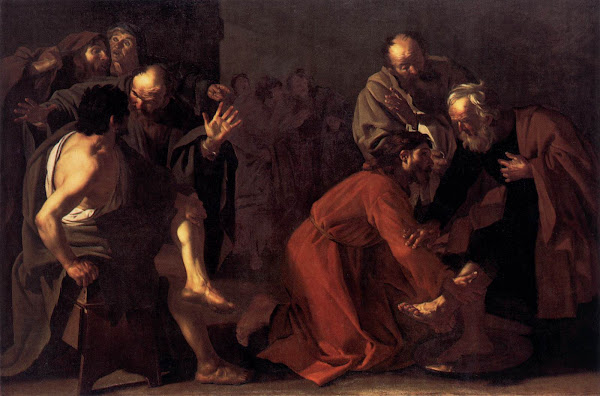
HAMLET AS SERVANT-PRINCE: A PARAPHRASED & OFTEN-MISSED BIBLE ALLUSION: Hamlet: I am glad to see you well. Horatio! - or I do forget myself. Horatio: The same, my lord, and your poor servant ever. Hamlet: Sir, my good friend - I'll change that name with you. Four key Shakespeare & the Bible scholars missed this, while Peter Milward (on the tragedies) caught it: Hamlet says he would be his friend Horatio’s “poor servant,” not the other way around. This alludes to multiple gospel passages in which Jesus says that if you would be greatest, you must be servant of all (Matt 20:26; Mark 9:35; Luke 22:26) and that Jesus won’t call his disciples servants any longer, but friends (John 15:15), and he washes their feet to demonstrate such service (John 13:1-9). [IMAGE: Dirck van Baburen (circa 1594/1595–1624) / Christ Washing the Apostles Feet / circa 1616 / Public domain via Wikipedia.] Why does it matter? Along with Hamlet’s scolding of Polonius for his judgmental and...
HAMLET'S BIBLE: MY BOOK PROJECT

HAMLET'S BIBLE: MY BOOK PROJECT I’m writing a book about biblical influences, allusions and plot echoes in Hamlet, tentatively titled “Hamlet’s Bible.” Others since the 1860s have tried to document all known bible allusions in *all* of Shakespeare’s plays, and these are helpful reference books but have drawbacks: 1. Like many reference books, they often read like phone books. 2. The most up-to-date (Shaheen) is prohibitively expensive. 3. We usually read one play at a time; readers with limited exposure to a few plays are unlikely to invest in a reference book if they’d only use one chapter per play. 4. These books neglect paraphrased allusions & plot echoes. 5. They also lack historical and interpretive context. My students would say, “Ok, but what are the allusions doing there? What did they mean?” My book will ~ include essays about threads & clusters of biblical & religious allusions & plot echoes; ~ deal primarily with Hamlet, not all of Shakesp...
C. Elliot Browne on Francisco, Bernardo, & Pazzi Conspiracy
C. ELLIOT BROWNE WROTE IN 1876 that the names of the first two characters on stage in Hamlet may allude to assassins in the Pazzi conspiracy.* Modern readers may think: Never heard of that! Are there Pazzi allusions in other Elizabethan plays? In a 1995 book, Frank Ardolino shows that Thomas Kyd’s play, The Spanish Tragedy—the best-known English revenge tragedy before Hamlet—contained allusions to the Pazzi conspiracy. If Kyd’s play did so, it’s easier to think that Hamlet contained them as well. But the sentinels in Hamlet are not assassins. And there are correspondences between stories of Francis of Assisi and Bernard of Clairvaux, and Hamlet - so the Pazzi allusion probably wasn’t the only thing on WS's mind. Q: But why might scholars have neglected the possibility that these names are allusions to the saints? A: England after the reformation, and Protestants after Luther in general, rejected the Catholic cult of the saints - and may have avoided painful memories of lost ...