Posts

LOVE & FEAR & YODA & HAMLET

Image
“My goal, in short, is to help explain Shakespeare, not to endorse the religion he had or the religion he became. But we cannot fully grasp Shakespeare’s own aims, I argue, until we come to terms with those religions too.” Jeffrey Knapp, 2002, Shakespeare's Tribe There is a sort of hinge in Shakespeare’s Hamlet , built on a contrast or sometimes proposed complementarity of love and fear. There is also a universe of Yoda memes on the internet, many of them dealing with Master Yoda’s thoughts on the dangers of fear and the Dark Side. What might Yoda and Hamlet have in common regarding the themes of love and fear? Early in the play, we learn that Hamlet would rather speak of mutual love with his sentinels and his friend Horatio, than hear them profess anything about their duty to serve him. We also learn of Hamlet’s great love expressed in letters to Ophelia. It seems Prince Hamlet would, by far, prefer to dedicate himself to love rather than to revenge. Laertes, howeve...

All's Well That Ends Well: Helena's Rape of Bertram in Historical Context

Image
Tony Tambasco has a good blog post about Shakespeare's play, All's Well That Ends Well, a play title which he notes could be paraphrased as "the ends justify the means," suggesting the play is humorously critical of such thinking. You can read his blog post here . Tambasco explains that the plot of this play involves a woman, Helena, who wishes to marry Bertram, and who tricks him into non-consensual sex, which many countries today would consider rape. He opens his blog post with a comment about how the #MeToo movement and other cultural developments have made Shakespeare's play, Measure for Measure, much more popular, but we should also be considering the rape of Bertram by Helena at this time in history. He notes that because of patriarchy in Shakespeare's England, women often lacked agency (a theme, I would add, that also comes up in Jane Austin's novels regarding the limited options for women and the way they often depended on advantageous marr...

So Many Ophelia—Hamlet Parallels!

Image
I have been reading Julia Reinhard Lupton's good book, Thinking with Shakespeare , with special attention, of course, to the chapter on Hamlet , which is very rich in that it's challenging me to think in ways outside of my previous habits. This blog post is not to share any of Lupton's ideas in particular, though I hope to do so in a future post, especially regarding her mention of Moses as related to Hamlet seeing his father's ghost. Sometimes when I research, I mark or copy down quotes and ideas I think I can use. Other times, while the text I'm reading is about A, B, and C, my mind leaps, and I'm thinking of J,K,L. It's a mysterious process. I am not a fan of saying the Catholic Rosary, but I have heard some say that the prayers of the rosary are meant to occupy and distract your ego or consious mind (or "monkey mind"), which allows other insights to surface or breakthroughs to occur. This is what I mean by stumbling upon J-K-L while doing r...

Ophelia's Prayer Book & the Annunciation of Mary

Image
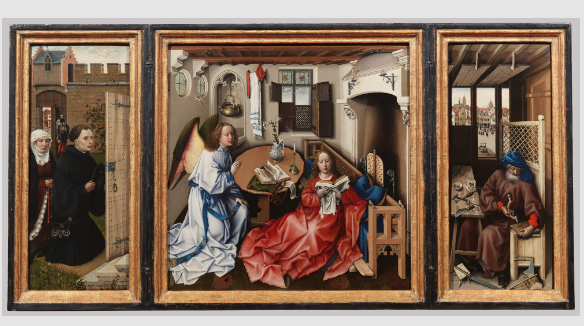
In Hamlet act 3, scene 1, Ophelia's father Polonius asks her to read a book so that she might project "devotion's image" and "pious action" as well as her own loneliness when Prince Hamlet first sees her. In other words, he is using her for bait to trap Hamlet into conversation while Claudius and Polonius eavesdrop. I have written about this scene in a previous blog post regarding the echoes of the story of Suzannah and the Elders , from the book of Daniel. But today I want to note a visual echo of the Annunciation of Mary, when an angel visits to tell her that she is to bear a son, Jesus. [See Bridget Gellert Lyons, "The Iconography of Ophelia," page 61: "The woman with a book was reminiscent of countless representations of the Virgin, who was most commonly shown reading when the Angel of the Annunciation came to visit her." ELH , Spring, 1977, Vol. 44, No. 1, pp. 60-74 https://www.jstor.org/stable/2872526 ] In her remarka...

DARK TRANSFIGURATION & MOSES ECHOES in HAMLET 1.4-5

Image
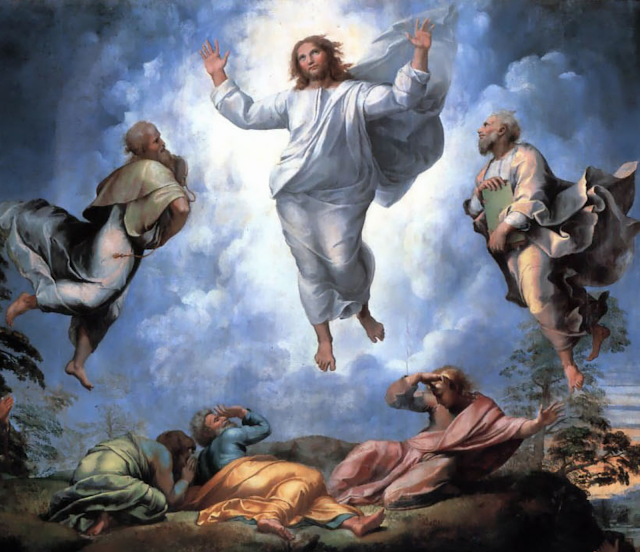
[Detail from painting of the Transfiguration, by Raphael] ~~~~~~~~~~~~~~~~~~~~~~~~~~~~~~~~~~~~~~~~~~~~~~~~~~~~~~~~~~~~ In Hamlet’s meeting with the ghost in act 1, scenes 4-5, there is a dark and ironic variation on the Transfiguration, as told in the gospels (Mt 17:1–, Mk 9:2–, Lk 9:28–): Gospels: Jesus goes up on a mountain with three disciples: James, Peter, and the beloved John. Hamlet: the prince initially gets news of the ghost from three: Marcellus, Bernardo, and beloved friend Horatio. - All three, plus Hamlet, speak of Hamlet keeping watch with them that night, like Jesus with James, Peter, and the beloved John. Later, perhaps for dramatic efficiency's sake, Bernardo does not join them for the watch, so Hamlet goes to meet the ghost with only two, Horatio and Marcellus. Gospels: Jesus is transfigured in light and speaks with Elijah and Moses. Hamlet wears black and is darkly transfigured toward madness and revenge after speaking with the ghost who claims to be h...

Jonah, Nineveh, & Alexander the Great

Image
Here's a fascinating article on archaeological research to find the location of a battle won by Alexander the Great in 331 BCE, probably located in Nineveh, the city to which the Hebrew prophet Jonah was sent. https://www.triesteallnews.it/2019/04/16/iraq-archeologi-di-udine-scoprono-il-sito-della-battaglia-di-gaugamela/ The book of Jonah is dated as having been written in 4th/5th century BCE (though it references events in the reign of Jeroboam II, 786–746 BC). So the book of Jonah may have been written as a veiled commentary on Alexander's victory there? This may be old news to Hebrew scripture scholars, but it's a new insight for me, coming at the topic via my interest in the Jonah echo in Shakespeare's Hamlet. I found this via Mirella Granelli on LinkedIn. Thanks, @Mirella! In the journal Clio (III, 1974, 111-128), Paul Jorgensen's essay, "Elizabethan ideas of war in Hamlet," contrasts two ways that nations relate to God regarding state corru...

Still Glowing from RMMRA-Denver

Image
The Rocky Mountain Medieval & Renaissance Association (RMMRA) conference in Denver, April 11-13, was amazing, very thought-provoking and affirming, so while still glowing, I wanted to share a few things about how it went and what impressed me. First, I volunteered to chair a session about male shame and honor in medieval texts, including the poem, "Sir Gawain and the Green Knight." Three graduate students in the Institute for Medieval Studies at The University of New Mexico presented papers. To prepare, I read some literature on the psychology of shame, and also reviewed some literature on gift economies (Lewis Hyde's The Gift: Imagination and the Erotic Life of Property , a cult favorite). The presenters seemed to assume at first that it was a binary: Either honor or shame, and that this was mostly related to warrior culture. In fact, I found that gift dynamics are inextricably tied in with these other dynamics of violence, honor, and shame, and I would go so far a...

Poem accepted

Image
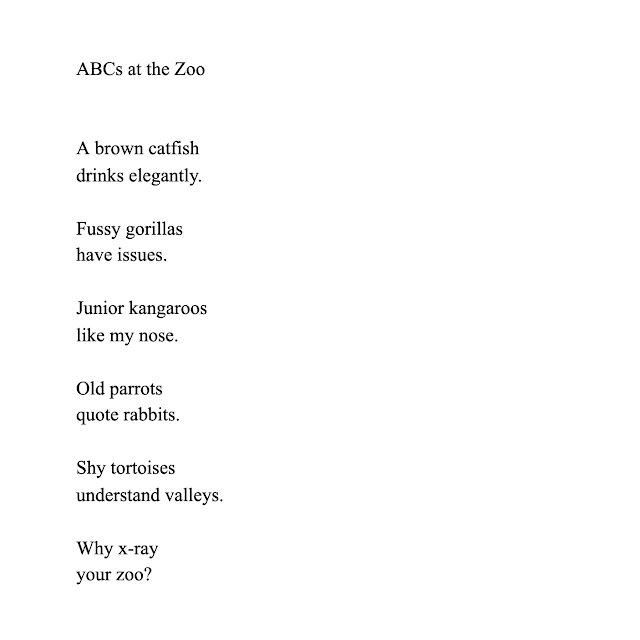
I recently received news that one of my poems was accepted to be published in the sidewalk poetry project in the town where I live, Northfield, Minnesota. Northfield is home to two colleges (St. Olaf and Carleton), and in part because of that, has a relatively high interest in the arts: Though our population is only slightly over 20,000, we actually have an arts commissioner (the current one was formerly a local school principal, and is a personal friend). The judges deliberated without knowing who wrote the poems (we submitted without any names on the pages with our poems), and mine was one of those chosen. In recent years, I have tried a few ABC poems in the style of former US poet laureate Robert Pinsky, whose poem in that form was published in the New York Review of Books; I discovered it when Dustin Hoffman recited it from memory on the Charlie Rose show. His ABC poem with one word per letter of the alphabet, in order. I have been experimenting in this form, taking the al...

Marlowe, or Shakespeare's fellow actors, as influence?

Image
In 2016, Gary Taylor, editor of the New Oxford Shakespeare, explained in a BBC article that Christopher Marlowe was being credited in their latest edition of the plays as co-writer of some of the plays long attributed to Shakespeare alone. But if there's a hint of Marlowe's voice in some of the plays, where does that come from? Marlowe himself? or some other Marlowe-influenced source? Carol Rutter of the University of Warwick thinks it wasn't Christopher Marlowe directly, but Shakespeare's fellow actors and their knowledge of Marlowe's plays from performing them, that influenced the plays: This is an important conversation to have, especially when scholars of Shakespeare are often not playwrights themselves, and with only scholarly knowledge of the creative process rather than first-hand knowledge.

RMMRA Denver topic: PROTESTANT, EMPIRICAL, & CONFIRMATION BIASES IN SHAKESPEARE & THE BIBLE, AND HOW WE MIGHT TRANSCEND THEM

Image
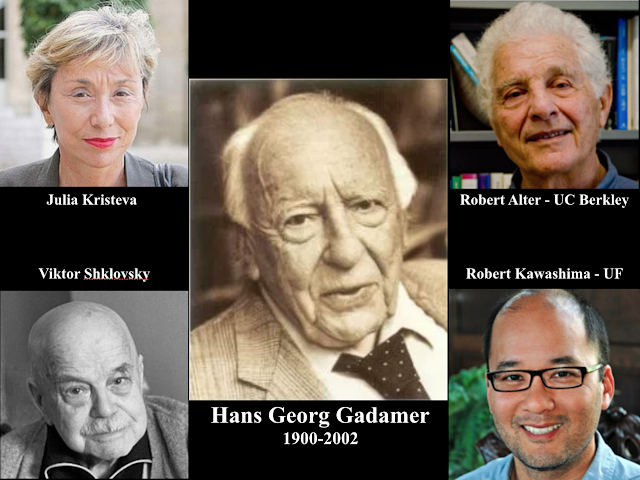
This week I am headed to Denver, Colorado, for a meeting of the Rocky Mountain Medieval and Renaissance Association (instead of attending the Shakespeare Association of America conference in Washington D.C., which was tempting for its proximity to the Folger Shakespeare Library). I am presenting a paper called “How Gadamer Might Rethink Shakespeare & the Bible,” in which I consider how a Protestant bias of “Scripture Alone” (Sola Scriptura), and an empirical bias of the emerging sciences in the mid-1800s, established an early tradition that favored very literal references in biblical allusions that utilized biblical names and phrases, over paraphrase and plot echo, which are often relatively neglected by many of the main reference books in the field. (Darwin's book, On the Origin of Species , was published just five years before Charles Wordsworth's 1864 book on Shakespeare and the Bible, and it, too, is obsessed with empirical evidence and close observation). These b...

SHAKESPEARE, SUICIDE, & HOW NARRATIVE ARTS CAN HELP ADVANCE THEOLOGICAL UNDERSTANDING

Image
Gustav Klimt, Death of Romeo & Juliet, "Theatre of Shakespeare" (1886) from historic Burgtheater, Vienna, via UK Shakespeare Magazine, Twitter. Shakespeare has many plays with suicides in them. Most famously, perhaps, is the dual suicide of Romeo and Juliet. Lady Macbeth kills herself, as do Anthony and Cleopatra, Brutus, Cassius, the wife of Brutus, Timon of Athens, and a daughter of King Lear. In Lear, the blinded Gloucester wants to commit suicide by jumping off a cliff, but his son in disguise sets it up to make his father believe he has been miraculously saved. Othello kills himself after he realizes he has been tricked into killing his wife by Iago (whose name is a Spanish form of James, which makes sense considering how the English hated the Spanish after the Armada, and the Jesuits, based in Spain; but which creates cognitive dissonance when we think of how the play was written while a king named James occupied the English throne). In Hamlet, the prince c...

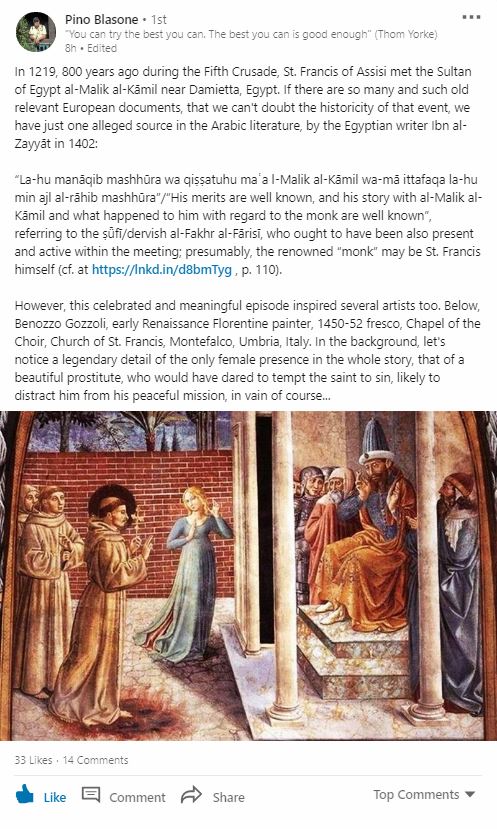
Pino Blasone on Francis and the Sultan

Image
For those of you who have followed my posts about Francisco and Bernardo, the first two characters on stage in Hamlet , and my research regarding the lives of the saints after whom they may have been named (Francis of Assisi and Bernard of Clairvaux), and if you are LinkedIn members, you might be interested in a recent post by Pino Blasone, essayist, teacher of Latin and philosophy, cultural journalist, writer of verse and fiction, and on LinkedIn, often reflecting on art and art history : https://www.linkedin.com/feed/update/urn:li:activity:6515518607085051904 If you have not read my posts on Francis and Bernard, you can type into the search bar at the top right of this blog, the name "Francisco" and also (new search) the name "Bernardo" (or Francis, Bernard) and you'll find them quickly. You can also look for those posts I have labeled "Francisco & Bernardo" by using the label list search from the drop-down menu in the upper left on this blo...

Shakespeare, Christ Figures, and the Critics

Image
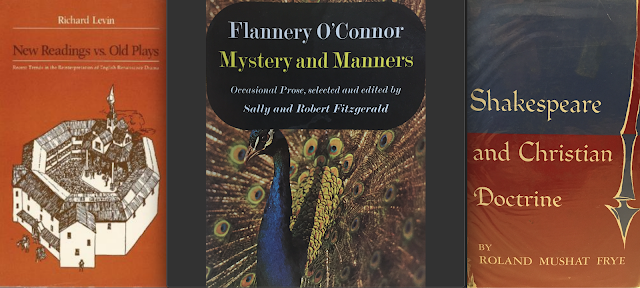
Two books in roughly the past half-century have done a good job identifying the flaws in sloppy or superficial Christian criticism that tries too hard at times to find Christ-figures everywhere. These have had good and bad effects on the way that people who are less aware of the field of Shakespeare and Religion sometimes perceive it. On the one hand, Christians should not proselytize sloppily through Shakespeare, finding religious allegories anywhere or everywhere, and if they point out religious themes or biblical echoes, they should cite evidence to support their claims. Fair enough. But some of this criticism of the Christian theologizers is fraught with its own flaws and distortions, as well as having unintended negative effects. Roland Mushat Frye was a scholar-in-residence at the Folger Shakespeare Library, and his book, Shakespeare and Christian Doctrine (1963), is often cited. Chapter 1 (19-42) is called "Theologizing Analyses: The School of Knight," named after...

TO ASSUME, OR NOT TO ASSUME: Defamiliarization & Allusion in Shakespeare & the Bible

Image
[Illustration: Bottom the Weaver from Shakespeare's Midsummer Night's Dream , by Arthur Rackham, 1939] In the last few years, I have been reading as many books and essays about Shakespeare and religion as I can get my hands on, and among the many things that strike me is this: Protestant, Catholic, Jewish, and other critics can read the same text and come away with very different interpretations, even paying attention to the same details. Of course, this makes perfect sense, and Shakespeare implies that this will happen through certain lines in Hamlet. Readers or viewers bring different assumptions to their experience of the plays, and they often exercise a kind of confirmation bias, noticing details that confirm their assumptions or biases. We all do this, of course, and in part, it's what makes academic research interesting: to discover what people with different experiences, assumptions, and biases make of the same text. But when you've been wrestling with th...