Posts

(Part 11) Cordelia is about her father's business in Shakespeare's King Lear

Image
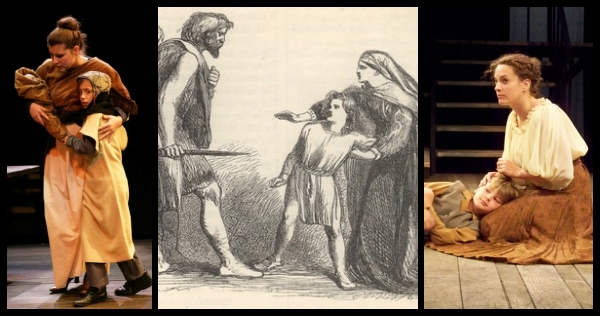
~~~~~~~~~~~~~~~~~~~~~~ INDEX OF POSTS IN THIS SERIES: https://pauladrianfried.blogspot.com/2023/01/index-hamlet-in-32-as-boy-jesus-lost.html ~~~~~~~~~~~~~~~~~~~~~~~~~~~~~~~~~~~~~~~~~~~~~~~~ This series has considered Hamlet’s allusion to Luke 2:46-52, the tale of the boy Jesus amazing temple elders and his parents.[1] Last week we considered a similar thematic echo in Macbeth , when the son of Lady Macduff amazes and humors his mother with wit and grace while also catching her conscience, like a court fool. But Hamlet and Macbeth are not the only Shakespeare plays that echo or allude to the Luke 2 story: King Lear contains an allusion to this gospel story, spoken by Lear’s exiled daughter, Cordelia.[2] We might recall how in Luke 2, Jesus tells his parents that he went to the temple because he had to be about his (heavenly) “father’s business.” Hamlet also believes he must be about his father’s business, but he is confused, at first striving reluctantly to be about the ghost’...
Shakespeare's First Folio Anniversary

Image
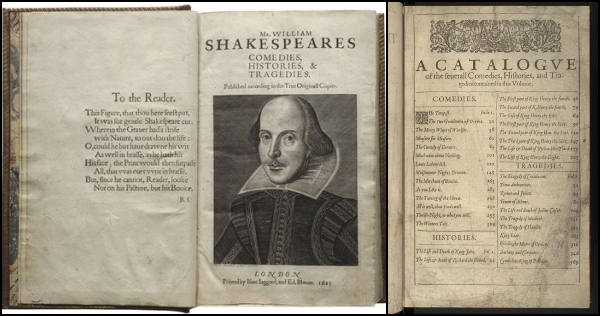
This year is the 400th anniversary of the printing of Shakespeare's First Folio, which contains 36 plays that it labels as 15 comedies, 10 histories, and 12 tragedies. Some of these have later been called problem plays or romances. Of the 36 plays, 18 may have been lost forever if not for the printing of the First Folio. - There are a few others that we know Shakespeare had a hand in that are not included in the First Folio: Two Noble Kinsmen, Pericles, and Edward III. - There are also lost Shakespeare plays: Love's Labour's Won, and Cardenio. - And some Folio plays are known to have been collaborations. The exact date of Shakespeare's birth is not known, although his baptism was recorded as taking place on April 26, 1564, and his death on April 23, 1616. To keep things neat and tidy, his birth and death are observed on the same date, April 23, and this year, the anniversary of the First Folio has attracted special celebrations and publications. Seven years after Sh...

(Part 10) Boy Amazes Mother in Shakespeare's Macbeth

Image
~~~~~~~~~~~~~~~~~~~~~~ INDEX OF POSTS IN THIS SERIES: https://pauladrianfried.blogspot.com/2023/01/index-hamlet-in-32-as-boy-jesus-lost.html ~~~~~~~~~~~~~~~~~~~~~~~~~~~~~~~~~~~~~~~~~~~~~~~~ When considering an allusion by an author, it’s often informative to check and see if that author has other works that make a similar allusion. With Hamlet’s allusion to the boy Jesus amazing his mother and the temple elders in 3.2, besides checking things such as homilies of the time (as I did in Part 9 of this series) [1], we might wonder: Did Shakespeare allude to this Bible tale in other plays? Naseeb Shaheen believes Shakespeare’s Cymbeline has a brief reference to this same gospel tale (1.1.47-52), and King Lear (more explicitly) in 4.4.26-32. Less explicitly - yet perhaps quite significantly - in Macbeth, the dynamics between Lady Macduff and her son have a strong thematic connection to the tale of the boy Jesus amazing and [a-]stonishing his parents (and especially his mother, as...

Hamlet's Emmaus in Jonah's Belly: Allusions inside of allusions

Image
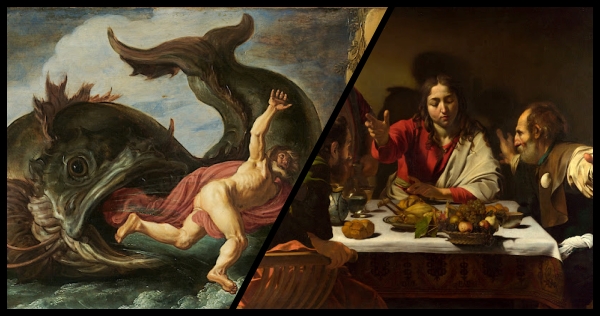
HOW IS IT POSSIBLE that one allusion or plot echo might be encompassed inside of another? A playwright can begin one thread of a story with an allusion, have the action cut away to a sub-plot with a different allusion, and pick up later on the original story thread. This happens in Hamlet, with plot echoes of Jonah and Emmaus. JONAH [1]: Hamlet’s sea-voyage contains important similarities to the sea-voyage of Jonah.[2] Bits of this allusion or the plot echo begin early in the play, with Hamlet exclaiming to the ghost, “O my prophetic soul!” [3] Later there are repeated references to his upcoming sea-voyage to England. [4] On his sea-voyage, we don’t hear of his having been in the belly of the pirate ship until Horatio reads a letter in which Hamlet mentions pirates [5]. To Claudius, Hamlet writes how he was “set naked on your kingdom.” [6] EMMAUS: Before we hear details that complete the Jonah echo in 5.2, Hamlet and Horatio are two Danes on the road to Elisinore, stopping in a graveya...

(Part 9) Twisting the tale of the boy Jesus in the temple: Bishop Jewell, official book of homilies

Image
~~~~~~~~~~~~~~~~~~~~~~ INDEX OF POSTS IN THIS SERIES: https://pauladrianfried.blogspot.com/2023/01/index-hamlet-in-32-as-boy-jesus-lost.html ~~~~~~~~~~~~~~~~~~~~~~~~~~~~~~~~~~~~~~~~~~~~~~~~ Most considerations of a biblical allusion in Shakespeare do well to consider whether, and how, official homilies of the time treated the biblical text. This applies to this series,[1] and Hamlet’s allusion [2] to Luke and the boy Jesus, amazing temple elders and his parents. People in Shakespeare’s England were required by law to attend church. They would hear Luke 2:46-52 every January on the Sunday after Epiphany.[3] Only one official homily [4], attributed to Bishop John Jewell, mentions these verses from Luke. The homily is called, “OF THE RIGHT USE OF THE CHURCH OR TEMPLE OF GOD, AND OF THE REVERENCE DUE UNTO THE SAME.”[5] EXCERPT 1: “In the second [chapter] of Luke it is written, how that the mother of Christ, and Joseph, when they had long sought Christ, whom they had lost, and could ...

Thanks to readers, 1-31 March, 2023

Image
Thanks to readers, 1-31 March, 2023 ~~~~~~~ Thank you to readers of this blog for this past month, which the blog's analytics say came to 563 views from the following countries: Thank you for your interest. I am grateful and humbled. ~~~~~~~~~~~~~~~~~~~~~~~~ Disclaimer : If and when I quote or paraphrase bible passages or mention religion in many of my blog posts, I do not intend to promote any religion over another, nor am I attempting to promote religious belief in general; only to explore how the Bible and religion influenced Shakespeare, his plays, and his age. ~~~~~~~~~~~~~~~~~~~~~~~~~~~~~~~~~~~~~~ ~~~~~~~~~~~~~~~~~~~~~~~~~~~~~~~~~~~~~~ Thanks for reading! ~~~~~~~~~~~~~~~~~~~~~~~~~~~~~~~~~~~~~~ ~~~~~~~~~~~~~~~~~~~~~~~~~~~~~~~~~~~~~~ My current project is a book tentatively titled Hamlet’s Bible , about biblical allusions and plot echoes in Hamlet . Below is a link to a list of some of my top posts (“greatest hits”), including a description of my book project...

"See the inmost part of you": Gertrude's literalism, fear of evisceration in 3.4

Image
In Hamlet 3.4, the scene in Gertrude's closet, Hamlet tells her that he will show his mother her "inmost part," and it's clear to the audience or readers that he's talking about her conscience. But she quickly jumps to the conclusion that perhaps he is going to kill her: "What wilt thou do? Thou wilt not murther me? Help, help, ho!" This scene is often played with some violence by Hamlet toward his mother, throwing her on her bed, to help explain why she jumps to this conclusion. But this is not in the stage directions, and perhaps there are other reasons why she jumps to this conclusion. ~~~~~~~~~~~~~~~~~~~~~~~~~~~~~~~~~~~~~~~~~~~~~~~~~~~ With me in the "Rethinking Science and Religion" seminar at Shakespeare Association of America this spring, there were two members who wrote about Renaissance anatomists and drawings of the dissected human body. This made me think about Elizabethan public executions of Catholics and others, sometimes inv...

SAA conference 2023 in Minneapolis, MN

Image
Next week I will be part of a seminar at a conference: the annual meeting of the Shakespeare Association of America, which will be held this year in Minneapolis, Minnesota, USA.[1] I’ve attended before: 2018: I attended the 2018 meeting in Los Angeles, California, where I met Gayle Gaskill, editor of the New Kitteridge edition of Shakespeare’s Twelfth Night, as well as other scholars, young and old, with interesting tales to tell.[2] Gayle and I went on to present papers at the SCSC conference in the fall of 2018.[3] 2020: I was part of a seminar on “Mind, Cognition, and Affect” in 2020,[4] held on Zoom due to the pandemic. My paper was about labors of gratitude and regret in Hamlet, exploring how these emotions were instrumental in character arcs. See my series on that topic. [5] 2023: This year, I am taking part in the seminar, “Reconsidering Science and Religion,” on Thursday, 30 March, 3:30 to 5:30 p.m. CST. My paper is called “Kuhnian Paradigm Shifts and Emmaus Untet...

(Part 8) Hamlet in 3.2 as the boy Jesus: Why has this been missed?

Image
~~~~~~~~~~~~~~~~~~~~~~ INDEX OF POSTS IN THIS SERIES: https://pauladrianfried.blogspot.com/2023/01/index-hamlet-in-32-as-boy-jesus-lost.html ~~~~~~~~~~~~~~~~~~~~~~~~~~~~~~~~~~~~~~~~~~~~~~~~ In previous parts of this series,[1] I have explored Hamlet’s allusion in 3.2 to himself and his mother Gertrude [2] as like the boy Jesus, found in the temple by an astonished mother Mary among the elders.[3]  This allusion was missed by all major writers of reference books on Shakespeare and the Bible through at least the late 20th century [4]. Why have these scholars in this specialty field missed this allusion? Possibilities: 1. THE BIAS OF SCHOLARS: Perhaps many critics have preferred to imagine Hamlet as either not religious, or as a virtuous hero, rather than as one who would gloat after The Mousetrap and compare himself, perhaps blasphemously, to the boy Jesus? [5] And perhaps some scholars, especially in the last half century, simply resisted viewing Hamlet as a Christ fig...