Posts

HORATIO GETS “MOTE/PLANK” EQUATION BACKWARDS IN HAMLET 1.1:

Image
Horatio says King Hamlet fought Fortinbras of Norway, “pricked on by emulate pride.” From their catechism, early audiences knew pride was the worst of the seven deadly sins. The kings had a signed agreement “ratified by law and heraldry” that the loser would forfeit land, but now the son of Fortinbras is gathering an army to get the land back. Marcellus notes, Denmark is so busy preparing for war that shipwrights are not even stopping to observe Sunday as sabbath and day of rest, as required by bible and church (note: more sin). Bernardo says that this must be the reason for the ghost’s visits, since the late king “was and is the question of these wars.” Then Horatio downplays the seriousness of the situation: “A mote it is to trouble the mind's eye.” Matthew 7:3-5 says that, if you wish to help take the mote (dust speck) from your neighbor’s eye, you should first take the plank from your own. Scholars have noted this allusion. But Horatio gets it backwards, claiming ...
SCHOLARLY SNOBBERY or ANTI-CATHOLIC BIAS?

Image
When Scholars of Shakespeare’s Hamlet note that the name Marcellus contains an allusion to Virgil’s Aeneid, and Horatio alludes to the poet Horace and a Horatio in a Thomas Kyd tragedy of the time, consider that these allusions may have been intended for the 1%, or at least a more educated upper class among the first audiences of the play, and regular theater-goers. Meanwhile, most scholars neglect allusions in the character names of Francisco and Bernardo (the first two on stage) to Saints Francis of Assisi and Bernard of Clairvaux, associated with some of the hundreds of monasteries in England that were dissolved during the reign of Henry VIII. Allusions in the names of Francisco and Bernardo are more for the working class, the groundlings, whose ancestors back through the centuries had named their children after Christian saints. Stories associated with these saints offer relevant comparisons with the characters and plot in Hamlet, and deserve our consideration. Mentioning the M...

FIXING THE FATHER'S MESS IN HAMLET & ROGUE ONE

"O cursed spite / That ever I was born to set it right!" —What do Shakespeare’s Hamlet and “Star Wars: Rogue One” have in common that Hamlet and Disney’s “The Lion King” do not? (Hint: It's not about a "nunnery.") When “Lion King” opened (1994), one oft-quoted reviewer called it “Hamlet on the Serengeti.” It’s obvious: writers for the animated feature modeled their story after Shakespeare’s play. Shakespeare’s Hamlet begins with talk of the ghost’s appearance and soldiers wondering why Denmark is working so hard to prepare for war. The reason? Decades earlier, the king (Hamlet’s father) had slain Fortinbras, King of Norway, in single combat; now the fatherless son of Fortinbras is preparing an army to attack, take back the land, and avenge his father’s death. These soldiers may be among the first to die in such a war, so they have a right to ponder what their leaders are up to and who caused the mess. The play ends with Hamlet giving his “dying voice” i...
Among the most popular of my posts on Hamlet and the Bible (through the start of June 2017), these four seem to be holding strong, perhaps in part because LinkedIn indicates that a significant cluster of the views are from professors, lecturers, and teachers, and the posts offer ideas that may be useful as discussion starters in a classroom setting: "Four approaches to the names of the sentinels, Francisco and Bernardo," "Top 6 reasons Shakespeare probably named Francisco... after Francis of Assisi," "Shakespeare's Hamlet was something fresh in English revenge tragedies," and "Some of the harder biblical allusions to spot in Shakespeare's plays are the ones that are more thoroughly paraphrased, or subtle plot echoes." My most recent, which gives an example of a paraphrased bible reference, is also becoming popular in a short time. But just because they're popular doesn't mean they're flawless: Feel free to contribu...

HAMLET AS SERVANT-PRINCE: A PARAPHRASED & OFTEN-MISSED BIBLE ALLUSION

Image
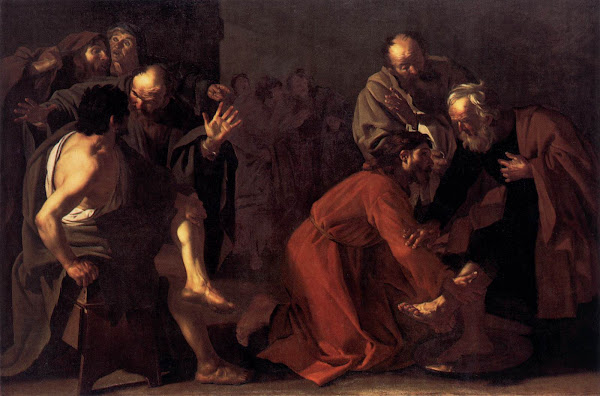
HAMLET AS SERVANT-PRINCE: A PARAPHRASED & OFTEN-MISSED BIBLE ALLUSION: Hamlet: I am glad to see you well. Horatio! - or I do forget myself. Horatio: The same, my lord, and your poor servant ever. Hamlet: Sir, my good friend - I'll change that name with you. Four key Shakespeare & the Bible scholars missed this, while Peter Milward (on the tragedies) caught it: Hamlet says he would be his friend Horatio’s “poor servant,” not the other way around. This alludes to multiple gospel passages in which Jesus says that if you would be greatest, you must be servant of all (Matt 20:26; Mark 9:35; Luke 22:26) and that Jesus won’t call his disciples servants any longer, but friends (John 15:15), and he washes their feet to demonstrate such service (John 13:1-9). [IMAGE: Dirck van Baburen (circa 1594/1595–1624) / Christ Washing the Apostles Feet / circa 1616 / Public domain via Wikipedia.] Why does it matter? Along with Hamlet’s scolding of Polonius for his judgmental and...

HAMLET'S BIBLE: MY BOOK PROJECT

Image
HAMLET'S BIBLE: MY BOOK PROJECT I’m writing a book about biblical influences, allusions and plot echoes in Hamlet, tentatively titled “Hamlet’s Bible.” Others since the 1860s have tried to document all known bible allusions in *all* of Shakespeare’s plays, and these are helpful reference books but have drawbacks: 1. Like many reference books, they often read like phone books. 2. The most up-to-date (Shaheen) is prohibitively expensive. 3. We usually read one play at a time; readers with limited exposure to a few plays are unlikely to invest in a reference book if they’d only use one chapter per play. 4. These books neglect paraphrased allusions & plot echoes. 5. They also lack historical and interpretive context. My students would say, “Ok, but what are the allusions doing there? What did they mean?” My book will ~ include essays about threads & clusters of biblical & religious allusions & plot echoes; ~ deal primarily with Hamlet, not all of Shakesp...

C. Elliot Browne on Francisco, Bernardo, & Pazzi Conspiracy

Image
C. ELLIOT BROWNE WROTE IN 1876 that the names of the first two characters on stage in Hamlet may allude to assassins in the Pazzi conspiracy.* Modern readers may think: Never heard of that! Are there Pazzi allusions in other Elizabethan plays? In a 1995 book, Frank Ardolino shows that Thomas Kyd’s play, The Spanish Tragedy—the best-known English revenge tragedy before Hamlet—contained allusions to the Pazzi conspiracy. If Kyd’s play did so, it’s easier to think that Hamlet contained them as well. But the sentinels in Hamlet are not assassins. And there are correspondences between stories of Francis of Assisi and Bernard of Clairvaux, and Hamlet - so the Pazzi allusion probably wasn’t the only thing on WS's mind. Q: But why might scholars have neglected the possibility that these names are allusions to the saints? A: England after the reformation, and Protestants after Luther in general, rejected the Catholic cult of the saints - and may have avoided painful memories of lost ...

Four Approaches to Francisco & Bernardo in Hamlet

Image
FOUR APPROACHES to the names of sentinels Francisco & Bernardo at the opening of Shakespeare’s Hamlet: 1. Pay no attention to the names. Just enjoy. 2. Assume (as Joseph Ritson did, writing in 1783) that Shakespeare didn’t know his Latin or Italian well and sometimes chose such names randomly. This may imply permission to ignore these names (as in 1, above), but you can feel you’ve taken the playwright down a notch in the process, avoiding Bardolatry (à la Ritson). 3. Assume (as C. Elliott Browne did, writing in 1876) that these names point to two key assassins in the Pazzi conspiracy of 1478. The allusion therefore points to papal corruption and Machiavellian scheming, which could seem anti-Catholic, justifying England’s break from Rome. Scholars with a Protestant bias can feel self-satisfied with this one and look no further. Or the connection to names of Pazzi assassins may be cover (out-wit the censors) for #4: 4. Consider that the names point to Saints Francis of A...

TOP SIX REASONS Shakespeare probably named Hamlet sentinel Francisco after Francis of Assisi

Image
TOP SIX REASONS #Shakespeare probably named the sentinel Francisco (first character on stage in Hamlet ) after Francis of Assisi: 6. "Get thee to a nunnery!": Clare, friend of Francis, founded the Poor Clares; the source stories for Hamlet had no parallel "to a nunnery!" rejection of a lover. 5. Fortinbras' lost land: Franciscan friars are usually positive figures for Shakespeare; many Franciscan monasteries, named after Francis, were dissolved by Henry VIII (lost land!), who married his brother's wife, as did Claudius in Hamlet. 4. Heart-sick: Francisco complains of heart-sickness in 1.1, as does Hamlet in 5.2; Francis was described as often being heart-sick with compassion for the sick and poor. 3. World-weary: Hamlet complains (2.2) of being world-weary in language similar to that used by biographer [hagiographer] Thomas of Celano to describe Francis. 2. Father issues: Hamlet and Francis both refocus on [a heavenly father or] "P...

FATHER ISSUES FOR HAMLET & FRANCISCO

Image
Shakespeare's Hamlet has father issues, and only after being spared by pirates at sea does he refocus from his father's ghost to what he sees as the hand of Providence. It might have been better if he'd made the break sooner. But Shakespeare chose to name the first character on stage Francisco, a sentinel, and a possible allusion to Francis of Assisi, who also had father issues, and whose monasteries spread all over Europe and to England, where hundreds of monasteries were "dissolved" during the reign of Henry VIII - a nice way of saying land was stolen to be sold off by the crown and for political favors. [April 12, 2024 note: We may also observe that, just as Francis of Assisi had father issues - and famousely sought to separate himself from an abusive father in favor of a heavenly one - Bernard of Clairvaux was famous for having said to have had a dream in which he was fed on milk from the breast of the Virgin Mary, a vision portrayed in various paintings....

MIGHT ART LOST IN DISSOLVED MONASTERIES HAVE HELPED CONNECT HAMLET'S FRANCISCO & BERNARDO TO THE SAINTS?

Image
Did Shakespeare choose the names Francesco and Bernardo as the first two characters in Hamlet, sentinels, because he named them after Saints Francis of Assisi and Bernard of Clairvaux, two saints associated with hundreds of Franciscan and Cistercian monasteries that were lost during the reign of Henry VIII? And might Shakespeare's parents have remembered wall paintings in churches or chapels near or on these monastery grounds, which depicted events from the lives of these saints - as many frescoes do in other parts of Europe? A number of churches in Florence, the location of the Pazzi conspiracy, have frescoes that depict Francis, cutting ties with his father, or Francis going to visit the sultan (leader of the enemy forces) during a crusade. These were well-known stories and may have some relevance to the plot of Hamlet. [April 12, 2024 note: Much is made of the fact that Hamlet is upset with his mother for marrying his uncle, considered a scandalously incestuous marriage i...

INDEX OF POSTS on Francisco & Bernardo

Image
Starting in 2017, I did a number of posts about Francisco and Bernardo, two sentinels in the opening scene who may have been named not only after the Catholic saints (Francis of Assisi, and Bernard of Clairvaux), each of whom have rich stories and possible reasons for allusions, but also after the two assassins in the Pazzi Conspiracy. The possible implications for holding up a mirror to the times and to Shakespeare's original audiences are wide-reaching and profound. MIGHT ART LOST IN DISSOLVED MONASTERIES HAVE HELPED CONNECT HAMLET'S FRANCISCO & BERNARDO TO THE SAINTS? https://pauladrianfried.blogspot.com/2017/04/might-lost-art-in-dissolved-monasteries.html - April 03, 2017 FATHER ISSUES FOR HAMLET & FRANCISCO https://pauladrianfried.blogspot.com/2019/01/shakespeares-hamlet-has-father-issues.html - April 10, 2017 TOP SIX REASONS Shakespeare probably named sentinel Francisco after Francis of Assisi https://pauladrianfried.blogspot.com/2017/04/top-six-reas...

Shakespeare's Hamlet was something fresh in English revenge tragedies

Image
Shakespeare's Hamlet was something fresh in English revenge tragedies. The most popular of them, The Spanish Tragedy, either conveyed the assumption that God was on England's side, against Spain and Rome, or according to some, the play's violence was so over-the-top that it may have been intended to cause its audience to question the impulse for revenge against national enemies. Hamlet turned this on its head and used the end of a royal house in Denmark as an analogy for England's hope for a heroic ending to the House of Tudor. Think of the film, Avatar, which worked as an analogy for resource wars led by the US against smaller (and increasingly Muslim) nations, and against indigenous peoples over centuries. Planet Earth wants to mine "unobtanium" at the cost of many alien lives; earthlings are, mostly, the bad guys, while the aliens live in better harmony with their planet. But the film Avatar struck a nerve and was a record-breaking box-office hit. Obvi...

PARAPHRASED BIBLICAL ALLUSIONS OR PLOT ECHOES MAY BE AMONG THE MOST DEEPLY INTERNALIZED

Some of the harder biblical allusions to spot in Shakespeare's plays are the ones that are more thoroughly paraphrased or subtle plot echoes. ~ Some of these might have been made subtle for aesthetic reasons (e.g. to avoid cliches) or to avoid the censors (avoid criticizing the crown and its advisers with political commentary laced with righteous biblical quotes). ~ But some of the paraphrased and subtle references may be among the most important, in part because, to paraphrase or create a subtle plot echo, you must have internalized the scripture reference very deeply and insightfully; then you can make it your own in fresh writing that resonates with the influence of the buried allusion. This idea contradicts most of the major works (and many minor ones as well) that attempted to catalog all the (obvious) biblical allusions in Shakespeare's plays. These include Bishop Charles Wordsworth (1864), Thomas Carter (1905), Richmond Noble (1935), Naseeb Shaheem (tragedies, 1987),...

OF EASTER EGGS & LION KINGS

Image
I am writing a book about biblical allusions in Shakespeare's Hamlet. But to appeal to the young, when I speak to younger groups, I could say I'm writing a book about religious #EasterEggs in the story that Disney's The Lion King was based on. To people between 14 and 25, an allusion sounds too much like "illusion," but its the same as what the young refer to as an "easter egg" in a movie (hidden meaning or reference). There are many, many youtube videos claiming to reveal the easter eggs in Disney films, Star Wars films, etc. And many young people who have not read or seen Hamlet have seen #TheLionKing. It's just hard for the young to imagine that the ghost of Simba's dad might be a demon in disguise, and Simba kills Nala's dad accidentally, thinking he's killing Scar in revenge. Or that Simba's love interest would drown herself. Or that Simba would forge a new letter on a ship, ordering two schoolfriends to be executed.  ...

King Lear at the Guthrie, 2017

Image
I attended the last performance of #King Lear at the #Guthrie Theater in Minneapolis, Minnesota tonight. The backdrop to the stage made it seem the story was unfolding in a missile silo. It was acted very enthusiastically, with Edmund sometimes clownish in his villainy. [ Trailer ] Please chime in to discuss the play if you're a Lear fan. I was struck at how Lear's discussion with Burgundy of Cordelia's dowry treated her like a whore for sale, and reminded me of Ophelia speaking of Hamlet's "tenders" of his affection, and her father saying she should charge a higher rate (legal tender), as well as other Shakespearean moments where a wife complains about a husband's secrecy and that she feels treated like a whore, for pleasure and comfort, but not for the sharing of secrets. Favorite lines: "'Tis the time's plague when madmen lead the blind." "Get thee glass eyes; And like a scurvy politician, seem To see the things ...

HAMLET & OLIVIA: Mourning too long?

Image
Stephen Greenblatt ("Shakespearean Negotiations") is among those scholars who note that Twelfth Night 's Olivia is a caricature of Elizabeth I, mourning the death of her father (HenryVIII, whom she idolized) and brother (young King Edward), and making excuses to avoid being courted for marriage. https://en.wikipedia.org/wiki/Twelfth_Night_(1996_film) Olivia's steward, Malvolio, may therefore be a caricature of William Cecil, Lord Burghley, who in the play is toyed with as being possessed and gets a mock-exorcism (!), which (in the eyes of some, like Essex) Cecil deserved, of course. If the unnaturally mourning Olivia can be Eliz I, what about Hamlet? If Viola, and MofV's Portia, and AYLI's Rosalind, etc., can disguise themselves as males, then Hamlet can stand (at least in part) for an idealized Elizabeth, a recipe for how Elizabeth I might end her life and reconcile with James, that prince from the north, the son of her enemy, as Hamlet does with Fo...