HOW MACHIAVELLIAN DO YOU LIKE YOUR POLONIUS? In Shakespeare's Hamlet, how much Machiavelli should we imagine in the king's key adviser, Polonius? Is Polonius an aging and self-absorbed old man— a bootlicker too concerned about his daughter’s virginity? (Then why is he the key adviser?) Or is he a manipulator who purposefully withholds his daughter's affections so they will be more desired by Hamlet, so that the match will get royal approval, and so that she might marry into royalty? (Does he lead Gertrude to want her son’s heart mended by the return of Ophelia’s once-denied love, so his daughter will then be the next queen —implied perhaps in the David Tennant version?) In 2.2, Polonius is certain that the denial of his daughter's affections has caused Hamlet's madness, in spite of Claudius' inclinations otherwise. In 3.1, Gertrude, manipulated by Polonius, says, "for your part, Ophelia, I do wish That your good beauties be the happy cause ...
Posts
HAMLET, WITTENBERG, & . . . FAUST? A trend among scholars of Shakespeare & Religion is to view Hamlet as a Protestant v. Catholic play: The ghost regrets not receiving Catholic sacraments before death, and the prince goes to school in Wittenberg (of Luther fame). But Marlowe's Wittenbergian, Faust, is not so often cited by scholars seeking hints of Catholic or Protestant ideas in the play. If we expand the Catholic-Protestant binary at least to three (Wittenberg-Luther-Faust), then Wittenberg points not only to Luther, but to temptation. Hamlet is tempted to revenge and madness, but perhaps (according to some) recovers a bit after his sea voyage. Luther questioned how literally Catholics should take Jesus' words over the break and wine, "This is my body/blood." A good question. But this opens a can of worms (no Diet of Worms pun intended, but—OK). If we don't take eucharist literally as a "real presence," then why should we ta...
HOW WOULD YOU LIKE YOUR OPHELIA & FORTINBRAS?
Of the many aspects of Branagh's Hamlet that critics noted, one involved images of Hamlet and Ophelia, naked in bed (plucking the heart from the mystery of the question of whether they had been lovers, or whether—as Ophelia tells her father—Hamlet had merely expressed his love in "honorable fashion"). Another involves the entry of an attacking Fortinbras at the end of the play, with an army. An older tradition assumes Ophelia is a virtuous, virginal and obedient daughter who alludes to scripture in conversation with her brother, but as women were considered the "weaker vessel" (a-hem), she goes insane and perhaps (contrary to Gertrude's account?) commits suicide. Others have noted the presence of abortifacient herbs among the flowers she names in her mad scene, and claim that she is pregnant with Hamlet's child, but that this could not be stated explicitly due to the censors. Another old tradition likes to believe that the diplomatic overtures ...
HOW WOULD YOU LIKE YOUR HAMLET? Madman? Privileged drop-out? The Man-who-would-have-been-king? Examination of just three film actors in the role of Shakespeare's Hamlet since the 1990s (Branagh, Hawke, Tennant) reveals distinctly different approaches to casting and portraying the prince. Kenneth Branagh: It is easy to imagine Branagh as a prince who could have made a good king, and that Claudius "Popp'd in between the election and [his] hopes." It's also easy to see how he may have been "loved of the distracted multitude" (4.3). Ethan Hawke: Hawke plays an angst-filled hipster, a privileged drop-out caught in a cul-de-sac of life ("Denmark's a prison"). It seems he has little interest in being king and may prefer Occupy Wall Street (kudos for that). It's easy to see why the board of directors prefers Claudius. Perhaps loved mostly by hipster students among the distracted multitude? David Tennant: Tennant's Hamlet is ...
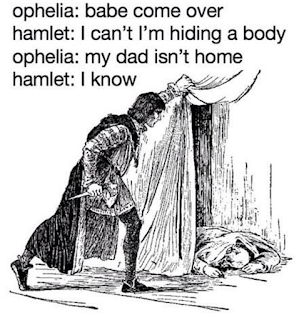
Ophelia was hoping for some quality time with Hamlet after the chaos of the show, listening to "I Think We're Alone Now," an Elizabethan madrigal cover of the song by Tommy James and the Shondells. But it was "not to be." (This image has been on Twitter since at least July, and Reddit since at least April) ~~~~~~~~~~~~~~~~~~~~~~~~~~~~~~~~~~~~~~~~~~~ Links to a description of my book project: On LinkedIn: https://lnkd.in/eJGBtqV On this blog: https://pauladrianfried.blogspot.com/2017/05/hamlets-bible-my-book-project-im.html [Originally posted around the week of 9/15/17 on LinkedIn ]
Nothing male or female but thinking makes it so? To paraphrase Shakespeare's Hamlet: Is there nothing male or female but thinking makes it so? (Or when Hamlet spoke the original line to Rosencrantz and Guildenstern, "nothing good or bad," was he feigning, playing a role, pulling their chain?) Although not the norm, there have been notable productions of Hamlet in the last two centuries in which the prince haas been played by an actress, Sarah Bernhardt's performance in a 1900 film adaptation being one of the more famous. Some productions rotate actors through key parts; this was the case in the recent Guthrie production of King Lear in Minneapolis, where two excellent actors took turns playing the role of Lear. A Great Lakes Theater production of Hamlet in Cleveland has one male actor and one female actor take turns with the role of the prince (not in the same show, but on different nights). . . . After "The Mousetrap" play-within-the-play, Hamlet...
Richard Utz: Race, Racism, and the Middle Ages When Shakespeare fans and scholars speak of antisemitism and racism, they often talk of The Merchant of Venice (with its shylock the Jew), Othello (with a black Muslim as its title character), and The Tempest (with its "savage" Caliban) for starters. Richard Utz and "friends at The Public Medievalist" have assembled a wonderful and thought-provoking list of readings more related to the Middle Ages than Shakespeare, but some of my connections may find it interesting and helpful. It is intended in part to counter the tendencies of certain people of the far right to hijack the Middle Ages (via arm-chair revisionism) for white supremacy. - PF https://www.linkedin.com/pulse/race-racism-middle-ages-richard-utz/ ~~~~~~~~~~~~~~~~~~~~~~~~~~~~~~~~~~~~~~~~~~~ Links to a description of my book project: On LinkedIn: https://lnkd.in/eJGBtqV On this blog: https://pauladrianfried.blogspot.com/2017/05/hamlets-bible-my-bo...
KING OEDIPUS, KING DAVID, THE PROPHET NATHAN, & HAMLET
Freud claimed that Hamlet had an Oedipus complex, but Shakespeare may have had the biblical King David more in mind. —Hamlet killed his uncle in the end, but not to marry Mom (she’s already dead). Oedipus unknowingly kills his father and marries his mother; David knowingly arranges for Uriah to die in battle (2 Sam 11:14-17) to marry Bathsheba. Both marry the wife of their respective victims. Both are confronted about the truth of their actions later by a prophet-figure (Oedipus, by the blind seer Tiresias; David, by the prophet Nathan). Note some of the David parallels in Hamlet: —Claudius is like David: both kill quite intentionally to marry the victim's wife, and Claudius may have had an affair with Gertrude before King Hamlet's death, like David did with Bathsheba. —Hamlet complains that his mother and uncle have not mourned long enough for the death of King Hamlet. Similarly, after learning that his son by Bathsheba is sick, David fasts and prays for seven days, ...
HAMLET HAS A DAVID COMPLEX
Freud claimed Hamlet had an Oedipus complex, but Shakespeare seems to have had the biblical King David more in mind. —Claudius is like King David: both kill to marry the victim's wife; Claudius may have had an affair with Gertrude before King Hamlet's death, like David with Bathsheba. —Hamlet complains that his mother and uncle have not mourned long for the death of King Hamlet; after learning that his son is sick, David fasts and prays for seven days, but on learning that the child has died, he ends his mourning with disturbing speed (2 Sam 12:18-23). —Hamlet pretends to be mad to deflect a threat; so does David (1 Sam 21:13). —Hamlet uses a play to "catch the conscience of the king" (3.2). Nathan used a story to catch the conscience of King David (2 Sam 12:1-9). —Hamlet spares Claudius (3.3) at prayer (but with dark motives); David spared King Saul when he had the chance to kill him (1 Sam 24). —Claudius sends a letter with Hamlet to have him exec...
King Lear & Colin Kaepernick: Colin Kaepernick was just an overpaid athlete in a sports system that abuses the health of players in exchange for big money. But his choice not to stand for the national anthem was like the start #of Shakespeare's #KingLear, when Lear asks his daughters which of them is willing to put on the most convincing outward show (of a family love version of patriotism) for him. Daughters Goneril and Regan try to outdo one another with flags and fawning and "support the troops" bumperstickers. They care more about the outward show than about sincerity, faithfulness, or love. Lear's most beloved daughter, Cordelia, will have none of that foolishness. She wants to take a knee or sit or hold a protest sign during the King Lear national anthem. She gets banished, of course. She marries French royalty, where Freedom Fries come from. And then she comes back later to try to save her father, who is being mistreated by the more o...
Old King Hamlet as Caesar figure, not Christ figure After the death of King Hamlet, the sentinels are nervous confronting one another at the end of Francesco’s shift and the start of Bernardo’s. They are also anxious about why Denmark is so busy preparing for war. Shakespeare’s play was written at a time when many Protestants thought biblical prophecies in the biblical books of Revelations and Daniel were coming true (see Apocalypse & Armada in Kyd's Spanish Tragedy by Frank R. Ardolino); many believed the end times were approaching, and that Rome was the Whore of Babylon. The Dover Straits earthquake of 1580, a 1598 appearance of Haley’s Comet, and a 1598 total eclipse visible across much of England and Scotland (“disasters in the sun”) only increased such speculation. Bernardo and Marcellus tell Horatio about the hour of the night when the ghost had appeared and begin describing the positions of the stars, when the ghost appears again. After the ghost leaves, as Horatio...
A Thing of Nothing: Shakespeare anatomy joke
In a Shakespeare anatomy joke, men have a “thing” between their legs; women have a “nothing.” So “Much Ado about Nothing” jokes about female anatomy and the wooing, wedding, & bedding of women. Much ado. Yet when Hamlet says, “The king is a thing [...] of nothing” (4.2), No Fear Shakespeare paraphrases it, “...of no importance.” That's (G-rated) meaning #1. Some critics say “...of nothing” is nihilist: Monarchy as existential nothingness! "Not to be"! Meaning #2 (similar, philosophical) . In Christian doctrine, the church claims God created the heavens & earth out of nothing, not out of preexisting stuff. So Claudius echoes creation: A "thing" out of nothing. Meaning #3 (theological/cosmological). It could also mean the king is a male (with a thing/phallus), born of a woman’s “nothing.” Meaning #4 (biological). Some of these may be examples of "overthink" (Hamlet: "thinking too precisely on the event"). But...
Horatio: "A piece of him" as Eucharistic controversy pamphlet joke?
Horatio: A piece of him / Eucharistic controversy pamphlet joke In Shakespeare's Hamlet, Horatio's line on the cold night is curious: BERNARDO: Say, / What, is Horatio there? HORATIO: A piece of him. Stephen Greenblatt's "Hamlet in Purgatory" gives examples of Tudor-era Protestant pamphlets about Eucharist and their humorous phrasing of skepticism about Roman Catholic ideas of transubstantiation, where bread and wine supposedly become the body and blood of Christ: "Protstant polemicists had returned throughout the sixteenth century to the moment of creating God's Body; it was for them a way of mocking what they took to be the crude materialism of the Catholic doctrine fo transubstantiation. Hence they dwelt with gleefulness on the persistence and what we might call the embarassments of matter. If God was actually bread, they tirelessly jested, it meant that God could be eaten by worms, flies, or mice, that the divine body could decay and rot, or t...
Hamlet, the Mystical Body, & the Body Politic
Hamlet, the Mystical Body, & the Body Politic /or/ Everybody's Got a Mystical Body, but Some are Bigger &/or Better Than Others Shakespeare’s Hamlet contains many references to the mystical body and well as to the body politic. Early in the play, Laertes warns his sister Ophelia not to set her hopes too high on a relationship with Prince Hamlet. He warns her, not only because she could get pregnant and bring scandal to their family, but also because Hamlet may have to marry some foreign princess, say, to secure a treaty, or taking popular opinion into account so that his choice of a bride doesn't inspire resentment in a body politic that would at times be expected to yield to him as well (factors Elizabeth also faced): Laertes: He may not, as unvalued persons do, / Carve for himself; for on his choice depends / The safety and health of this whole state; / And therefore must his choice be circumscribed / Unto the voice and yielding of that body / Whereof he is t...
Fortinbras & redating Hamlet to 1603
Fortinbras & redating Hamlet to 1603 In Jan. 2017, news sites noted that (some) scholars re-dated Shakespeare’s Hamlet to 1603, not 1601. Many mention Fortinbras, a prince from the north to whom Hamlet gives his dying voice to be the next king of Denmark, and how Fortinbras is like James, a king from the north who becomes the next king of England after Elizabeth’s death and the end of the House of Tudor. This is gratifying, not for any certainty about new dating of the play, but because for years I’d been telling literature students that Hamlet (who idolizes his father through much of the play) is like Elizabeth (who idolized her father and called herself a prince), and that giving Denmark to Fortinbras is like giving England to James. (More details in comments below.) A greater mystery: How most published editions for centuries failed to state this explicitly as the historical background to the writing of a play that touches on many Tudor-era royal scandals. They prefe...
New article: The challenge of finding religiously inclusive ways to write about biblical allusions in Hamlet (with link)
New article: The challenge of finding religiously inclusive ways to write about biblical allusions in Hamlet. E. M. W. Tillyard claims that the Elizabethan worldview was pretty strictly hierarchical, yet contrary to this, the biblical-Elizabethan view also recognized the prophet who speaks truth to power in unexpected (non-hierarchical) ways. What to do? Providing some historical context is a good first step. To wrestle with this and other related challenges, I borrow some ideas from Lewis Hyde (The Gift: Imagination and the Erotic Life of Property) regarding gift economies and "The Labor of Gratitude." I also examine what Karen Armstrong claims to be a common thread in many world religions, the Golden Rule, taken (in Christianity's case) from older Hebrew scriptures and from what Jesus says is one of the two most important laws in Judaism. Then I connect this to Ophelia's line: "They say the owl was a baker's daughter." I'll bet you were won...
Inclusivity, and the Owl as a Baker's Daughter
BEING INCLUSIVE ABOUT RELIGIOUS ALLUSIONS IN HAMLET /&/ WHAT'S AN OWL GOT TO DO WITH A BAKER'S DAUGHTER? My goal in writing Hamlet’s Bible is to be as inclusive as possible in explaining biblical and religious allusions in the play. I hope to do this, not only to appeal to the broadest possible audience, but also because it simply helps if the goal is to understand Shakespeare’s rich use of religious and biblical allusions. It is my firm conviction that one does not have to be a Christian, or to have ever attended church, to understand the biblical allusions in the play once they're pointed out and explained. It just means that, for those unfamiliar with Christianity and the bible, it may take a bit more explaining. It is a basic fact that readers of Shakespeare today are much more diverse than in Elizabethan times. Even in nations with so-called Christian majorities, college and high school instructors of English Literature have students with a great variety of ...
How Geographical Memory May Have Encouraged the Naming of Two Characters in Hamlet

I’ve said that Francisco and Bernardo in Hamlet were probably named after Francis of Assisi and Bernard of Clairvaux, saints associated with Franciscan and Cistercian monasteries in England, because of correlations between the lives of the saints and the plot and themes of Hamlet. That these were also the names of two Pazzi Conspiracy assassins * may have been convenient (anti-Catholic) cover, to avoid suspicion from the censors. Consider the proximity of Franciscan and Cistercian monasteries within 20 miles of Stratford Upon Avon, and others in (present-day) London, or on the way: Franciscan: Coventry Greyfriars, 19 mi NE Oxford Greyfriars (en route to London) In/near London: Aldgate Abbey Greenwich Greyfriars Newgate Greyfriars Richmond Greyfriars Abbey of the Minoresses Cistercian: Stoneleigh Abbey, 14 mi NE Bordesley Abbey, 16 mi NW Coombe Abbey, 23 mi NE In/near London: Eastminster Abbey Stratford Langthorne Abbey Also, we might note that Henry Carey, 1st...
MELANCHOLY: LOST DELIGHT IN HAMLET & FRANCIS OF ASSISI
In 2.2, Hamlet describes his melancholy to Rosencrantz & Guildenstern: " I have of late... lost all my mirth ...this goodly frame, the earth, seems to me a sterile promontory, this most excellent canopy, the air, ...this brave o'erhanging firmament, this majestical roof fretted with golden fire, why, it appears... a foul and pestilent congregation of vapours. ...what is this quintessence of dust? man delights* not me...." This resembles a description of Francis of Assisi in his youth From pt.1, ch.2, par.3 of Thomas of Celano's "Vita Beati Francisci " (Life of Blessed Francis), commissioned 1228. After soldiering, being a P.O.W. , and a long illness, Francis goes for a walk, "But neither the beauty of the fields, the pleasantness of the vineyards, nor anything that is fair to see could in any way delight* him. And he wondered at the sudden change in himself and began to deem the lovers of such things to be very fools, and from that...
Paraphrased biblical allusions in Shakespeare may be among the most important (though harder to spot)
Some of the harder biblical allusions to spot in Shakespeare's plays are the ones that are more thoroughly paraphrased, or subtle plot echoes. - Some of these might have been made subtle for aesthetic reasons (e.g. to avoid cliches) or to avoid the censors (avoid criticizing the crown and its advisers with political commentary laced with righteous biblical quotes). - But some of the paraphrased and subtle references may be among the most important, in part because, to paraphrase or create a subtle plot echo, you must have internalized the scripture reference very deeply and insightfully; then you can make it your own in fresh writing that resonates with the influence of the buried allusion. This idea contradicts most of the major works (and many minor ones as well) that attempted to catalog all the (obvious) biblical allusions in Shakespeare's plays. These include books by authors Bishop Charles Wordsworth (1864), Thomas Carter (1905), Richmond Noble (1935), Naseeb Shahee...
Hannibal Hamlin on how Biblical Elizabethan culture was

FROM HANNIBAL HAMLIN'S INTRODUCTION (SEE PIC BELOW) to his book, "The Bible in Shakespeare," which offers a systematic study of Shakespeare's biblical allusions in a wide array of his plays - but no focused analysis of many/most such allusions in a single play (as I'm attempting with Hamlet). Even audience members and readers of the plays who notice some of the biblical allusions often do not recognize how profoundly biblical Elizabethan culture was, but Hamlin grasps this, as the following sample from the first page of his introduction shows. If you're a fan of Shakespeare and the bible, Hamlin's book is a good investment. If you can't afford it, try local libraries, or inter-library loans. The samples available on Google Books are incomplete, and a scholar like Hamlin deserves to have his work supported, and not to have Google Books reproduce major parts of it by way of legal loopholes. If you work in a college, university, or theater with a res...
HORATIO GETS “MOTE/PLANK” EQUATION BACKWARDS IN HAMLET 1.1:
Horatio says King Hamlet fought Fortinbras of Norway, “pricked on by emulate pride.” From their catechism, early audiences knew pride was the worst of the seven deadly sins. The kings had a signed agreement “ratified by law and heraldry” that the loser would forfeit land, but now the son of Fortinbras is gathering an army to get the land back. Marcellus notes, Denmark is so busy preparing for war that shipwrights are not even stopping to observe Sunday as sabbath and day of rest, as required by bible and church (note: more sin). Bernardo says that this must be the reason for the ghost’s visits, since the late king “was and is the question of these wars.” Then Horatio downplays the seriousness of the situation: “A mote it is to trouble the mind's eye.” Matthew 7:3-5 says that, if you wish to help take the mote (dust speck) from your neighbor’s eye, you should first take the plank from your own. Scholars have noted this allusion. But Horatio gets it backwards, claiming ...
SCHOLARLY SNOBBERY or ANTI-CATHOLIC BIAS?
When Scholars of Shakespeare’s Hamlet note that the name Marcellus contains an allusion to Virgil’s Aeneid, and Horatio alludes to the poet Horace and a Horatio in a Thomas Kyd tragedy of the time, consider that these allusions may have been intended for the 1%, or at least a more educated upper class among the first audiences of the play, and regular theater-goers. Meanwhile, most scholars neglect allusions in the character names of Francisco and Bernardo (the first two on stage) to Saints Francis of Assisi and Bernard of Clairvaux, associated with some of the hundreds of monasteries in England that were dissolved during the reign of Henry VIII. Allusions in the names of Francisco and Bernardo are more for the working class, the groundlings, whose ancestors back through the centuries had named their children after Christian saints. Stories associated with these saints offer relevant comparisons with the characters and plot in Hamlet, and deserve our consideration. Mentioning the M...