Posts

HAMLET: PRIEST, PROPHET, & KING (part 1)

Image
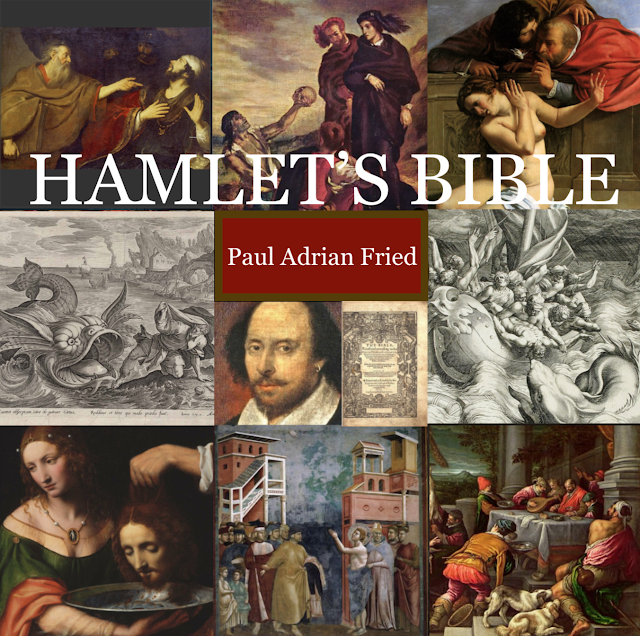
HAMLET: PRIEST, PROPHET, & KING (part 1) Shakespeare links Hamlet to an ancient tradition that viewed Jesus as priest, prophet, and king, which all Christians share by baptism. This came to be known as the “threefold office.” PROPHET: Like the prophet Nathan who tries to catch King David's conscience in a story, Hamlet attempts this with Claudius in a play. He later has a Jonah-like sea voyage, and his condemnation of Denmark's sins has been compared to language used by other prophets. Like John the Baptist, he opposes a king's incestuous marriage. KING: “It is I, Hamlet the Dane,” he says in the graveyard, revealing himself to the funeral party. Many believe Hamlet here claims his heritage as rightful king. He comes to terms with death and, after the sea-voyage, thinks Providence is on his side. PRIEST: “Let be.” / “The readiness is all.” In conversation with Horatio who is worried that the sword-duel may be a trap, Hamlet shows that he is ready to offer up his...

DID JOHN SHAKESPEARE'S FAMILY SUFFER UNDER A GOVERNMENT PROGRAM TO HARASS CATHOLICS?

(Or general harassment of people fined by the crown?) ~ Prof. Glyn Parry of U. Roehampton searched the National Archives for more evidence of John Shakespeare's legal troubles. His discoveries expand our potential for understanding how the family life and legal/political troubles of his father may have shaped the thinking of William Shakespeare: "The documents Parry found include multiple writs against John Shakespeare, and record his debts to the Crown, including one for £132 – around £20,000 today. They reveal how his property remained at risk of seizure by the Crown, hampering his credit as an entrepreneur, and that this continued until 1583. "They also connect Shakespeare’s family with what Parry calls “a national scandal: the use of informers to enforce economic and social legislation”. Professional informers were part of a corrupt system which ultimately enriched the Queen and her courtiers…. "Parry believes that the situation would have influenced the...

HAMLET’S WINDOWS TO OTHER TEXTS

Image
Biblical allusions are not the only kinds in Shakespeare—there are many— and Hamlet invites us to consider many texts in light of others, as Julia Kristeva and Bakhtin would say regarding intertextuality; Robert Alter (“The Art of Biblical Narrative”) notes that allusion opens windows to other texts, inviting us to revisit/rethink each in new dialectics. Hamlet includes allusions to Horace and to Virgil’s Aeneid, a founding myth for Rome, founded by outsiders (Trojans), like England, settled/raided/conquered by many outsiders (including Danes). Like Aeneas, Hamlet has a kind of sacred duty. Rome later fell, suggesting in the play that, just as Rome fell, Shakespeare’s England, too, could fall. By the end, Hamlet’s idolatry of his father, voiced in Greek/Roman mythological allusions, effectively stops after his Jonah-like sea-voyage. Suicide, the “Roman” way out, is also rejected. Why? So that Horatio might tell Hamlet’s tale (spread his gospel?). In Hamlet, the potent...

Versions of Hamlet: Quartos, Folios, Edited

WHICH HAMLET? Many choices, Shakespeare fans: 1. The First (“bad”/unauthorized) Quarto (1602-3) reflects perhaps an early draft, or a shorter script for countryside touring while playhouses were closed? 2. Later came the Second (expanded, approved) Quarto (1604). 3. Still later came the First Folio (1623). 4. Eventually, some scholars created editions of Hamlet that combined most of the unique passages from both the Second Quarto and the First Folio, making a MUCH longer text overall— as if each word from Shakespeare were from an angel. (The Kenneth Branagh version uses this long, combined text.) But Shakespeare was no angel. Some prefer the First Folio because it might represent Shakespeare’s “last word” on the final (best?) text. This is also limiting: Perhaps he tailored each reversion to his changing times, and the last draft was not the best/last word, but more relevant to its times—and careful of its censors? 5. So this justifies what #dramaturgs and #directo...
Music and Musicality in Shakespeare - a video by Andrew Bretz (1975-2018). Here’s a link to one of Andrew Bretz’s fine videos, This one, about music in, and the musicality of, Shakespeare. It had only 69 views as of this morning, but is deserving of many more. Andrew and I followed one another on Twitter; he was Acting Project Coordinator for the Canadian Shakespeare Association, taught in the English Department at Queen’s University in Kingston, Ontario, and produced a number of interesting, helpful and polished videos about Shakespeare and other subjects related to literature and writing. Andrew died on Tuesday, August 21. He was only 42 years old. His family has set up a fund for a scholarship in his name, to which I'll provide a link in the first comment below this post. The English Department at Queens U also noted his passing and has resources for students and faculty who are mourning his death. I'll put a link there in another comment below this post. Schola...
SCIENCE INFLUENCED & RESTRICTED ANALYSIS OF BIBLICAL ALLUSIONS IN SHAKESPEARE'S PLAYS — AND INFLUENCED THE PLAYS AS WELL The long shadow of science had a restrictive influence on Shakespeare critics who tried to catalog biblical allusions in his plays: Perhaps caught up in enthusiasm for the scientific method, some literary scholars rejected what they viewed as too-subjective biblical allusions and influences (paraphrase and plot echo), and favored instead what seemed to them more like objective data: allusions that contained exact or nearly-exact bible quotes that could be matched with bible translations available at the time: See books by Charles Wordsworth (1864), Thomas Carter (1905), Richmond Noble (1935), and Naseeb Shaheem (1987-1999). Yet in “Truth and Method,” his famous book on interpretation/hermeneutics, Hans Georg Gadamer stressed that the arts and scholars of the arts should not feel obligated to conform to so-called scientific methods. I agree. Also, Natal...
WHEN EVERYTHING STARTS TO LOOK LIKE HAMLET I read the#prologue of the best-selling novel, “The Flicker of Old Dreams” by Susan Henderson , and liked it right away: It was a lot like Hamlet! And being obsessed with Hamlet as I am, what’s not to like? —A key character (athletic “royalty”?) dies before the main action begins. —Some think the younger brother (as in Hamlet) was responsible. —One dad seems to have toxic masculinity issues (like Claudius & the dead king); another father-figure is kinder (like Yorick). —Things are rotten, out of joint, needing to be set right (and wheat at the grain elevator literally rots). —Gossip plays a strong role, like poison in the ear. —Characters like gravediggers (mortician, embalmer) play key roles; one of these is the kinder dad (like the gravedigger who channels the spirit of Yorick). Coincidence? We shall see! Will a key character kill a love interest’s dad, then sail toward England (at least metaphorically) but jump on a pirate s...
UK SHAKESPEARE MAG ISSUE 14—WHO IS HAMLET? "Who the Hell is Hamlet?" has many good articles, many of them about recent productions, but others as well: https://issuu.com/shakespearemagazine/docs/shakespeare_magazine_14/5 —Rhodri Lewis has a wonderful article (p.6) on Hamlet's age, with a fresh approach (many claim he's 30, based on the gravedigger's word, but Lewis has good reason not to trust that); —Article on Tom Hiddleston (p.14) as Hamlet, directed by Kenneth Branagh, in a production that included women cast in some of the traditionally male roles (Horatio, Rosencrantz, Guildenstern). —Another article on Andrew Scott (who played Moriarity in the BBC Sherlock Holmes series) as Hamlet, with surveillance technology playing a key role (a relevant twist that was also explored by Shakespeare Theatre Company earlier this year). —On Daisy Ridley's Ophelia film —Article, "Why Do Women Love Hamlet?" by Samira Ahmed —Sample art from The Victori...
BALDWIN: "WHY I STOPPED HATING SHAKESPEARE" Today (August 2) is James Baldwin's birthday. He once wrote an essay called "Why I Stopped Hating Shakespeare": "found in The Cross of Redemption: Uncollected Writings (public library)," in which he describes how certain lines in Julius Caesar became his point of access for a more sympathetic reading of Shakespeare. Here is Maria Popova at Brain Pickings , doing what she does best, and sending such gems our way: https://www.brainpickings.org/2016/11/11/james-baldwin-shakespeare-language-poetry/ ~~~~~~~~~~~~~~~~~~~~~~~~~~~~~~~~~~~~~~~~~~~ [Originally posted around the week of 8/2/18 on LinkedIn ] ~~~~~~~~~~~~~~~~~~~~~~~~~~~~~~~~~~~~~~~~~~~ Links to a description of my book project: On LinkedIn : https://lnkd.in/eJGBtqV On this blog : https://pauladrianfried.blogspot.com/2017/05/hamlets-bible-my-book-project-im.html ~~~~~~~~~~~~~~~~~~~~~~~~~~~~~~~~~~~~~~~~~~~ #Shakespeare #Literature #LiteraryCr...

TO INTEND, OR NOT TO INTEND?

(Biblical Allusion & Author Intention in Shakespeare as Writer) In Hamlet and other plays, are biblical plot echoes there due to the author’s conscious intention? Or did he absorb so many biblical ideas/phrases/plot structures that it was often (a-hem) unconscious/unintentional/accidental? —Hamlet has more explicit (chapter-&-verse) biblical allusions than any other of Shakespeare’s plays (in part because it’s so long). —Many would claim: if an allusion is explicit, the playwright probably intended it. —But if it’s a plot echo of Jonah, or King David, or Emmaus, with no explicit quote/allusion to those parts of the bible, is it unconscious/not intended? —If conscious, did he make these plot echoes more subtle/inexplicit for aesthetic reasons (not to sound too preachy)? Or sometimes to make a risky political statement, but avoid the censors? —If unconscious, what does that mean? —If I internalize driving on one side of the road because that’s how it’s done in my cu...
Image
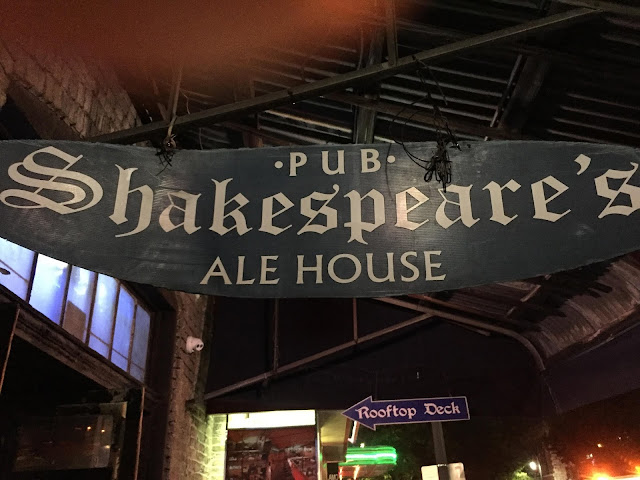
SHAKESPEARE’S PUB SIGN, AUSTIN TX "And thereof comes the proverb: 'Blessing of your heart, you brew good ale.'" - Two Gentlemen of Verona 3.1 One of my favorite elementary school teachers (beloved spouse) is attending the International Literacy Association (#ILA) #conference in Austin, TX, and invited me along. Heard some good #jazz and #blues on 6th Street last night (and saw many fun signs with creative pub names. ~~~~~~~~~~~~~~~~~~~~~~~~~~~~~~~~~~~~~~~~~~~ [Originally posted around the week of 7/20/18 on LinkedIn ] ~~~~~~~~~~~~~~~~~~~~~~~~~~~~~~~~~~~~~~~~~~~ Links to a description of my book project: On LinkedIn : https://lnkd.in/eJGBtqV On this blog : https://pauladrianfried.blogspot.com/2017/05/hamlets-bible-my-book-project-im.html ~~~~~~~~~~~~~~~~~~~~~~~~~~~~~~~~~~~~~~~~~~~ #Shakespeare #Bars #Austin #Signage #TEXAS #PUB #ALE
What came first: warlike Denmark, or Sabbath-violating? In Hamlet, 1.1, Marcellus talks about “post-haste” preparations for war, urgent (enforced) labor that "Does not divide the Sunday from the week." Some questions: 1. If a nation truly honors the Sabbath in all its depth of meaning, why would they choose war over humility and reconciliation, as the gospels teach love of even enemies? 2. Yes, the pragmatic might put all else aside to make needed preparations for war; but isn’t war itself a sign of failure on a grand scale of human values and of transcendent spiritual values, which urge people to love one another as they love themselves? 3. Didn't Claudius violate the spirit of the Sabbath by killing his brother? And King Hamlet, by giving in to “emulate pride” and killing Old Fortinbras, whose son would later seek vengeance and the land back, leaving Denmark with the looming threat of war? Doesn’t this show how the rotten fruits of sin are passed down through g...

HAMLET & CONTRASTING CRITICAL TRADITIONS

Some interpreters of Hamlet assume that ~Hamlet’s praise of his father should be trusted (that King Hamlet was mostly good); and that ~the prince was obliged to avenge his father's murder. Yet Horatio describes the king as “pricked on by a most emulate pride”; the ghost describes himself as in a state of sin when he died, not having confessed or received the sacraments. This leads some to question the king’s legacy. Hamlet's hyperbolic praise compares his father to pagan gods: Idolatry, or mere Renaissance tradition? Does this merit scrutiny? The dead king doesn't seem to have been a loving father involved in the life of his son; he seems harsh and demanding, while Yorick seems the loving surrogate father. The prince’s analogies of pagan gods might imply that he idolizes his father too much before the sea-voyage, after which Hamlet is silent about his father. This would support the Jonah plot echo: From the belly of the fish, Jonah mentions vanity (or in some tr...
PAPER ACCEPTED FOR 2018 SEPTEMBER SW CCL I recently had another paper accepted, this one for the the 2018 Southwest Conference on Christianity and Literature at Oklahoma Baptist University in late September. The theme of the conference is "Gathering in the Strange: Literary Vision in a Disenchanted World." Related to the theme of "the Strange," my paper will examine four works that echo aspects of the biblical Emmaus story about meeting Christ in the stranger. I have briefly written about two of these in past LinkedIn posts: In The Merchant of Venice https://lnkd.in/dynRAwu and in Hamlet https://lnkd.in/egrcrUa I'll also examine Emmaus plot elements in Flannery O'Connor's short story, "A Good Man is Hard to Find," and in (gasp!) the Disney film, Moana; this is especially striking once spotted in Moana. Welcoming the stranger exposes one to danger and enemies. But if we neglect the stranger out of fear, then we miss the chance to...
USING SCRIPTURE AS A WEAPON in Hamlet 1.2 In his book, Hamlet in Purgatory, Stephen Greenblatt shows how the English government and church took the protestant view that the fate of the dead can’t be changed by prayers of the living; they encouraged briefer mourning, in harmony with Ecclesiasticus/Sirach 38:17-21. Mourn the dead, but don’t forget to live. Yet Hamlet’s mourning is an embarrassment to Gertrude, who deprived her son of the throne by marrying Claudius. She fears he might be putting on a show of grief as a quiet tantrum for not being made king. Hamlet denies that it is merely show. Claudius turns helpful biblical advice into aggressive insults against Hamlet’s manhood and faith. He fears that Hamlet’s mourning may contain a hint of rebellion against his having usurped the throne meant for the prince, since Claudius used an improper or “incestuous” marriage to achieve his ends. Both Gertrude and Claudius turn the good advice of scripture into a weapon against Hamlet t...

IN HAMLET, MUST AN ALLUSION TO THE INCARNATION IMPLY A DIVINE INFANCY NARRATIVE?

FOR SHAKESPEARE, MUST AN ALLUSION TO THE INCARNATION IMPLY A DIVINE INFANCY NARRATIVE? Two weeks ago, I posted regarding how Hamlet 1.1 refers to many Christian mysteries: Incarnation, teachings, passion, resurrection, and end times. The allusion to the incarnation takes the form of an allusion to “that season... / Wherein our Saviour's birth is celebrated.” But the gospels show that the Christian idea of God can be incarnate in more ways than a Bethlehem-born infant: —The Emmaus tale shows how one can find the risen Jesus in the stranger who does for us things like those things that Jesus did. —Ophelia’s mention of the story about how “the owl was a baker’s daughter” is an example of how we sometimes reject the presence of Jesus in the stranger or beggar, with negative consequences. So we should not assume that mention of “our savior’s birth” is a foreshadowing of another infancy narrative in the play. That never comes. Hamlet finds God’s hand at work in the pirates; p...
PANEL & PAPER ACCEPTED FOR SIXTEENTH CENTURY SOCIETY CONFERENCE My panel and paper proposals were accepted for the Sixteenth Century Society Conference in Albuquerque, New Mexico, 1-4 Nov., 2018. The panel will be on how Shakespeare’s plays have not only obvious biblical allusions, but also plot echoes and other influences from the bible and the Book of Common Prayer. My paper will be on how certain biblical allusions and plot echoes shed light on Hamlet’s character arc. Also on the panel will be Gayle Gaskill, professor emeritus of the University of St. Catherine in St. Paul, Minnesota, and (William) Dean Clement of Cameron University in Lawton, Oklahoma. Gayle edited the New Kittridge ed. of Twelfth Night, and is an assistant ed. of the latest variorum edition; her book contributions include the 2002 collection, “The Merchant of Venice: New Critical Essays”; and “Who Hears in Shakespeare?: Auditory Worlds on Stage and Screen.” She has also written reviews of Shakespeare...
WAS SHAKESPEARE MISOGYNIST WITH TOO FEW FEMALE CHARACTERS COMPARED TO HIS CONTEMPORARIES? The following article is a break from my habit of Hamlet (or Shakespeare) and the bible: It's about challenging some assumptions about Shakespeare's genius and his place in the literary canon. Was he misogynist? Did he put too few strong female characters in his plays? How does he compare on this point to other playwrights of the time? Was Shakespeare placed on a pedestal in part because his portrayals of grumpy men appealed to 18th Century assumptions? One does not have to agree with all the article says to find insight and thought-provoking questions here. https://beforeshakespeare.com/2018/06/04/galatea-britgrad-and-diverse-alarums/ ~~~~~~~~~~~~~~~~~~~~~~~~~~~~~~~~~~~~~~~~~~~ [Originally posted around the week of 6/4/18 on LinkedIn ] ~~~~~~~~~~~~~~~~~~~~~~~~~~~~~~~~~~~~~~~~~~~ Links to a description of my book project: On LinkedIn : https://lnkd.in/eJGBtqV On this blo...

Christianity's central mysteries & teachings in Hamlet 1.1

Christianity's central mysteries & teachings in Hamlet 1.1: INCARNATION : Marcellus speaks of “ that season... / Wherein our Saviour's birth is celebrated.” The conception & birth of Christ claims God is not distant, but one like & among us (Emmanuel as "God-with-us," Mt1:22-23). TEACHINGS : Horatio says, “A mote it is to trouble the mind's eye,” which alludes to Mt 7:1-5 & Lk 6:41: take the plank from our own eye before taking the mote of dust from a neighbor’s eye; judge not that you be not judged. [P.S. The idea that we should judge ourselves before judging others is an extension of the second of two of the laws that Jesus identified as most important (love god, and love neighbor as self, or do unto others as you'd have them do unto you). The scripture passage that contains this "mote in the eye" reference also contains the "measure for measure" reference, a favorite of Shakespeare's, which became the title of ...

EMMAUS in HAMLET (Introduction/Index: Multi-Part Series)

Image
In the Luke 24:13-35 Emmaus story: (1) Mentor and fearless leader Jesus is crucified. (2) Two troubled disciples (D) head to Emmaus (E); (3) A stranger joins them, cheers them, explains scripture; in other words, the stranger does for them a number of the things Jesus had done. (4) they recognize the stranger as Jesus in breaking of bread (bread being one of two main elements at table at the Last Supper, the other being wine). This is not unlike stories from older Greek tales - for example, from Ovid, where Zeus and Hermes, in disguise, are welcomed as guests in the humble home of Baucis and Philemon. The basic idea is that without recognizing them at first, mortals extend hospitality and offer to share a meal with disguised gods or supernatural beings. In Hamlet, (1) Mentor and fearless leader King Hamlet is murdered. (2) Hamlet and Horatio, two troubled Danes (D) head to Elsinore (E). (3) A stranger/gravedigger cheers them with wit (in other words, does for Hamlet the kinds ...

RETROSPECTIVE 1

THANK YOU to all who've read my posts on SHAKESPEARE, HAMLET, & THE BIBLE this past year! Below: Key posts, articles, & links in case you missed any, or if you’re newly arrived to the party. ~~~~~~~~~~~~~~~~~~~~~~~~~~~~~ HAMLET'S BIBLE: My Book Project  https://pauladrianfried.blogspot.com/2017/05/hamlets-bible-my-book-project-im.html THE GHOST OF JONAH HAUNTS HAMLET https://pauladrianfried.blogspot.com/2018/04/the-ghost-of-jonah-haunts-hamlet.html EMMAUS in Hamlet https://pauladrianfried.blogspot.com/2018/05/emmaus-in-hamlet-in-emmaus-story-1.html EMMAUS in MERCHANT OF VENICE https://pauladrianfried.blogspot.com/2019/01/emmaus-in-merchant-of-venice-in.html THE GHOST OF LAZARUS HAUNTS HAMLET https://pauladrianfried.blogspot.com/2018/01/the-ghost-of-lazarus-haunts-hamlet.html HAMLET, "FELL SERGEANT DEATH" & MT 5:23-26 https://pauladrianfried.blogspot.com/2018/02/hamlet-fell-sergeant-death-matt-523-26.html VALENTINE & CLAUDIUS in H...

EMMAUS IN MERCHANT OF VENICE

Image
EMMAUS IN MERCHANT OF VENICE In THE MERCHANT OF VENICE, one can find a surprising variation on EMMAUS: The biblical tale of the disciples on the road to Emmaus is structured like this: 1. A mentor (Jesus) suffers (crucifixion & death). 2. Disciples on the road are troubled by all of this. 3. They meet a stranger they do not recognize who comforts them and explains things (scripture). 4. A physical sign (breaking bread) reveals the stranger’s identity (Jesus). In Merchant of Venice, a twist: 1. Mentor Antonio suffers apparent financial losses & threat of death (many scholars view him as a Christ-figure). 2. Bassiano & Gratiano are troubled and go to Venice (to save Antonio with Portia’s money). 3. They meet a stranger (Portia disguised) who explains mercy, salvation, & law to the court, and saves Antonio. 4. Bassanio & Gratiano reluctantly give their wedding rings as signs of gratitude, breaking their ring-vows instead of bread. Physical signs (ri...
EMMAUS PLOT ECHOES IN SHAKESPEARE When Jesus appears to two disciples on the road to Emmaus, was this a resuscitated corpse using super-powers, or just cleverness, to go unrecognized? Or was it not a resuscitated corpse at all? If we assume Jesus supernaturally altered his appearance, might we look for a plot echo in Bottom, altered by fairies in Midsummer Night's Dream? If we assume Jesus clouded the minds of the disciples, might we try magical characters, such as Prospero in The Tempest? Or better: If we think Jesus wore a white hood for shade and a cloth wrap to keep desert dust from nose and mouth, we might look for disguise: In Merchant of Venice, like two disciples, Bassanio & Gratiano fail to recognize Portia as the lawyer who “became man” to save their friend. What if a mere stranger did for two disciples the kinds of things Jesus had done? Listening with empathy, explaining scriptures, breaking bread? What if they found in him similar stuff as they had found in...

THE GHOST OF JONAH HAUNTS SHAKESPEARE’S HAMLET

Image
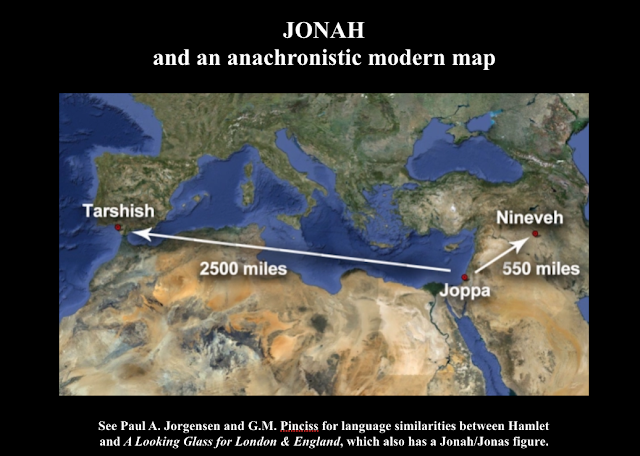
Hamlet, upon hearing from the ghost that Claudius killed his father, says, “O, my prophetic soul!” —and so the playwright invites us to associate the prince with biblical prophets. Sure enough, the play names the player queen "Baptista," which calls to mind John the Baptist, a prophet who was executed for criticizing the incestuous marriage of the king. Later Hamlet is on a westbound ship, like Jonah, a biblical prophet who was called to be a prophet, but who learned the old adage, "you can run, but you cannot hide." In the Saxo Grammaticus source tale, Amleth (Hamlet) goes to England, marries a princess, returns. But Shakespeare cuts it short mid-sea: Hamlet gets swallowed (figuratively) by a pirate ship that brings him back east to Denmark. Hamlet’s ocean-motion echoes that of prophetic soul Jonah: Called to prophecy in Nineveh, he took a westbound boat to Tarshish to flee his fate. In a storm, Jonah was swallowed by a fish that returned him eastward where...
Image
Call For Papers: For the Sixteenth Century Society & Conference in Albuquerque, NM (1-4 Nov. 2018), I’ve proposed a panel on how biblical allusions (in many forms) influence our readings of particular Shakespeare plays. Too often, biblical allusions are treated like wallpaper in the plays. Robert Alter writes of how allusions are like windows to another text, opening up larger conversations. Short proposals for papers are welcome. Details below. Best to focus on the many forms of biblical allusions in a single play. (You need not have read any of the books mentioned in the panel description; you need only have an interest in spotting and considering biblical allusions in a Shakespeare play, and interpreting the play in light of them.) https://lnkd.in/ehGh2NQ Deadline extended to April 23 to submit proposals to SCSC; please use Panel Code: P02M1518 #Shakespeare #EnglishLiterature #EnglishLit #EarlyModern #16C #Renaissance #literature #theatre #theology #biblicalstudies ...