Posts

SUICIDAL CLAUDIUS?

In the David Tennant Hamlet, in the final scene, Hamlet tries to stab Claudius with the "envenomed" sword, but Claudius (played by Patrick Stewart), ever trying to maintain control, grasps the blade that Hamlet is wielding (perhaps still poisoned). Hamlet pulls and Claudius cuts his hand. People at court cry "Treason," and some (not all) rush to restrain Hamlet from hurting the king. But this restraint keeps Hamlet from forcing the rest of the poison wine down Claudius' throat, which is a sort of long-standing tradition, and which some claim goes back to the original performances (but which some dispute). So how does Claudius get the cup? Hamlet offers it, Claudius takes it. Claudius realizes his game is up, he's been exposed as a murderer and coward (not stopping Gertrude from drinking), and he has no more reason to live. He drinks of his own volition, choosing the "Roman" way of suicide that Hamlet soon asks Horatio to reject. In the 1988...
A KING WITH TOO MANY HATS? In Shakespeare's Hamlet, for four centuries, readers and viewers have noted the confusion of roles Claudius tries to assume. After insulting the prince in a variety of ways for mourning too long (1.2), he calls Hamlet "most immediate to our throne," "Our chiefest courtier, cousin, and our son." Claudius tries not only to be king and uncle, but critic and father as well. Later, to highlight this and the "one flesh" marriage union, Hamlet twice calls Claudius his "mother" (4.3). What about "pope"? The play was written 65-70 years after England's break from Rome. Henry VIII asserted himself as head of England's church and granted his own divorce, usurping the role of religious leader for England's Christians that the pope had played. This created what Rome viewed as a schism, a new division in Christendom where there had previously been more unity of authority, belief, and ritual. In the...
Image
DO HAMLET'S MASKS INCLUDE MELANCHOLIC MISOGYNY? In an article from the 1995 edition of Hamlet Studies, Francesca Bugliani (Knox) interprets Hamlet's famous "To be or not to be" soliloquy. She does not consider biblical allusions, like Job's dilemma of whether to remain faithful to his God, or to curse God and die (a sort of "to be or not to be" crossroads). But she has a wealth of insightful observations. I've said before that I don't buy the Freudian explanation for Hamlet's apparent misogyny to Gertrude and Ophelia, but the Christian biblical and cultural tradition in which the play was written was certainly patriarchal and misogynist. Bugliani suggests it's melancholic misogyny, and may be one of many forms of feigned madness. But why feign melancholy misogyny with Ophelia? To sound her out, suspecting she's working with the enemy? To push her away from the threat to his life? (Or both?) In contemplating revenge and the sinfu...
Meet me in St. Louie? (for Hamlet) St. Louis Dispatch ARTS AND THEATER At last, the Rep goes big with Shakespeare's 'Hamlet' By Judith Newmark St. Louis Post-Dispatch Oct 8, 2017 ~~~~~~~~~~~~~~~~~~~~~~~~~~~~~~~~~~~~~~~~~~~ Links to a description of my book project: On LinkedIn : https://lnkd.in/eJGBtqV On this blog : https://pauladrianfried.blogspot.com/2017/05/hamlets-bible-my-book-project-im.html [Originally posted around the week of 10/10/17 on LinkedIn ]

SHOULD HAMLET'S MOM SUSPECT POISON, OR NOT?

In Shakespeare's Hamlet, do we want Gertrude to suspect poison in the "chalice" of wine into which Claudius drops a fine pearl? Or not? Various critics (like J. Dover Wilson in his book, "What Happens in Hamlet") have claimed that an older tradition believes Queen Gertrude likes immediate gratification of her desires. To them, this explains in part why she marries her dead husband's brother so quickly (get me sex!), and why she drinks the cup of wine that Hamlet refuses (she claims she's thirsty), in spite of the urgings from Claudius for her not to do so. In the Kenneth Branagh Hamlet and the Franco Zeffirelli Hamlet (starring Mel Gibson), Gertrude in both of these films seems unsuspecting of poison, and is later shocked at the realization of Claudius' foul play as the poison takes effect. But in both the David Tennant version and the Ethan Hawke version, the queen clearly suspects poison, and clearly volunteers herself (and risks her life). ...
“This is a very weird time in the world...." (Kazuro Ishiguro winds the Nobel prize in literature 2017— article from The Guardian ) “This is a very weird time in the world, we’ve sort of lost faith in our political system, we’ve lost faith in our leaders, we’re not quite sure of our values, and I just hope that my winning the Nobel prize contributes something that engenders good will and peace,” he said. “ It reminds us of how international the world is, and we all have to contribute things from our different corners of the world.” - Kazuro Ishiguro https://www.theguardian.com/books/2017/oct/05/kazuo-ishiguro-wins-the-nobel-prize-in-literature ~~~~~~~~~~~~~~~~~~~~~~~~~~~~~~~~~~~~~~~~~~~ Links to a description of my book project: On LinkedIn : https://lnkd.in/eJGBtqV On this blog : https://pauladrianfried.blogspot.com/2017/05/hamlets-bible-my-book-project-im.html [Originally posted around the week of 10/5/17 on LinkedIn ]

Hamlet & King David, Part II /or/ Henry VIII’s to blame

A few weeks back, I listed ways that Shakespeare’s Hamlet parallels the biblical King David more than the Oedipus tale, and especially to the story of David's infidelity with Bathsheba and his arranging for the death of Bathsheba’s husband so he can marry her. (To view that very brief article, click here.) Some may wonder: Why would there be so many allusions to the biblical King David in Hamlet? There are three important things to remember while contemplating these parallels with the King David story in Hamlet: First, bear in mind that people in Shakespeare's time could not openly criticize the government. Playwrights had to say things indirectly, or risk being caught by the censors and punished by the state. Second, recall that Shakespeare wrote the play at the end of Elizabeth's life, and was probably using certain events in the play's fictional setting in Denmark as analogies for various things about the end of the House of Tudor, most notably, Henry VIII an...

Henry Viii’s psalter and David: Inside the mind of a tyrant

I have posted a new article about Hamlet and King David Below is the link to my new article about Hamlet, the biblical King David, and Henry VIII: On LinkedIn : https://www.linkedin.com/pulse/hamlet-king-david-part-ii-paul-adrian-fried/?trackingId=gNgP1NASMbRZuXApS%2BEbng%3D%3D On this blog: https://pauladrianfried.blogspot.com/2017/10/Hamlet-David-pt2-HenryVIII-2blame.html [Shakespeare uses Hamlet and King Claudius to demonstrate some connections with the David stories, and these would have been seen by audiences as implying connections with Henry VIII as well, connections that most everyone living in that age would have recognized.] But to prepare for that, here's a helpful blog that mentions how Henry VIII commissioned a book of the Psalms, with illustrations that included Henry VIII himself in the role of the biblical King David . To understand why there are so many allusions to King David in Hamlet, it's essential to understand how fascinated Henry was with t...
HOW MACHIAVELLIAN DO YOU LIKE YOUR POLONIUS? In Shakespeare's Hamlet, how much Machiavelli should we imagine in the king's key adviser, Polonius? Is Polonius an aging and self-absorbed old man— a bootlicker too concerned about his daughter’s virginity? (Then why is he the key adviser?) Or is he a manipulator who purposefully withholds his daughter's affections so they will be more desired by Hamlet, so that the match will get royal approval, and so that she might marry into royalty? (Does he lead Gertrude to want her son’s heart mended by the return of Ophelia’s once-denied love, so his daughter will then be the next queen —implied perhaps in the David Tennant version?) In 2.2, Polonius is certain that the denial of his daughter's affections has caused Hamlet's madness, in spite of Claudius' inclinations otherwise. In 3.1, Gertrude, manipulated by Polonius, says, "for your part, Ophelia, I do wish That your good beauties be the happy cause ...
HAMLET, WITTENBERG, & . . . FAUST? A trend among scholars of Shakespeare & Religion is to view Hamlet as a Protestant v. Catholic play: The ghost regrets not receiving Catholic sacraments before death, and the prince goes to school in Wittenberg (of Luther fame). But Marlowe's Wittenbergian, Faust, is not so often cited by scholars seeking hints of Catholic or Protestant ideas in the play. If we expand the Catholic-Protestant binary at least to three (Wittenberg-Luther-Faust), then Wittenberg points not only to Luther, but to temptation. Hamlet is tempted to revenge and madness, but perhaps (according to some) recovers a bit after his sea voyage. Luther questioned how literally Catholics should take Jesus' words over the break and wine, "This is my body/blood." A good question. But this opens a can of worms (no Diet of Worms pun intended, but—OK). If we don't take eucharist literally as a "real presence," then why should we ta...

HOW WOULD YOU LIKE YOUR OPHELIA & FORTINBRAS?

Of the many aspects of Branagh's Hamlet that critics noted, one involved images of Hamlet and Ophelia, naked in bed (plucking the heart from the mystery of the question of whether they had been lovers, or whether—as Ophelia tells her father—Hamlet had merely expressed his love in "honorable fashion").  Another involves the entry of an attacking Fortinbras at the end of the play, with an army. An older tradition assumes Ophelia is a virtuous, virginal and obedient daughter who alludes to scripture in conversation with her brother, but as women were considered the "weaker vessel" (a-hem), she goes insane and perhaps (contrary to Gertrude's account?) commits suicide. Others have noted the presence of abortifacient herbs among the flowers she names in her mad scene, and claim that she is pregnant with Hamlet's child, but that this could not be stated explicitly due to the censors. Another old tradition likes to believe that the diplomatic overtures  ...
HOW WOULD YOU LIKE YOUR HAMLET? Madman? Privileged drop-out? The Man-who-would-have-been-king? Examination of just three film actors in the role of Shakespeare's Hamlet since the 1990s (Branagh, Hawke, Tennant) reveals distinctly different approaches to casting and portraying the prince.  Kenneth Branagh: It is easy to imagine Branagh as a prince who could have made a good king, and that Claudius "Popp'd in between the election and [his] hopes." It's also easy to see how he may have been "loved of the distracted multitude" (4.3). Ethan Hawke: Hawke plays an angst-filled hipster, a privileged drop-out caught in a cul-de-sac of life ("Denmark's a prison"). It seems he has little interest in being king and may prefer Occupy Wall Street (kudos for that). It's easy to see why the board of directors prefers Claudius. Perhaps loved mostly by hipster students among the distracted multitude? David Tennant: Tennant's Hamlet is ...
Image
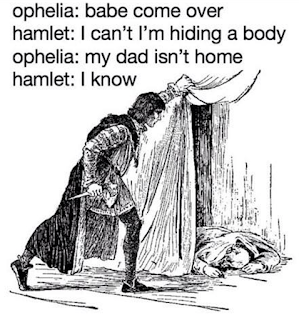
Ophelia was hoping for some quality time with Hamlet after the chaos of the show, listening to "I Think We're Alone Now," an Elizabethan madrigal cover of the song by Tommy James and the Shondells. But it was "not to be." (This image has been on Twitter since at least July, and Reddit since at least April) ~~~~~~~~~~~~~~~~~~~~~~~~~~~~~~~~~~~~~~~~~~~ Links to a description of my book project: On LinkedIn: https://lnkd.in/eJGBtqV On this blog: https://pauladrianfried.blogspot.com/2017/05/hamlets-bible-my-book-project-im.html [Originally posted around the week of 9/15/17 on LinkedIn ]
Nothing male or female but thinking makes it so? To paraphrase Shakespeare's Hamlet: Is there nothing male or female but thinking makes it so? (Or when Hamlet spoke the original line to Rosencrantz and Guildenstern, "nothing good or bad," was he feigning, playing a role, pulling their chain?) Although not the norm, there have been notable productions of Hamlet in the last two centuries in which the prince haas been played by an actress, Sarah Bernhardt's performance in a 1900 film adaptation being one of the more famous. Some productions rotate actors through key parts; this was the case in the recent Guthrie production of King Lear in Minneapolis, where two excellent actors took turns playing the role of Lear. A Great Lakes Theater production of Hamlet in Cleveland has one male actor and one female actor take turns with the role of the prince (not in the same show, but on different nights). . . . After "The Mousetrap" play-within-the-play, Hamlet...
Richard Utz: Race, Racism, and the Middle Ages When Shakespeare fans and scholars speak of antisemitism and racism, they often talk of The Merchant of Venice (with its shylock the Jew), Othello (with a black Muslim as its title character), and The Tempest (with its "savage" Caliban) for starters. Richard Utz and "friends at The Public Medievalist" have assembled a wonderful and thought-provoking list of readings more related to the Middle Ages than Shakespeare, but some of my connections may find it interesting and helpful. It is intended in part to counter the tendencies of certain people of the far right to hijack the Middle Ages (via arm-chair revisionism) for white supremacy. - PF https://www.linkedin.com/pulse/race-racism-middle-ages-richard-utz/ ~~~~~~~~~~~~~~~~~~~~~~~~~~~~~~~~~~~~~~~~~~~ Links to a description of my book project: On LinkedIn: https://lnkd.in/eJGBtqV On this blog: https://pauladrianfried.blogspot.com/2017/05/hamlets-bible-my-bo...

KING OEDIPUS, KING DAVID, THE PROPHET NATHAN, & HAMLET

Freud claimed that Hamlet had an Oedipus complex, but Shakespeare may have had the biblical King David more in mind. —Hamlet killed his uncle in the end, but not to marry Mom (she’s already dead). Oedipus unknowingly kills his father and marries his mother; David knowingly arranges for Uriah to die in battle (2 Sam 11:14-17) to marry Bathsheba. Both marry the wife of their respective victims. Both are confronted about the truth of their actions later by a prophet-figure (Oedipus, by the blind seer Tiresias; David, by the prophet Nathan). Note some of the David parallels in Hamlet: —Claudius is like David: both kill quite intentionally to marry the victim's wife, and Claudius may have had an affair with Gertrude before King Hamlet's death, like David did with Bathsheba. —Hamlet complains that his mother and uncle have not mourned long enough for the death of King Hamlet. Similarly, after learning that his son by Bathsheba is sick, David fasts and prays for seven days, ...

HAMLET HAS A DAVID COMPLEX

Freud claimed Hamlet had an Oedipus complex, but Shakespeare seems to have had the biblical King David more in mind. —Claudius is like King David: both kill to marry the victim's wife; Claudius may have had an affair with Gertrude before King Hamlet's death, like David with Bathsheba. —Hamlet complains that his mother and uncle have not mourned long for the death of King Hamlet; after learning that his son is sick, David fasts and prays for seven days, but on learning that the child has died, he ends his mourning with disturbing speed (2 Sam 12:18-23). —Hamlet pretends to be mad to deflect a threat; so does David (1 Sam 21:13). —Hamlet uses a play to "catch the conscience of the king" (3.2). Nathan used a story to catch the conscience of King David (2 Sam 12:1-9). —Hamlet spares Claudius (3.3) at prayer (but with dark motives); David spared King Saul when he had the chance to kill him (1 Sam 24). —Claudius sends a letter with Hamlet to have him exec...
King Lear & Colin Kaepernick: Colin Kaepernick was just an overpaid athlete in a sports system that abuses the health of players in exchange for big money. But his choice not to stand for the national anthem was like the start #of Shakespeare's #KingLear, when Lear asks his daughters which of them is willing to put on the most convincing outward show (of a family love version of patriotism) for him. Daughters Goneril and Regan try to outdo one another with flags and fawning and "support the troops" bumperstickers. They care more about the outward show than about sincerity, faithfulness, or love. Lear's most beloved daughter, Cordelia, will have none of that foolishness. She wants to take a knee or sit or hold a protest sign during the King Lear national anthem. She gets banished, of course. She marries French royalty, where Freedom Fries come from. And then she comes back later to try to save her father, who is being mistreated by the more o...
Old King Hamlet as Caesar figure, not Christ figure After the death of King Hamlet, the sentinels are nervous confronting one another at the end of Francesco’s shift and the start of Bernardo’s. They are also anxious about why Denmark is so busy preparing for war. Shakespeare’s play was written at a time when many Protestants thought biblical prophecies in the biblical books of Revelations and Daniel were coming true (see Apocalypse & Armada in Kyd's Spanish Tragedy by Frank R. Ardolino); many believed the end times were approaching, and that Rome was the Whore of Babylon. The Dover Straits earthquake of 1580, a 1598 appearance of Haley’s Comet, and a 1598 total eclipse visible across much of England and Scotland (“disasters in the sun”) only increased such speculation. Bernardo and Marcellus tell Horatio about the hour of the night when the ghost had appeared and begin describing the positions of the stars, when the ghost appears again. After the ghost leaves, as Horatio...

A Thing of Nothing: Shakespeare anatomy joke

In a Shakespeare anatomy joke, men have a “thing” between their legs; women have a “nothing.” So “Much Ado about Nothing” jokes about female anatomy and the wooing, wedding, & bedding of women. Much ado. Yet when Hamlet says, “The king is a thing [...] of nothing” (4.2), No Fear Shakespeare paraphrases it, “...of no importance.” That's (G-rated) meaning #1. Some critics say “...of nothing” is nihilist: Monarchy as existential nothingness! "Not to be"! Meaning #2 (similar, philosophical) . In Christian doctrine, the church claims God created the heavens & earth out of nothing, not out of preexisting stuff. So Claudius echoes creation: A "thing" out of nothing. Meaning #3 (theological/cosmological). It could also mean the king is a male (with a thing/phallus), born of a woman’s “nothing.” Meaning #4 (biological). Some of these may be examples of "overthink" (Hamlet: "thinking too precisely on the event"). But...

Horatio: "A piece of him" as Eucharistic controversy pamphlet joke?

Horatio: A piece of him / Eucharistic controversy pamphlet joke In Shakespeare's Hamlet, Horatio's line on the cold night is curious: BERNARDO: Say, / What, is Horatio there? HORATIO: A piece of him. Stephen Greenblatt's "Hamlet in Purgatory" gives examples of Tudor-era Protestant pamphlets about Eucharist and their humorous phrasing of skepticism about Roman Catholic ideas of transubstantiation, where bread and wine supposedly become the body and blood of Christ: "Protstant polemicists had returned throughout the sixteenth century to the moment of creating God's Body; it was for them a way of mocking what they took to be the crude materialism of the Catholic doctrine fo transubstantiation. Hence they dwelt with gleefulness on the persistence and what we might call the embarassments of matter. If God was actually bread, they tirelessly jested, it meant that God could be eaten by worms, flies, or mice, that the divine body could decay and rot, or t...

Hamlet, the Mystical Body, & the Body Politic

Hamlet, the Mystical Body, & the Body Politic /or/ Everybody's Got a Mystical Body, but Some are Bigger &/or Better Than Others Shakespeare’s Hamlet contains many references to the mystical body and well as to the body politic. Early in the play, Laertes warns his sister Ophelia not to set her hopes too high on a relationship with Prince Hamlet. He warns her, not only because she could get pregnant and bring scandal to their family, but also because Hamlet may have to marry some foreign princess, say, to secure a treaty, or taking popular opinion into account so that his choice of a bride doesn't inspire resentment in a body politic that would at times be expected to yield to him as well (factors Elizabeth also faced): Laertes: He may not, as unvalued persons do, / Carve for himself; for on his choice depends / The safety and health of this whole state; / And therefore must his choice be circumscribed / Unto the voice and yielding of that body / Whereof he is t...

Fortinbras & redating Hamlet to 1603

Fortinbras & redating Hamlet to 1603 In Jan. 2017, news sites noted that (some) scholars re-dated Shakespeare’s Hamlet to 1603, not 1601. Many mention Fortinbras, a prince from the north to whom Hamlet gives his dying voice to be the next king of Denmark, and how Fortinbras is like James, a king from the north who becomes the next king of England after Elizabeth’s death and the end of the House of Tudor. This is gratifying, not for any certainty about new dating of the play, but because for years I’d been telling literature students that Hamlet (who idolizes his father through much of the play) is like Elizabeth (who idolized her father and called herself a prince), and that giving Denmark to Fortinbras is like giving England to James. (More details in comments below.) A greater mystery: How most published editions for centuries failed to state this explicitly as the historical background to the writing of a play that touches on many Tudor-era royal scandals. They prefe...

New article: The challenge of finding religiously inclusive ways to write about biblical allusions in Hamlet (with link)

New article: The challenge of finding religiously inclusive ways to write about biblical allusions in Hamlet. E. M. W. Tillyard claims that the Elizabethan worldview was pretty strictly hierarchical, yet contrary to this, the biblical-Elizabethan view also recognized the prophet who speaks truth to power in unexpected (non-hierarchical) ways. What to do? Providing some historical context is a good first step. To wrestle with this and other related challenges, I borrow some ideas from Lewis Hyde (The Gift: Imagination and the Erotic Life of Property) regarding gift economies and "The Labor of Gratitude." I also examine what Karen Armstrong claims to be a common thread in many world religions, the Golden Rule, taken (in Christianity's case) from older Hebrew scriptures and from what Jesus says is one of the two most important laws in Judaism. Then I connect this to Ophelia's line: "They say the owl was a baker's daughter." I'll bet you were won...

Inclusivity, and the Owl as a Baker's Daugther

BEING INCLUSIVE ABOUT RELIGIOUS ALLUSIONS IN HAMLET /&/ WHAT'S AN OWL GOT TO DO WITH A BAKER'S DAUGHTER? My goal in writing Hamlet’s Bible is to be as inclusive as possible in explaining biblical and religious allusions in the play. I hope to do this, not only to appeal to the broadest possible audience, but also because it simply helps if the goal is to understand Shakespeare’s rich use of religious and biblical allusions. It is my firm conviction that one does not have to be a Christian, or to have ever attended church, to understand the biblical allusions in the play once they're pointed out and explained. It just means that, for those unfamiliar with Christianity and the bible, it may take a bit more explaining. It is a basic fact that readers of Shakespeare today are much more diverse than in Elizabethan times. Even in nations with so-called Christian majorities, college and high school instructors of English Literature have students with a great variety of ...