EMMAUS PLOT ECHOES IN SHAKESPEARE When Jesus appears to two disciples on the road to Emmaus, was this a resuscitated corpse using super-powers, or just cleverness, to go unrecognized? Or was it not a resuscitated corpse at all? If we assume Jesus supernaturally altered his appearance, might we look for a plot echo in Bottom, altered by fairies in Midsummer Night's Dream? If we assume Jesus clouded the minds of the disciples, might we try magical characters, such as Prospero in The Tempest? Or better: If we think Jesus wore a white hood for shade and a cloth wrap to keep desert dust from nose and mouth, we might look for disguise: In Merchant of Venice, like two disciples, Bassanio & Gratiano fail to recognize Portia as the lawyer who “became man” to save their friend. What if a mere stranger did for two disciples the kinds of things Jesus had done? Listening with empathy, explaining scriptures, breaking bread? What if they found in him similar stuff as they had found in...
Posts
THE GHOST OF JONAH HAUNTS SHAKESPEARE’S HAMLET

Hamlet, upon hearing from the ghost that Claudius killed his father, says, “O, my prophetic soul!” —and so the playwright invites us to associate the prince with biblical prophets. Sure enough, the play names the player queen "Baptista," which calls to mind John the Baptist, a prophet who was executed for criticizing the incestuous marriage of the king. Later Hamlet is on a westbound ship, like Jonah, a biblical prophet who was called to be a prophet, but who learned the old adage, "you can run, but you cannot hide." In the Saxo Grammaticus source tale, Amleth (Hamlet) goes to England, marries a princess, returns. But Shakespeare cuts it short mid-sea: Hamlet gets swallowed (figuratively) by a pirate ship that brings him back east to Denmark. Hamlet’s ocean-motion echoes that of prophetic soul Jonah: Called to prophecy in Nineveh, he took a westbound boat to Tarshish to flee his fate. In a storm, Jonah was swallowed by a fish that returned him eastward where...

Call For Papers: For the Sixteenth Century Society & Conference in Albuquerque, NM (1-4 Nov. 2018), I’ve proposed a panel on how biblical allusions (in many forms) influence our readings of particular Shakespeare plays. Too often, biblical allusions are treated like wallpaper in the plays. Robert Alter writes of how allusions are like windows to another text, opening up larger conversations. Short proposals for papers are welcome. Details below. Best to focus on the many forms of biblical allusions in a single play. (You need not have read any of the books mentioned in the panel description; you need only have an interest in spotting and considering biblical allusions in a Shakespeare play, and interpreting the play in light of them.) https://lnkd.in/ehGh2NQ Deadline extended to April 23 to submit proposals to SCSC; please use Panel Code: P02M1518 #Shakespeare #EnglishLiterature #EnglishLit #EarlyModern #16C #Renaissance #literature #theatre #theology #biblicalstudies ...
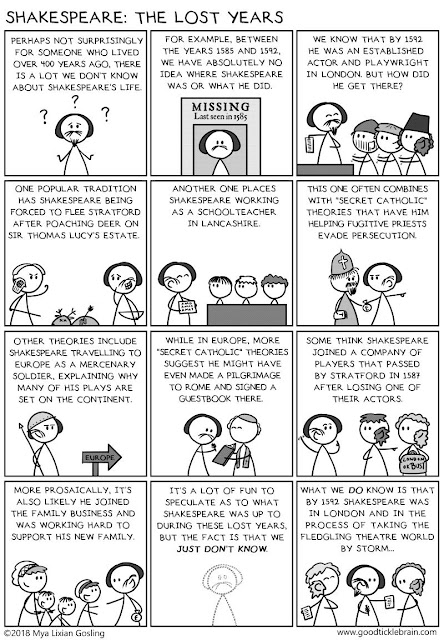
Good Tickle Brain comic has a good summary of Shakespeare's lost years : image below, link to GTB post on Twitter https://goodticklebrain.com/home/2018/4/10/shakespeare-the-lost-years #shakespeare ~~~~~~~~~~~~~~~~~~~~~~~~~~~~~~~~~~~~~~~~~~~ Links to a description of my book project: On LinkedIn : https://lnkd.in/eJGBtqV On this blog : https://pauladrianfried.blogspot.com/2017/05/hamlets-bible-my-book-project-im.html [Originally posted around the week of 4/12/17 on LinkedIn ]
JAMES SHAPIRO REVIEWS RHODRI LEWIS's "HAMLET & The VISION of DARKNESS" James Shapiro has a review of Rhodri Lewis's "Hamlet and the Vision of Darkness" in the New York Review of books . I follow Lewis on Twitter, have corresponded with him a bit, and am looking forward especially to his understanding of falconry terminology in Hamlet. Some other reviews have been less generous than Shapiro's, and I'm sure I may disagree with Lewis on a number of his conclusions; but a rich diversity of opinions, exploring and testing things that as yet may have gone untested, is essential if scholarly conversations are going to advance. This review is a helpful one to read in part because of how it offers a glimpse of the history of scholarly opinion on Hamlet, and how critical approaches to literature can also reflect the critic's relation to their own moment in history, necessarily including its political aspects. Highly recommended reading . https://...
Favorite experiences at SAA 2018 in Los Angeles
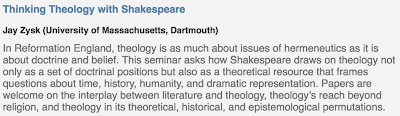
Favorite experiences at SAA 2018 Some of my favorite experiences at the Shakespeare Association of America (SAA) conference in Los Angeles included meeting other attendees, either at seminars, or by chance. On the ride from the airport on Wednesday, I met Jim Schiffer of SUNY, who is working on the Twelfth Night variorum project, which may be published entirely online. There was also a wonderfully moderated seminar on "Thinking Theology with Shakespeare." Jay Zyck of UMass-Dartmouth did an excellent job, and the abstracts of the papers hinted at may more insights and riches. Auditors only experienced the tip of the iceberg. ~~~~~~~~~~~~ At #Shax2018 3:30 to 5:30 p.m. today, an amazing and most effectively moderated seminar. Jay was obviously very thorough in his reading of all the papers, noticed common themes, elicited good questions from all presenters beforehand, so they were all well-prepared. ~~~~~~~~~~~~ A common observation: "This was one of the best-mo...
LOOKING FORWARD TO SAA 2018 - PROGRAM POST: Jay Zysk, Jennifer Rust, Gayle Gaskill
LOOKING FORWARD TO SAA 2018 - PROGRAM POST Looking forward to attending the Shakespeare Association of America's conference in Los Angeles this week. If you are there, message me via LinkedIn to say hi! Among the presenters/seminars I am especially looking forward to: 1. “Third Wave” Interdisciplinarity in Shakespeare and Biblical Studies — Lori Anne Ferrell (Claremont Graduate University) & Tammi J. Schneider (Claremont Graduate University). Among other works, Lori is the author of "Government by Polemic: James I, the King’s Preachers, and the Rhetorics of Conformity, 1603-1625" and "The Bible and the People." Among other works, Tammi is the author of "Sarah: Mother of Nations," "An Introduction to Ancient Mesopotamian Religion," and "Mothers of Promise: Women in the Book of Genesis." 2. Thinking Theology with Shakespeare — Jay Zysk (University of Massachusetts, Dartmouth). Jay is the author of "Shadow and Substan...
SCOURGE AND MINISTER: BERNARD AND FRANCIS

Shakespeare’s Hamlet begins with sentinels Francisco and Bernardo, alluding to Saints Francis of Assisi and Bernard of Clairvaux. Bernard chose the path of the scourge, preaching a 2nd Crusade in apparent defiance of the gospel command to love one’s enemies: Avenge perceived wrongs and reclaim the Holy Land instead of turning the other cheek. Francis chose the path of the minister of reconciliation rather than justice, having been a soldier and prisoner of war, and having repented of violence. He loved his enemies, greeting even violence with generosity and kindness, and met with the Sultan of Egypt during the 5th Crusade, in apparent defiance of military and church leaders who promoted that military misadventure. Scourge and minister: No wonder sentinels Francisco and Bernardo are suspicious of one another. With Bernard as scourge, and Francis as minister, sentinels Bernardo and Francisco are cross-hairs through which the opening of Hamlet is focused. In the end, Ham...
FAITH OF SHAKESPEARE - FROM SHAX MAG 13 Many modern readers can miss biblical allusions in Shakespeare's plays, and can treat the references to bible or religion as merely something like scenery in what they think are otherwise mostly secular plays. But in a recent article in Shakespeare Magazine, an interview with author Graham Holderness gives an excellent introduction to some of the religious issues and questions related to Shakespeare. Because church attendance was compulsory, and because of censorship, it may seem hard at first to tell what religious references are sincere explorations of religious and biblical themes, and what elements were used in the plays merely to construct an engaging plot. Holderness concludes that Shakespeare was faithful to the English church, but others like Harvard's Stephen Greenblatt believe he may have secretly held more Catholic sympathies. I tend to agree more with Greenblatt, yet the plays seem to indicate that he was no passive c...
INCESTUOUS, ADULTEROUS, MURDEROUS BEAST? (Henry VIII references in Hamlet)

What king of their recent memory would the earliest audiences for "Hamlet" have associated with that description? Henry VIII: Incestuous, he alleged, because he had second thoughts about having married the widow of his deceased older brother (as Claudius seems to have done). This was a key issue in the English Reformation. Adulterous, because Henry had affairs on the side while he was married to his various queens. In another play of the period, "A Looking Glass for London," the prophet Jonah is sent to urge another incestuous king to repent. Prophetic urging of a king to repent of incest and other sins may have been a double-edged sword: 1) it supports Henry's desired annulment from what he saw as an incestuous marriage. Yet 2) it's also a strong critique of Henry, a king with many sins. But in Hamlet, the prince urges the queen, not the king, to repent. When Hamlet’s mother tells him (3.4) he has cleft her heart in twain, and he replies, “throw ...
RELIGIOUS RIFTS IN SHAKESPEARE’S ENGLAND
RELIGIOUS RIFTS IN SHAKESPEARE’S ENGLAND: ALL SHAKESPEARE’S LIFE THERE WAS A RIFT between the English Church and secret or recusant Catholics still adjusting to Henry VIII’s break from Rome and the reign of Catholic Mary I. Suspected Catholics were spied on, arrested, tortured, accused of treason, executed. There were other rifts as well between English Church Protestants and Puritans, as well as other factions. Catholics were divided, with many favoring outward conformity and obedience to the crown, but others supporting Jesuit missionaries and opposing Elizabeth's reign. In 1589, James VI of Scotland (Protestant son of Catholic Mary Queen of Scots, and later James I of England) married Anne of Denmark, who may have been secretly Catholic. From about 1591-1593, Shakespeare wrote his Henry VI and Richard III plays, about a rift between the houses of Lancaster and York, analogous to the Catholic-Protestant religious rift. The rift is finally healed by the marriage of Lancastria...
A TALE OF HAMLET & TWO BIBLES: BISHOPS & GENEVA
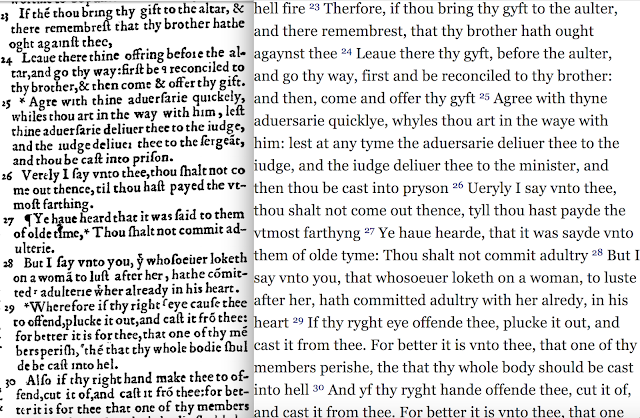
A TALE OF HAMLET & TWO BIBLES: BISHOPS & GENEVA In Shakespeare’s time, the approved Bishops’ bible was used in church; the inexpensive Geneva translation was used at home. Specific words (unlike paraphrase) can point to specific translations: Regarding his accidental killing of Polonius (3.4), Hamlet says, “...heaven hath pleased it so,/ To punish me with this and this with me,/ That I must be their scourge and *minister*.” Hamlet's phrase, “scourge and minister,” uses "minister" in the same sense as the Bishops’ bible Mt 5:25 (in the picture below, right): a minister of justice carries out a judge’s sentence. Because church attendance was required (and absence punishable by fines), Shakespeare would have heard this word, used in this biblical context, every year, all his life. In the Bishops' bible, the word "minister" is used instead of the word "sergeant, which appears in the same place in the Geneva bible. But when Hamlet says...
Part 3: ALL I NEED TO KNOW ABOUT PURGATORY I LEARNED FROM SHAKESPEARE’S HAMLET (& Stephen Greenblatt)
Part 3: ALL I NEED TO KNOW ABOUT PURGATORY I LEARNED FROM SHAKESPEARE’S HAMLET (& Stephen Greenblatt) Thought experiment: Three aging monarchs realize some past decisions & sins have caused innocent suffering. What to do? Repent? Monarch A donates money to a monastery where the monks have never spoken critically of the royal family. The king’s youngest brother was recently made abbot. After death, hundreds of masses will be said to reduce his time in purgatory. But perhaps the gift doesn’t rebalance the good to outweigh harm he has caused in the world. Monarch B donates to a convent where none of her relatives live or serve, in spite of the fact that the nuns have sometimes been critical of the choices of the royal family. Their primary mission is to serve needs of the sick and poor, to house the homeless, give them productive work, and teach useful skills. Monarch C reforms laws to be more fair and just, to reduce prison sentences when possible, and to raise wages and ...
ST. VALENTINE, OPHELIA, & CLAUDIUS in HAMLET

VALENTINE'S DAY not only makes sweethearts, florists, chocolatiers and greeting card manufacturers happy: It is also associated with various Christian martyrs... one of whom was beheaded [1] by order of Claudius II (r.268-270). NOTE: Hamlet escapes the beheading order of Claudius; Ophelia sings of Valentine's Day. COINCIDENCE? I THINK NOT. TAKEAWAY: Make sure your Valentines don't include orders for your beheading from a guy named Claudius! ALSO CONSIDER: St. Valentine's day was probably more of a Catholic and popular feast (taken over from paganism) than a Protestant church feast in Shakespeare's time, because although it included a tale of martyrdom and divine "caritas" love (a theological virtue), it is transformed in popular culture into a feast of Eros or human and romantic love. Scripture does describe the church as the bride and Christ as the groom, and yet perhaps some Protestants or Puritans of Shakespeare's time may have frowned up...
HAMLET: "FELL SERGEANT, DEATH" & MATT 5:23-26
Why do five major authorities on Shakespeare and the Bible since 1850 [1] miss the reference in "this fell sergeant, Death,/Is strict in his arrest" to Mt 5:23-26 (analogy for reconciling before death)? ~~~~~~~~~~~~~~~~~~~~~~ 23 If then thou bring thy gift to the altar, and there rememberest that thy brother hath ought against thee, 24 Leave there thine offering before the altar, and go thy way: FIRST BE RECONCILED TO THY BROTHER, and then come and offer thy gift. 25 Agree with thine adversary quickly, while thou art in the way with him, lest thine adversary deliver thee to the Judge, and the Judge deliver thee to the SERGEANT, and thou be cast into prison. 26 Verily I say unto thee, thou shalt not come out thence, till thou hast paid the utmost farthing. (1599 Geneva) ~~~~~~~~~~~~~~~~~~~~~~ Shakespeare understood: the SERGEANT in this passage can be a metaphor for death. Hence, "fell sergeant, Death".... Hamlet reconciles with Laertes in this scene befor...
Anti-plagiarism software helps identify George North "Rebellion and Rebels" text as another among many other already-known sources for Shakespeare. Identifying key phrases is a start. Noticing similar plot lines sometime involves a leap that human minds can notice, but software often misses. Paraphrased ideas are also harder than verbatim words or phrases. At present, software looking for matches in digitized texts can be a helpful tool, but it can't replace the human mind... ~~~~~~~~~~~~ Anti-cheat software reveals Shakespeare 'borrowed' phrases from little-known manuscript The Telegraph Margi Murphy 9 FEBRUARY 2018 • 12:53PM ~~~~~~~~~~~~~~~~~~~~~~~~~~~~~~~~~~~~~~~~~~~ Links to a description of my book project: On LinkedIn : https://lnkd.in/eJGBtqV On this blog : https://pauladrianfried.blogspot.com/2017/05/hamlets-bible-my-book-project-im.html [Originally posted around the week of 2/10/18 on LinkedIn ]
PRODUCTION OF HAMLET WITH ESPIONAGE TWIST IN D.C. Interview regarding a production of Hamlet with (appropriately) an espionage twist, around the corner from (a-ha!) a spy museum, located in (of course) Washington D.C. Claudius claims that planting Ophelia as bait and eavesdropping is OK, since, because he's king, they are "lawful espials," because, as Nixon used to say, if the president does it, that makes it legal. Polonius sends Reynaldo to spy on Laertes; Rosencrantz & Guildenstern spy on Hamlet; and Hamet and Horatio spy on Claudius and his reaction to "The Mousetrap" play-within-the-play.... This also brings to mind the excellent 2006 film, "The Lives of Others," about electronic surveillance and meddling in formerly communist countries.... Funny how a very old play can still prove to be very relevant. ~~~~~~~~~~ Shakespeare Theatre Company stages ‘Hamlet’ with modern espionage twist By Jason Fraley | @JFrayWTOP February 5, 201...
“Rich gifts wax poor when givers prove unkind”? After Polonius tells Ophelia to stop seeing Hamlet, and she obeys, why does Ophelia tell Hamlet (in 3.1), “Rich gifts wax poor when givers prove unkind”? (Hasn't SHE been unkind to Hamlet by obeying Dad, instead of honoring her heart and prince, who may be her future king?) A She believes her father, that Hamlet only wrote her sweet letters to take advantage of her sexually. (1.3) She thinks Hamlet unkind, because she believes Dad. B He frightened her when he visited her unannounced with doublet unbraced & stockings fouled. (2.1) He was unkind to frighten her like that. C He just claimed he "never gave [her] aught," (3.1) which she knows to be untrue, because she knows he gave her the letters. He was unkind to lie. D Some combination of the above or OTHER (please comment) (see comments on this LinkedIn post ) ~~~~~~~~~~~~~~~~~~~~~~~~~~~~~~~~~~~~~~~~~~~ Links to a description of my book proje...
Hamlet & Purgatory—Part 2: SHAKESPEARE WAS A SUCCESSFUL EVANGELIST FOR THE IDEA OF PURGATORY
SHAKESPEARE WAS A SUCCESSFUL EVANGELIST FOR THE IDEA OF PURGATORY, considering how many Anglican & Protestant readers/scholars for centuries accept that the ghost is Hamlet’s father, from purgatory (even—perhaps—sent by God), and that #Hamlet must avenge his death. The assumption of many male readers has been "manly": The ghost is his dad, and Hamlet must avenge. STEPHEN GREENBLATT does a good job in "Hamlet in Purgatory," showing how people challenged the idea of purgatory as a fiction used to prey upon the gullible for their money. There is much truth to that. But on the other hand, it's always the job of the living to sort through the legacy of the dead and to make sense, to find what's still useful, redeeming what is good, rejecting what is harmful—hopefully with humility, not assuming we can pluck the hearts of their mysteries. This is analogous to prayers for the dead, and to the hope for purification of souls after death. Again, not literal...
IS YOUR CHILD TEXTING ABOUT HAMLET? Watch for the signs: BFF - Bernardo/Francisco first SMDH - Shakespeare Made Dear Horatio! OMG - Old Malevolent Ghost ICYMI - In Case Your Mother's Incestuous ASAP - As Scheming As Polonius IDC - I Detest Claudius SOS - Swear On Sword HAK - Hamlet Acting Krazy STFU - Soliloquizing To Forge Understanding ROTGL - Rosencrantz Only Trusts Guildenstern Lately LOL - Letters Ophelia Loved SOS - Spying On Someone IHNI - Is Hebenon Never Ingested? IMHO - In Mousetrap, Hamlet Owns GTFO - Gertrude, The Freudian Opiate ASAP - Arras Stiff; Ah, Polonius! TOU - Think Ophelia’s Upset? SMDH - Sailing Midship: Dane Hamlet OTW - Ophelia Truly Wacko GF - Gravedigger: Funny YOLO - Yorick Oft Laughed. Oft! CPU - Churlish Priest Upsets LMRAO - Laertes’ “Mountain” Remark: Awkward, Overstated LBH - Let Be, Horatio ROFL - Redeliver Our Foils, Laertes! ASAP - A Sadness After Poison TMS - Tell My Story ATM - Angels’ Transcendent Melodies OMFG ...
HAMLET & THE NECESSARY COMPOST OF THE IMAGINATION In early variorum editions of Hamlet, one finds that some readers/critics took an approach to the plays that tried to decipher which single historical figure seemed to be represented by which character in the play: Many thought Hamlet a stand-in for Sir Philip Sidney, or Essex, etc. But it seems more accurate to say that Shakespeare made composite characters, combining features of various historical figures; he also split up qualities of historical figures among various characters. So “decoding” usually falls very short, plagued by a kind of celebrity-reductionist mentality, a People Magazine approach to interpreting the plays. This sense of fracturing and combining elements from sources and historical figures (as I’ve mentioned before) seems to represent better how the compost of the imagination works in the plays. It’s also how the imagination may *need* to work in a harsh climate of censorship, where not masking thing...
Six possible sources of inspiration for Shakespeare's Gertrude - besides Saxo Grammaticus & Belleforest

WHAT WAS SHAKESPEARE'S INSPIRATION FOR GERTRUDE besides Saxo Grammaticus & Belleforest? Getrude, who after marriage to a great king, too-quickly marries not only a lesser man, but a patricide-murderer, her brother's husband ("incest")? Or another way to pose the question: If Shakespeare was using a common theme in history and in his culture to highlight certain controversial figures on which many in his audiences had opinions, to tap into their concerns and interests, what might some of these have been? If Hamlet is in part a commentary on the end of the House of Tudor, then it may help to consider Gertrude as a composite character, made of aspects of various historical figures: 1. Catherine of Valois, who married the lowly Owen Tudor after the death of Henry V. 2. Anne Boleyn, mother of Queen Elizabeth I, accused of incest. 3. Mary, Queen of Scots, who married her second husband’s alleged murderer. 4. Catherine Parr, the last wife of Henry VIII, w...
THE GHOST OF LAZARUS HAUNTS HAMLET
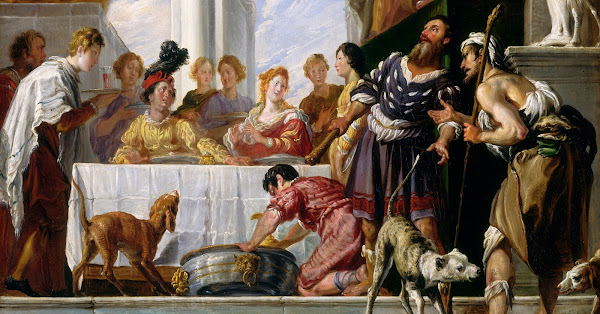
In addition to this 2018 post, see also my related series on the importance of the Lazarus allusion in the play, which begins here with a 16 February 2021 post: https://pauladrianfried.blogspot.com/2021/02/new-series-on-rich-man-lazarus.html ~~~~~~~~~~~~~~~~~~~~~~~~~~~~~~~~~~~~~~~~~~~~~~~~~~~~~~ In Shakespeare’s Hamlet, there are allusions to the bible story of the beggar Lazarus and the rich man (“Dives”) from Luke 16:19-31, read every First Sunday After Trinity Sunday, and also read every 5 March, 4 July, and every 30 October as the second lesson for Morning prayer. It is as if the playwright took parts of that story, diced them up, and sprinkled them throughout: 1. The Ghost (1.5) says his skin became “Lazar-like” from poison; Lazarus had skin-sores, which dogs licked. [Edit 9/11/2023: The ghost also says that his brother Claudius, in the “..porches of mine ear didst pour the leperous distillment” - in some paintings and illustrations of the Rich Man and Lazarus, the beggar...
Education in America: Learning Beyond Our Borders by David Bly 1/5/18 [ ARTICLE ON EDUCATION BY STATE REP DAVID BLY ] https://www.linkedin.com/feed/update/urn:li:activity:6355266110010507264 This article is by my friend and neighbor, State Representative David Bly, who I am so glad to have representing us. David has seen educational trends come and go, but he cuts through the fog and confusion, and consistently makes sense. School districts in the states of Minnesota, Iowa, Wisconsin and the Dakotas who sometimes find themselves floundering for a sense of direction should consider hiring him as a consultant when the legislature is not in session. Another thing I like about David is that he reads and understands Shakespeare and Kierkegaard and history and more. ~~~~~~~~~~~~~~~~~~~~~~~~~~~~~~~~~~~~~~~~~~~ Links to a description of my book project: On LinkedIn : https://lnkd.in/eJGBtqV On this blog : https://pauladrianfried.blogspot.com/2017/05/hamlets-bible-my-book-project...
CORRUPTED REFORMERS: WHY SOMEONE NAMED AFTER BERNARD OF CLAIRVAUX MIGHT BE FIRST TO SPEAK IN SHAKESPEARE’S HAMLET
Hamlet is a reformer who hopes to set right what is rotten and out-of-joint in Denmark, but becomes corrupted himself when slaying the unseen Polonius. Bernard of Clairvaux was a reformer who wished to set right what was rotten and out-of-joint in the monastic movement and in Christian Europe, but became corrupted himself for ignoring the gospel command to love enemies & promoting a (failed) crusade against unseen Muslims— and corrupted also for conspiring against Peter Abelard. More on Bernardo in Hamlet (and Peter Abelard) : https://pauladrianfried.blogspot.com/2017/12/bernardo-abelard-hamlet-laertes-reconcile.html [April 12, 2024 note: Much is made of the fact that Hamlet is upset with his mother for marrying his uncle, considered a scandalously incestuous marriage in Shakespeare's time, and also perhaps, by doing so, denying him the throne he expected after his father's death. Perhaps more famously, St. Francis of Assisi is famous for having disowned his fa...